
5 Bodyweight Exercises That Build More Muscle Than You Think
Stop underestimating bodyweight training. These five exercises build serious muscle mass—backed by research, proven by results. No gym required.
Why Bodyweight Training Builds Real Muscle
The Truth About Bodyweight Muscle Building: Muscle growth (hypertrophy) occurs when three conditions are met: mechanical tension, metabolic stress, and muscle damage. Bodyweight exercises deliver all three when programmed correctly. A 2018 study by Kotarsky et al., published in the Journal of Strength and Conditioning Research put 23 trained men through 4 weeks of progressive push-up training versus barbell bench press and found equivalent muscle growth in the chest and triceps between the two.
The mistake most people make: treating bodyweight exercises like endurance training. Doing 100 push-ups builds endurance, not muscle. Building muscle requires progressive overload—making exercises harder over time through leverage changes, tempo manipulation, or unilateral variations. The five exercises below are consistently underestimated because people never progress them properly.
Each exercise in this guide targets major muscle groups, allows for clear progression, and builds functional strength that translates beyond the gym. You don't need barbells to build an impressive physique—you need the right exercises, proper form, and consistent progressive overload.
Muscle Protein Synthesis
A 2010 study in PLoS ONE by Burd et al. found that low-load resistance exercise taken to failure stimulated greater muscle protein synthesis than high-load, low-volume training—evidence that the training stimulus (fatigue, not the number on the bar) is what drives muscle growth.
Rep Range Flexibility
A 2017 meta-analysis by Schoenfeld et al., published in the Journal of Strength and Conditioning Research reviewed 21 studies and found hypertrophy is achievable across a wide spectrum of loads when sets are taken to failure—heavy loads only pull ahead for maximal-strength outcomes, not muscle size. Bodyweight exercises naturally land in the 8-20 rep range, right in that effective zone.
"People ask me all the time which of these five is the 'best' one. Wrong question. The reason this list works is that nobody trains all five properly—everyone does push-ups and squats and skips dips, Nordic curls, and pike push-ups because they're humbling. The exercises people avoid are usually the ones building the muscle they're missing."
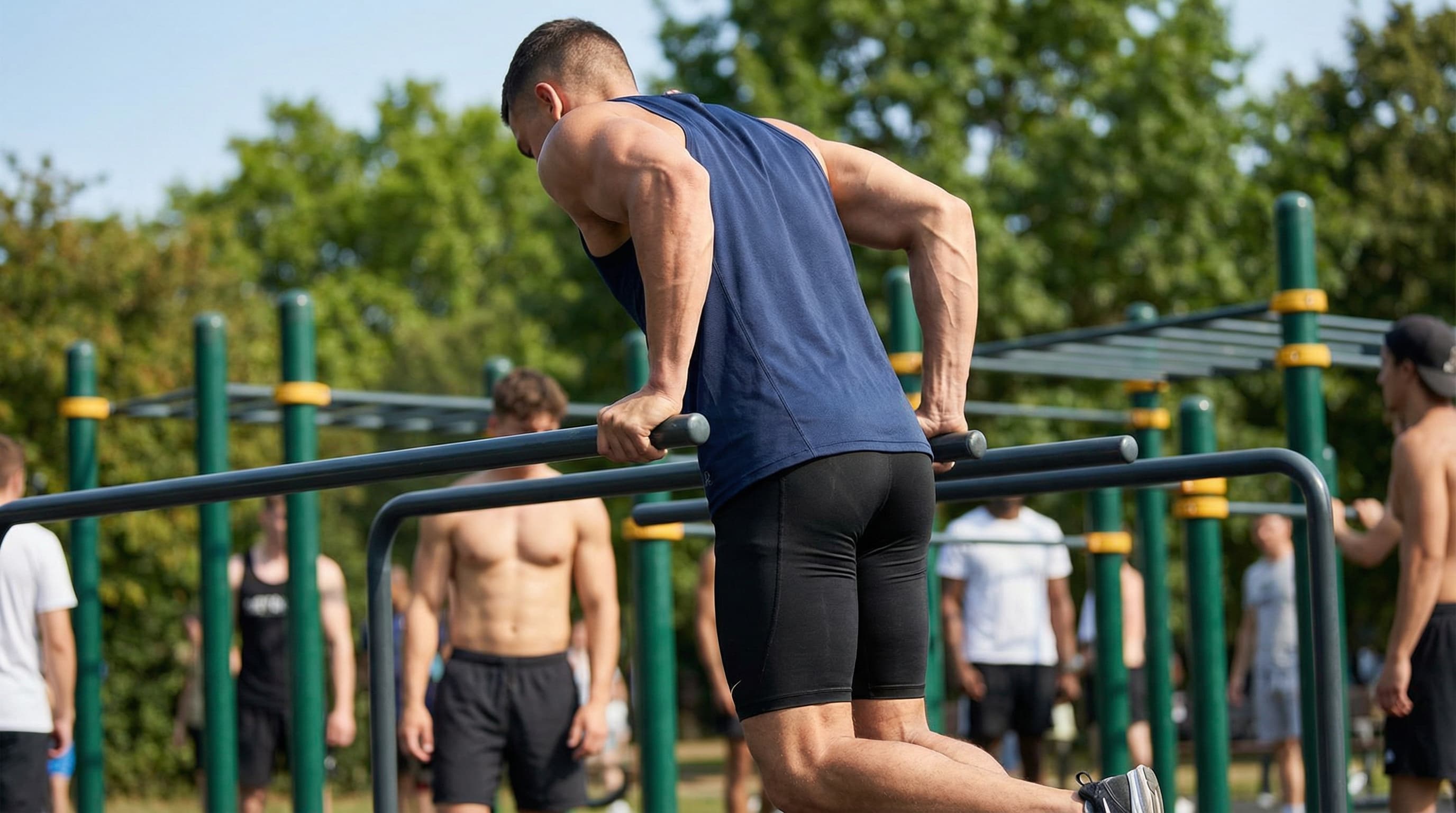
Dips: The Upper Body Squat
Primary Muscles: Chest (Lower), Triceps, Anterior Deltoids
Why Dips Build Serious Muscle
Dips are called "the upper body squat" because they're a compound movement that loads multiple muscle groups with your full bodyweight. EMG research shows dips activate the lower chest 15% more than flat bench press and produce tricep activation comparable to close-grip bench press.
The muscle-building advantage: Dips allow for a deep stretch at the bottom position (maximum mechanical tension) and full contraction at the top. They're also easy to progressively overload—start with partial reps, build to full range, then add weight with a dip belt or weighted vest.
Perfect Form Guide
- Starting Position: Support yourself on parallel bars with arms fully extended, shoulders down (not shrugged), core engaged, slight forward lean for chest emphasis
- Descent: Lower slowly (3 seconds) until upper arms are parallel to ground or slightly below. Elbows should track at 45° from body, not flaring out
- Ascent: Drive through hands, press back to starting position. Focus on squeezing chest and triceps at top
- Breathing Pattern: Inhale on descent, exhale on ascent
Progressive Overload Path
- Level 1 (Weeks 1-3): Bench dips (feet on ground) - 3 sets × 12-15 reps
- Level 2 (Weeks 4-6): Bench dips (feet elevated) - 3 sets × 10-12 reps
- Level 3 (Weeks 7-10): Parallel bar dips (partial range) - 3 sets × 6-8 reps
- Level 4 (Weeks 11-16): Full range dips - 3-4 sets × 8-12 reps
- Level 5 (16+ weeks): Weighted dips (+10-50lbs) - 3-4 sets × 6-10 reps
Pike Push-Ups: Shoulder Mass Without Weights
Primary Muscles: Anterior Deltoids, Triceps, Upper Chest
Why Pike Push-Ups Build Boulder Shoulders
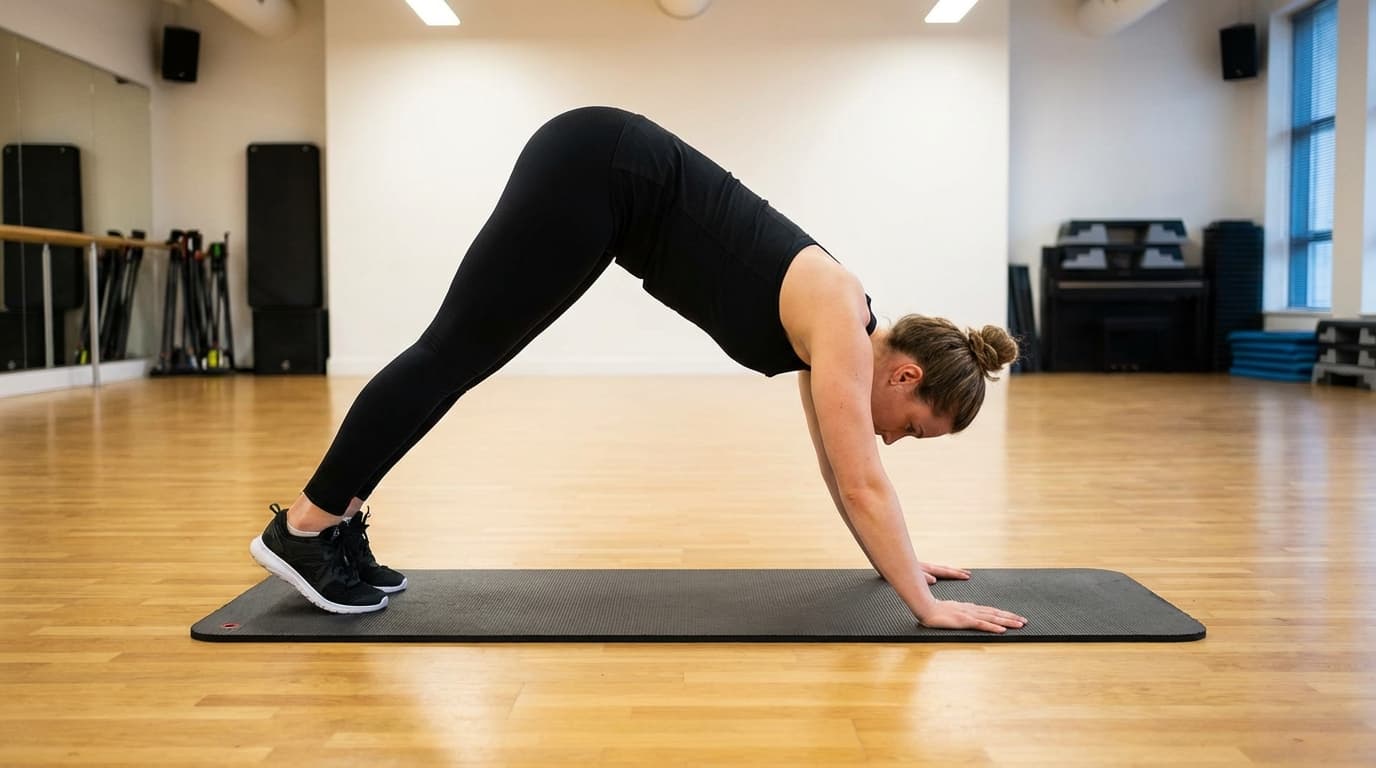
Pike push-ups are the bodyweight equivalent of overhead press. By positioning your body in an inverted V-shape, you shift load from chest to shoulders. Research comparing shoulder activation shows pike push-ups produce 73% of the deltoid activation of military press—impressive for a bodyweight movement.
The progression potential is massive: Wall pike push-ups → floor pike push-ups → elevated pike push-ups → wall-supported handstand push-ups → freestanding handstand push-ups. Each progression loads your shoulders with more of your bodyweight.
Perfect Form Guide
- Starting Position: Start in downward dog yoga position: hands and feet on ground, hips high, body forming inverted V. Hands shoulder-width, feet hip-width
- Descent: Bend elbows and lower head toward ground between hands. Keep hips high—don't let them drop. Elbows should point back at 45°, not out to sides
- Ascent: Press back up to starting position, focusing on driving through shoulders. Full lockout at top
- Key Cue: Imagine pressing your head through a hole in the floor. The movement should be vertical, not forward
Progressive Overload Path
- Level 1 (Weeks 1-2): Wall pike push-ups - 3 sets × 10-12 reps
- Level 2 (Weeks 3-5): Floor pike push-ups - 3 sets × 8-10 reps
- Level 3 (Weeks 6-9): Elevated pike push-ups (feet on chair) - 3 sets × 6-8 reps
- Level 4 (Weeks 10-14): Wall-supported handstand push-ups - 3 sets × 5-8 reps
- Level 5 (15+ weeks): Deficit handstand push-ups (hands on plates) - 3 sets × 4-6 reps
Tempo Variation for Growth
Once you can do 12+ reps at a level, slow the tempo: 3-second descent, 1-second pause at bottom, 1-second ascent. This increases time under tension and builds more muscle.
Shoulder Safety Note
Always warm up shoulders with arm circles and band pull-aparts. If you feel pinching in shoulders (not muscle burn), reduce range of motion or regress to easier variation.
Nordic Curls: The Hamstring Builder
Primary Muscles: Hamstrings, Glutes, Lower Back
Why Nordic Curls Are Severely Underestimated
Nordic curls produce hamstring hypertrophy comparable to heavy leg curls and Romanian deadlifts. A 2024 study by Maeo et al., published in Medicine & Science in Sports & Exercise found that 12 weeks of Nordic curl training increased total hamstring muscle volume by 11%, with the semitendinosus growing by as much as 20%.
The eccentric advantage: Nordic curls are an eccentric-focused exercise (muscle lengthening under load), which creates more muscle damage and metabolic stress than concentric movements. This makes them brutally effective for muscle growth—and brutally difficult.
Perfect Form Guide
- Setup: Kneel on padded surface with ankles anchored (under couch, partner holding them, or using Nordic curl bench). Torso upright, core braced, hands ready to catch fall
- Eccentric Phase: Slowly lower your torso forward as far as possible while keeping hips extended (don't fold at hips). Control the descent with hamstrings—fight gravity
- Bottom Position: When you can no longer control the descent, catch yourself with hands in push-up position
- Concentric Phase: Push off ground gently to assist hamstrings in pulling yourself back to upright. Use as little push-off help as possible
Critical Safety Warning
Nordic curls create extreme delayed onset muscle soreness (DOMS) when you first start. Start with only 1-2 sets of 3-5 reps for the first 2 weeks. Expect significant soreness 48-72 hours after first session. This is normal but intense—plan accordingly and don't train legs heavily the next day.
Progressive Overload Path
- Level 1 (Weeks 1-3): Band-assisted Nordic curls - 2 sets × 5 reps (use resistance band for assistance)
- Level 2 (Weeks 4-6): Eccentric-only Nordic curls - 3 sets × 5 reps (5-second descent, push back up)
- Level 3 (Weeks 7-10): Eccentric-only Nordic curls - 3 sets × 8 reps (slower descent)
- Level 4 (Weeks 11-16): Full Nordic curls - 3 sets × 5-8 reps (minimal push-off assistance)
- Level 5 (16+ weeks): Weighted Nordic curls - 3 sets × 4-6 reps (hold weight plate to chest)
Bulgarian Split Squats: Unilateral Leg Mass
Primary Muscles: Quadriceps, Glutes, Hamstrings
Why Bulgarian Split Squats Build Serious Leg Size
Bulgarian split squats (rear-foot elevated split squats) are one of the best exercises for building leg mass—period. EMG studies show they activate quadriceps as much as back squats while producing higher glute activation. The unilateral nature forces each leg to handle your full bodyweight, creating significant mechanical tension.
The advantage for bodyweight training: Even without external weight, Bulgarian split squats are challenging because you're essentially doing a one-legged squat with your bodyweight. They also correct muscle imbalances—your strong leg can't compensate for your weak leg like it can in bilateral squats.
Perfect Form Guide
- Setup: Stand facing away from bench/chair (knee height). Place top of rear foot on bench behind you. Front foot should be far enough forward that when you descend, front knee stays over ankle
- Descent: Lower straight down by bending front knee. Keep torso upright or slight forward lean. Back knee should nearly touch ground. Front knee tracks over toes (this is safe despite myths)
- Ascent: Drive through front heel, squeezing glute and quad to return to starting position. Keep weight on front leg—back leg is only for balance
- Balance: If balance is an issue, start with rear foot on ground (split squat) before elevating it
Quad-Focused Variation
Setup: Torso more upright, front foot closer to bench, knee tracks forward over toes. This shifts emphasis to quadriceps.
Glute-Focused Variation
Setup: Torso leans slightly forward, front foot farther from bench, drive through heel. This shifts emphasis to glutes and hamstrings.
Progressive Overload Path
- Level 1 (Weeks 1-2): Split squats (rear foot on ground) - 3 sets × 10-12 reps per leg
- Level 2 (Weeks 3-5): Bulgarian split squats - 3 sets × 8-10 reps per leg
- Level 3 (Weeks 6-9): Tempo Bulgarian split squats - 3 sets × 8-10 reps (3-second descent)
- Level 4 (Weeks 10-14): Weighted Bulgarian split squats - 3-4 sets × 8-12 reps (hold dumbbells/backpack)
- Level 5 (15+ weeks): Heavy weighted Bulgarian split squats - 3-4 sets × 6-10 reps
Inverted Rows: The Back Thickness Builder
Primary Muscles: Lats, Rhomboids, Rear Deltoids, Biceps
Why Inverted Rows Are Essential for Back Development
Inverted rows (also called Australian pull-ups or bodyweight rows) build back thickness and pulling strength. While pull-ups emphasize vertical pulling and lat width, inverted rows target horizontal pulling—essential for mid-back development (rhomboids, trapezius, rear delts).
The muscle-building advantage: Inverted rows allow you to train back muscles to near failure more safely than pull-ups (you can simply put feet down). They're also easier to progressively overload by adjusting body angle—the more horizontal you are, the harder the exercise becomes.
Perfect Form Guide
- Setup: Find a sturdy bar or table edge at waist-to-chest height. Lie underneath, grab bar with overhand grip (hands shoulder-width). Body should be straight from head to heels (plank position)
- Pulling Phase: Pull chest to bar by driving elbows back and squeezing shoulder blades together. Keep body rigid—don't let hips sag or pike up. Touch chest to bar (or as close as possible)
- Lowering Phase: Lower with control (2-3 seconds) to full arm extension. Don't let shoulders shrug forward—maintain scapular retraction
- Critical Cue: Think "elbows to back pockets." Pull with your back, not your arms. Biceps assist but shouldn't dominate the movement
Progressive Overload Path
- Level 1 (Weeks 1-2): Incline rows (bar at chest height) - 3 sets × 10-12 reps
- Level 2 (Weeks 3-5): Horizontal rows (bar at hip height) - 3 sets × 8-10 reps
- Level 3 (Weeks 6-9): Horizontal rows with feet elevated - 3 sets × 8-10 reps
- Level 4 (Weeks 10-14): Archer rows (pull to one side) - 3 sets × 6-8 reps per side
- Level 5 (15+ weeks): Weighted inverted rows - 3-4 sets × 8-12 reps (weighted vest or chains)
Grip Variations
- Overhand (Pronated): Emphasizes upper back and rear delts
- Underhand (Supinated): More bicep engagement, easier variation
- Neutral: Best for elbow health, balanced muscle activation
Common Setup Options
- Sturdy table (lie underneath, pull to edge)
- Barbell in power rack or squat stand (adjustable height)
- Gymnastic rings (most versatile, allows rotation)
- TRX/suspension trainer
- Two stable chairs with broomstick across
Complete Training Program for Muscle Growth
Nutrition Guidelines for Bodyweight Hypertrophy
Training provides the stimulus, but nutrition determines whether you actually build muscle. These guidelines optimize muscle growth with bodyweight training:
Protein Targets
Daily Goal: 0.8-1.0g per pound of bodyweight
- 150lb person: 120-150g protein daily
- 180lb person: 144-180g protein daily
- 200lb person: 160-200g protein daily
Distribute across 3-4 meals (30-40g per meal) for optimal muscle protein synthesis. See our complete protein intake guide for the full breakdown.
Caloric Surplus
Muscle Gain Goal: +200-400 calories above maintenance
- Calculate maintenance: bodyweight × 14-16 calories
- Add surplus: Aim for 0.5-1lb gain per week (beginners can gain faster)
- If gaining too fast (>1.5lb/week): reduce surplus by 100-200 calories
Carbohydrate Timing
Pre-Workout (1-2 hours before):
- 30-60g carbs for energy (oatmeal, rice, fruit)
- 20-30g protein (optional)
Post-Workout (within 2 hours):
- 60-100g carbs to replenish glycogen
- 30-40g protein for muscle repair
Sleep Requirements
Target: 7-9 hours per night
- Sleep deprivation reduces muscle protein synthesis by 18-30%
- Growth hormone released during deep sleep phases
- Poor sleep increases cortisol (muscle breakdown)
- Prioritize sleep quality: dark room, cool temperature (65-68°F), consistent schedule — see our complete sleep schedule guide
Hydration
Daily Goal: Half your bodyweight in ounces
- 150lb person: 75oz (9-10 cups) water daily
- 200lb person: 100oz (12-13 cups) water daily
- Add 16-20oz during training sessions (sip throughout)
- Dehydration reduces strength by 10-15% and recovery
Supplement Considerations
Essential (if deficient):
- Protein powder (convenience, not necessity)
- Creatine monohydrate (5g daily, proven muscle builder)
- Vitamin D (if limited sun exposure)
Optional: Caffeine (pre-workout performance), omega-3 (recovery). Most supplements are unnecessary—focus on whole foods first.
Sample Daily Meal Plan (180lb person, muscle gain)
Breakfast (7:00 AM): 4 eggs scrambled, 2 cups oatmeal with berries, black coffee | ~600 calories, 35g protein
Pre-Workout Snack (10:00 AM): Banana with 2 tbsp peanut butter | ~250 calories, 8g protein
Workout (11:00 AM - 12:00 PM)
Post-Workout Lunch (12:30 PM): 8oz grilled chicken breast, 2 cups rice, large salad with olive oil | ~750 calories, 60g protein
Afternoon Snack (3:30 PM): Greek yogurt (2 cups) with granola | ~400 calories, 40g protein
Dinner (7:00 PM): 6oz salmon, sweet potato, roasted vegetables with butter | ~650 calories, 45g protein
Daily Total: ~2,650 calories, 188g protein, 280g carbs, 80g fat
Frequently Asked Questions
Can you really build muscle with just bodyweight exercises?
How do I make bodyweight exercises harder as I get stronger?
How many times per week should I do these exercises for muscle growth?
Do I need to eat differently when training for muscle with bodyweight exercises?
Which builds more muscle: high reps or low reps?
How long does it take to see muscle growth from bodyweight training?
Turn These Muscle Builders Into a Weekly Plan
Choose your schedule and experience level, and Odin will build these bodyweight movement patterns into a balanced week of training.
Build My Free Weekly Plan