
How Much Protein Do You Need to Build Muscle?
Discover the exact daily protein intake for muscle growth with bodyweight training. Research-backed guidelines, timing strategies, and practical meal plans from beginner to advanced.
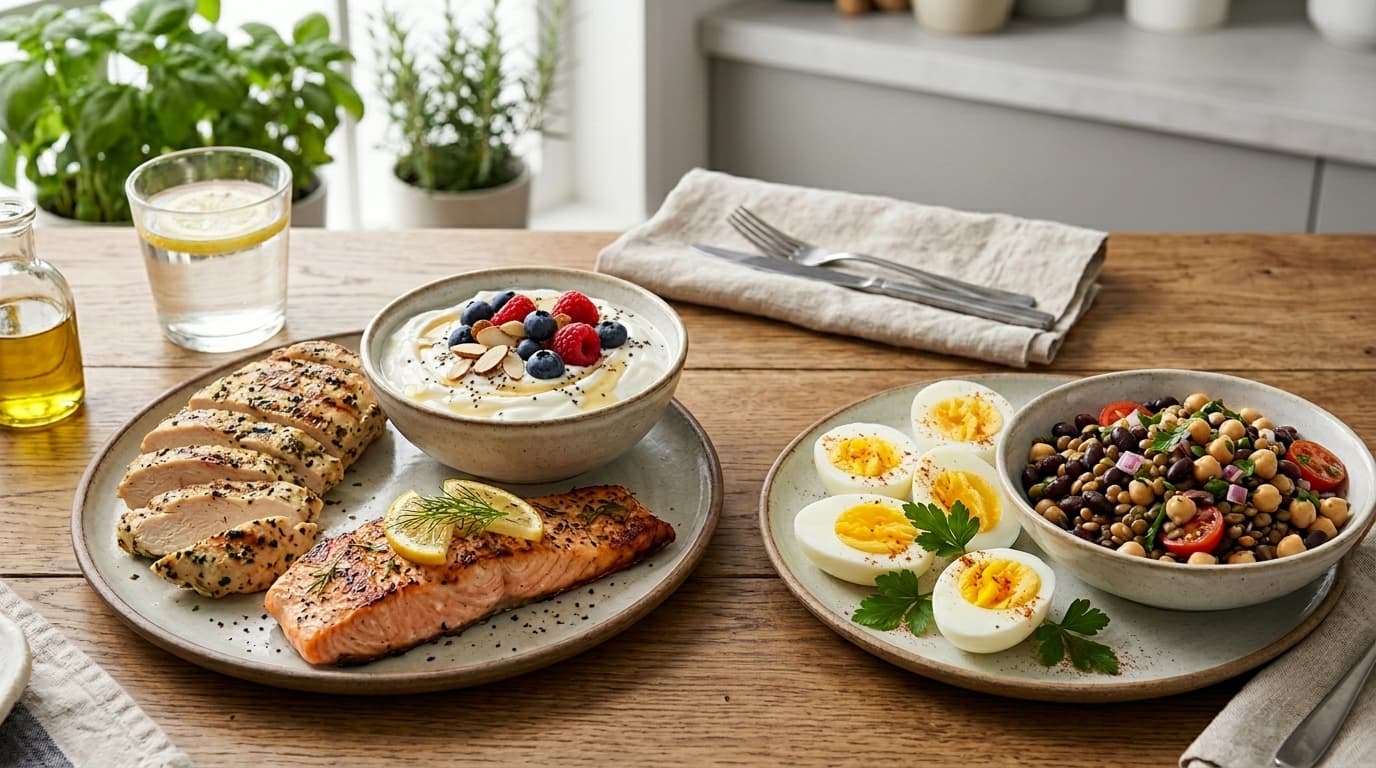
TL;DR - Quick Answer
- Muscle building: 1.6-2.2 grams of protein per kilogram of bodyweight daily (0.7-1.0g per pound)
- Example: 70kg (154 lb) person needs 112-154 grams daily
- Distribution: Spread across 3-5 meals, 20-40g per meal for optimal results
- Timing: Total daily intake matters more than precise timing
- Bodyweight training: Same requirements as weightlifting—muscles don't know the difference
What is Protein and Why Does It Matter for Muscle Growth?
Protein is a macronutrient composed of amino acids—the building blocks your body uses to repair and build muscle tissue. It is the only macronutrient that directly provides the raw materials for muscle protein synthesis (MPS), the biological process that creates new muscle fibers and repairs damaged ones after training.
Without adequate protein, your body cannot build muscle—no matter how hard you train. Your muscles are constantly breaking down and rebuilding in a process called muscle protein turnover. When you resistance train (whether with weights or bodyweight), you create micro-tears in muscle fibers. Protein provides the amino acids needed to repair these tears and build them back stronger and larger.
According to a 2018 meta-analysis by Morton and colleagues, published in the British Journal of Sports Medicine, dietary protein supplementation significantly augments muscle mass and strength gains during prolonged resistance training in adults. The research analyzed 49 studies with 1,863 participants and confirmed that protein intake is a critical variable in muscle adaptation.
Beyond muscle building, protein serves essential functions: enzyme and hormone production, immune function, tissue repair, and maintaining lean body mass during fat loss. For athletes and active individuals, protein needs are significantly higher than the general population's recommended dietary allowance (RDA).
How Much Protein Do You Need for Muscle Growth?
The research-backed answer: 1.6-2.2 grams of protein per kilogram of bodyweight per day (0.7-1.0 grams per pound) for individuals engaged in resistance training. This range has been validated by multiple systematic reviews and meta-analyses as optimal for maximizing muscle protein synthesis and hypertrophy.
| Goal | Protein per kg | Protein per lb | Example (70kg/154lb) |
|---|---|---|---|
| Sedentary (RDA) | 0.8g/kg | 0.36g/lb | 56g daily |
| Active Maintenance | 1.2-1.6g/kg | 0.5-0.7g/lb | 84-112g daily |
| Muscle Building | 1.6-2.2g/kg | 0.7-1.0g/lb | 112-154g daily |
| Fat Loss (preserve muscle) | 2.0-2.4g/kg | 0.9-1.1g/lb | 140-168g daily |
| Advanced Athletes | 2.0-2.5g/kg | 0.9-1.1g/lb | 140-175g daily |
"Most people chasing muscle don't have a training problem, they have a protein problem. They'll debate rep ranges for an hour and never once weigh their chicken."
Protein Requirements for Bodyweight Training
Your muscles don't know whether resistance comes from a barbell or your own bodyweight. Protein requirements for calisthenics and bodyweight training are identical to weightlifting. What matters is mechanical tension, muscle damage, and metabolic stress—all of which bodyweight training provides when performed with progressive overload.
The Evidence
A 2018 study in the Journal of Strength and Conditioning Research by Kotarsky and colleagues put 23 trained men through 4 weeks of either progressive bodyweight push-up training or traditional barbell bench press and found comparable strength gains between the two, confirming that bodyweight training triggers the same muscle-building stimulus as external load. Participants following bodyweight programs need the same protein intake (1.6-2.0g/kg) to maximize muscle adaptation. For the full science behind why bodyweight training builds real muscle, see our complete guide.
Practical Application
Whether you're doing push-ups, pull-ups, pistol squats, or handstand training, follow the same protein guidelines: 1.6-2.2g/kg daily, distributed across multiple meals. Your body's protein synthesis response to training stimulus is the same regardless of equipment.
Does Protein Timing Matter?
The short answer: Total daily protein intake matters far more than precise timing. The infamous "30-minute anabolic window" after training is largely a myth. Research shows the window for optimal protein synthesis is actually 4-6 hours post-workout, not 30 minutes.
| Factor | Impact Level | Recommendation |
|---|---|---|
| Total Daily Protein | CRITICAL | Hit your 1.6-2.2g/kg target every day |
| Meal Distribution | MODERATE | Spread across 3-5 meals, 20-40g per meal |
| Pre-Workout Protein | LOW | Optional; matters if training fasted |
| Post-Workout Timing | LOW | Within 4-6 hours is fine, not 30 minutes |
| Before Bed Protein | MODERATE | 20-40g casein or slow-digesting protein |
Practical Timing Guidelines
- Priority #1: Hit your total daily protein target (1.6-2.2g/kg)
- Priority #2: Distribute protein across meals (3-5 meals, 20-40g each)
- Priority #3: Include protein in your post-workout meal (within 4-6 hours)
- Optional optimization: Consume 20-40g of slow-digesting protein (Greek yogurt, cottage cheese, casein) before bed to support overnight recovery
How to Distribute Protein Throughout the Day
Research suggests consuming 20-40 grams of protein per meal, spread across 3-5 meals daily, maximizes muscle protein synthesis. This approach keeps your body in a consistently anabolic (muscle-building) state throughout the day.
3 Meals Per Day
Target: 140g daily
- Breakfast: 45g protein
- Lunch: 50g protein
- Dinner: 45g protein
- Simple and convenient
- Higher per-meal amounts may reduce efficiency
4 Meals Per Day
OPTIMALTarget: 140g daily
- Breakfast: 35g protein
- Lunch: 35g protein
- Post-workout: 35g protein
- Dinner: 35g protein
- Maximizes protein synthesis
- Balanced throughout day
5 Meals Per Day
Target: 140g daily
- Breakfast: 28g protein
- Mid-morning: 28g protein
- Lunch: 28g protein
- Post-workout: 28g protein
- Dinner: 28g protein
- Maximum distribution
- Requires more planning
Sample Daily Meal Plan: 140g Protein (4 Meals)
Breakfast (7:00 AM) - 35g protein
- 3 whole eggs (18g)
- 1 cup Greek yogurt (17g)
- 1 cup oatmeal with berries
- Total: ~35g protein, ~450 calories
Lunch (12:30 PM) - 35g protein
- 150g grilled chicken breast (35g)
- Large mixed salad with olive oil
- 1 cup quinoa
- Total: ~35g protein, ~500 calories
Post-Workout Snack (4:00 PM) - 35g protein
- Protein shake with 1 scoop whey (25g)
- 1 banana
- 2 tbsp peanut butter (8g)
- Total: ~33g protein, ~400 calories
Dinner (7:00 PM) - 35g protein
- 180g salmon (36g)
- Sweet potato
- Steamed broccoli and asparagus
- Total: ~36g protein, ~550 calories
Best Protein Sources for Muscle Building
Not all protein sources are created equal. The quality of protein is determined by its amino acid profile and digestibility. Focus on complete proteins that contain all nine essential amino acids, particularly leucine—the primary driver of muscle protein synthesis.
| Protein Source | Protein per 100g | Leucine Content | Quality |
|---|---|---|---|
| Chicken Breast | 31g | High (2.5g per 100g) | Excellent |
| Salmon | 25g | High (2.0g per 100g) | Excellent |
| Greek Yogurt | 10g | Moderate (0.8g per 100g) | Excellent |
| Eggs | 13g | High (1.1g per 100g) | Excellent |
| Whey Protein | 80g | Very High (10g per 100g) | Excellent |
| Lean Beef | 26g | High (2.1g per 100g) | Excellent |
| Tofu (Firm) | 8g | Moderate (0.6g per 100g) | Good |
| Lentils | 9g | Low (0.6g per 100g) | Good |
| Cottage Cheese | 11g | High (1.0g per 100g) | Excellent |
| Quinoa | 4g | Low (0.3g per 100g) | Good |
Animal vs. Plant Protein
Animal proteins are complete proteins with optimal leucine content and digestibility. They require smaller portions to meet protein targets.
Plant proteins (except soy and quinoa) are often incomplete and lower in leucine. Vegans should combine sources (rice + beans) and consume 10-20% more total protein to compensate for lower digestibility.
Protein Supplements: Necessary?
Supplements are convenient, not essential. Whey and casein protein are high-quality, fast-absorbing options that make hitting daily targets easier. However, whole food sources provide additional nutrients (vitamins, minerals, fiber). Aim to get 80% of protein from whole foods, using supplements only for convenience or to fill gaps.
How to Calculate Your Protein Needs
Use this simple calculator to determine your optimal daily protein intake based on your bodyweight, training status, and goals:
5-Step Protein Calculator
Calculate Your Bodyweight in Kilograms
If you know your weight in pounds, divide by 2.2 to convert to kilograms.
Example: 154 lbs ÷ 2.2 = 70 kg
Identify Your Training Level
- Beginner: 0-1 year of consistent training
- Intermediate: 1-3 years of consistent training
- Advanced: 3+ years of consistent training
Determine Your Goal
- Muscle Building: Primary goal is gaining muscle mass
- Maintenance: Maintaining current physique and strength
- Fat Loss: Losing fat while preserving muscle
Select Your Protein Multiplier
Level + Goal Multiplier Beginner + Muscle Building 1.6-1.8 g/kg Intermediate/Advanced + Muscle Building 1.8-2.2 g/kg Any Level + Fat Loss 2.0-2.4 g/kg Any Level + Maintenance 1.6-1.8 g/kg Calculate Your Daily Target
Multiply your bodyweight (kg) by your chosen multiplier.
Common Protein Intake Mistakes
Not Tracking Protein Intake
The Mistake: Guessing daily protein intake without tracking. Most people significantly overestimate how much protein they consume, often by a wide margin.
The Fix: Track everything you eat for 7 days using MyFitnessPal, Cronometer, or a food journal. Once you understand portion sizes and protein content, you can estimate more accurately. Weigh foods initially to calibrate your visual estimates.
Front-Loading All Protein in 1-2 Meals
The Mistake: Consuming 80-100g protein in one meal, then minimal protein the rest of the day. Muscle protein synthesis has a ceiling per meal—excess is oxidized, not stored as muscle.
The Fix: Distribute protein across 3-5 meals, 20-40g per meal. This keeps muscle protein synthesis elevated throughout the day, maximizing adaptation to training.
Relying Only on Plant Proteins Without Combining Sources
The Mistake: Eating incomplete plant proteins (rice, beans, nuts) in isolation without combining complementary sources. This results in insufficient essential amino acids, particularly leucine.
The Fix: Combine complementary plant proteins (rice + beans, hummus + pita) in the same meal. Vegans should aim for 10-20% more total protein (1.8-2.4g/kg) to account for lower digestibility and amino acid profiles.
Ignoring Protein During Fat Loss
The Mistake: Reducing calories for fat loss without maintaining or increasing protein intake. This results in significant muscle loss alongside fat loss—the opposite of body recomposition goals.
The Fix: Increase protein to 2.0-2.4g/kg during calorie deficits. Higher protein preserves lean mass, increases satiety (helps adherence), and has a higher thermic effect (burns more calories during digestion).
Obsessing Over Post-Workout Timing
The Mistake: Panicking about the "30-minute anabolic window" and forcing down protein immediately post-workout while neglecting total daily intake and meal distribution.
The Fix: Focus on total daily protein first (1.6-2.2g/kg), distribution second (3-5 meals), and timing third (within 4-6 hours post-workout is fine). The hierarchy matters: getting 80g protein in one meal is worse than hitting 140g across 4 meals, regardless of workout timing.
Drinking Protein Shakes Without Whole Food Protein
The Mistake: Relying exclusively on protein powders for daily intake, missing out on micronutrients, fiber, and satiety from whole foods.
The Fix: Aim for 80% of protein from whole food sources (chicken, fish, eggs, Greek yogurt, legumes). Use supplements strategically to fill gaps or for convenience (post-workout shake, busy mornings), not as primary protein sources.
Assuming More Protein is Always Better
The Mistake: Consuming excessive protein (3-4g/kg) thinking it will accelerate muscle growth. Beyond 2.2g/kg, there are no additional benefits for muscle protein synthesis—you're just oxidizing expensive calories.
The Fix: Stick to the evidence-based range: 1.6-2.2g/kg. Invest the "extra" calories in carbohydrates (for training fuel and recovery) or fats (for hormone production and satiety). Balance matters more than maxing out a single macronutrient.
Frequently Asked Questions
How much protein do I need per day to build muscle?
Is protein intake different for bodyweight training versus weightlifting?
Can you build muscle with just 0.8g protein per kg bodyweight?
Does protein timing matter, or just total daily protein intake?
How much protein do beginners need compared to advanced athletes?
What happens if I eat too much protein—can it harm my kidneys?
Pair Your Nutrition With a Weekly Training Plan
Now that your protein target is clear, build a personalized bodyweight schedule around your goal, available days, and session length.
Build My Free Weekly Plan