Odin LogoOdin
Complete Progressive Guide

Push-Up Progression: Beginner to Advanced Variations

A science-backed, step-by-step guide to mastering push-ups—from your first incline rep to one-arm variations. Build chest, shoulders, and triceps strength anywhere, no equipment required.
22 min readBy Odin Fitness Team
Download on the App Store
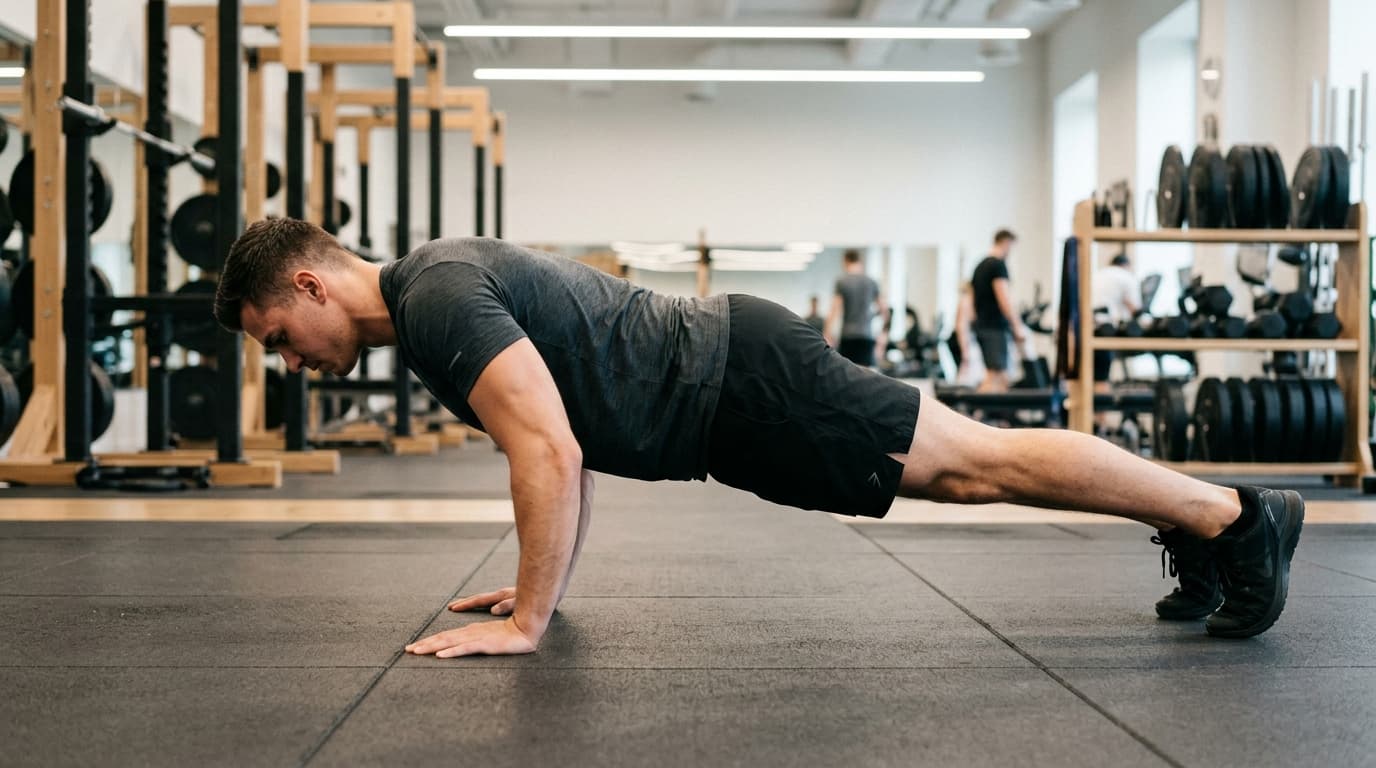
Athlete demonstrating perfect push-up form with proper body alignment, showing the progression from incline to advanced variations for building upper body strength

TL;DR: Push-Up Progression Summary

  • Beginners start here: Wall push-ups → incline push-ups → standard floor push-ups (4-8 weeks)
  • Intermediate progression: Master 3 sets of 15 standard push-ups before advancing to decline, diamond, or tempo variations
  • Advanced variations: Archer push-ups, pseudo-planche, one-arm progressions require 6-12 months of consistent training
  • Key principle: Progressive overload through harder variations beats doing more reps of easy variations
  • Training frequency: 3-4 sessions per week with 48-72 hours recovery between push-focused workouts

What Are Push-Ups and Why They Build Functional Strength

Definition: The push-up is a fundamental bodyweight exercise that builds upper body pressing strength by requiring you to push your body weight away from the ground while maintaining a rigid plank position. Push-ups simultaneously train the chest, shoulders, triceps, and core without requiring any equipment, making them the most accessible upper body strength builder available.

Push-ups represent a fundamental human movement pattern—horizontal pushing—that translates directly to real-world strength. Unlike isolation exercises that target single muscles, push-ups build functional pressing power used when pushing open doors, lifting yourself from the ground, or any overhead pressing movement. According to research published in the Journal of Strength and Conditioning Research (2019), push-up performance correlates strongly with overall physical fitness and cardiovascular health markers.

The push-up's versatility makes it invaluable: absolute beginners can start with wall push-ups, while elite athletes challenge themselves with one-arm and planche variations. Progressive push-up training builds muscle, increases relative strength (strength-to-weight ratio), and improves core stability—all critical components of functional fitness that translates beyond the gym.

The Science of Push-Ups: Biomechanics & Muscle Activation Research

Understanding the biomechanics and research behind push-up training helps you train smarter, avoid plateaus, and select the right progressions:

EMG Studies: Muscle Activation Patterns

Electromyography (EMG) research by Cogley et al. (2005) in the Journal of Strength and Conditioning Research measured muscle activation during various push-up hand positions. Standard push-ups showed balanced chest, shoulder, and triceps activation, while narrow (diamond) positions increased triceps activation by 20%, and wide positions emphasized chest activation. Understanding activation patterns helps you select variations that target your weaknesses.

Progressive Overload Without Weights

A comprehensive review by Schoenfeld (2010) in Sports Medicine established that progressive mechanical tension drives muscle growth. For push-ups, this means progressing to harder variations (decline, one-arm, tempo) provides sufficient overload for continued strength gains—you don't need weights to build muscle when you increase leverage disadvantage and instability.

Bodyweight Training Effectiveness

Research published in IJERPH (2015) demonstrated that calisthenics training produces comparable strength and muscle gains to traditional weight training when volume and intensity are matched. The study followed participants doing push-up progressions versus bench press variations and found no significant difference in pectoralis major hypertrophy or pressing strength gains. Push-ups work—you just need progressive overload.

Core Stability Requirements

Studies on core activation show that push-ups engage abdominal and lower back muscles significantly more than bench press variations. A 2020 study in the Journal of Physical Therapy Science found that push-ups require 30-40% more core stabilization than equivalent weighted pressing movements, making them superior for building functional, transferable strength that prevents injury and improves posture.

The most important research finding for beginners: Tempo (controlled speed) matters more than rep count. According to biomechanics research, performing push-ups with a 3-second lowering (eccentric) phase and 1-second pushing (concentric) phase builds 40% more strength than fast, uncontrolled reps. Quality beats quantity—slow, controlled push-ups with perfect form produce better results than high reps with poor mechanics.

What Muscles Do Push-Ups Work?

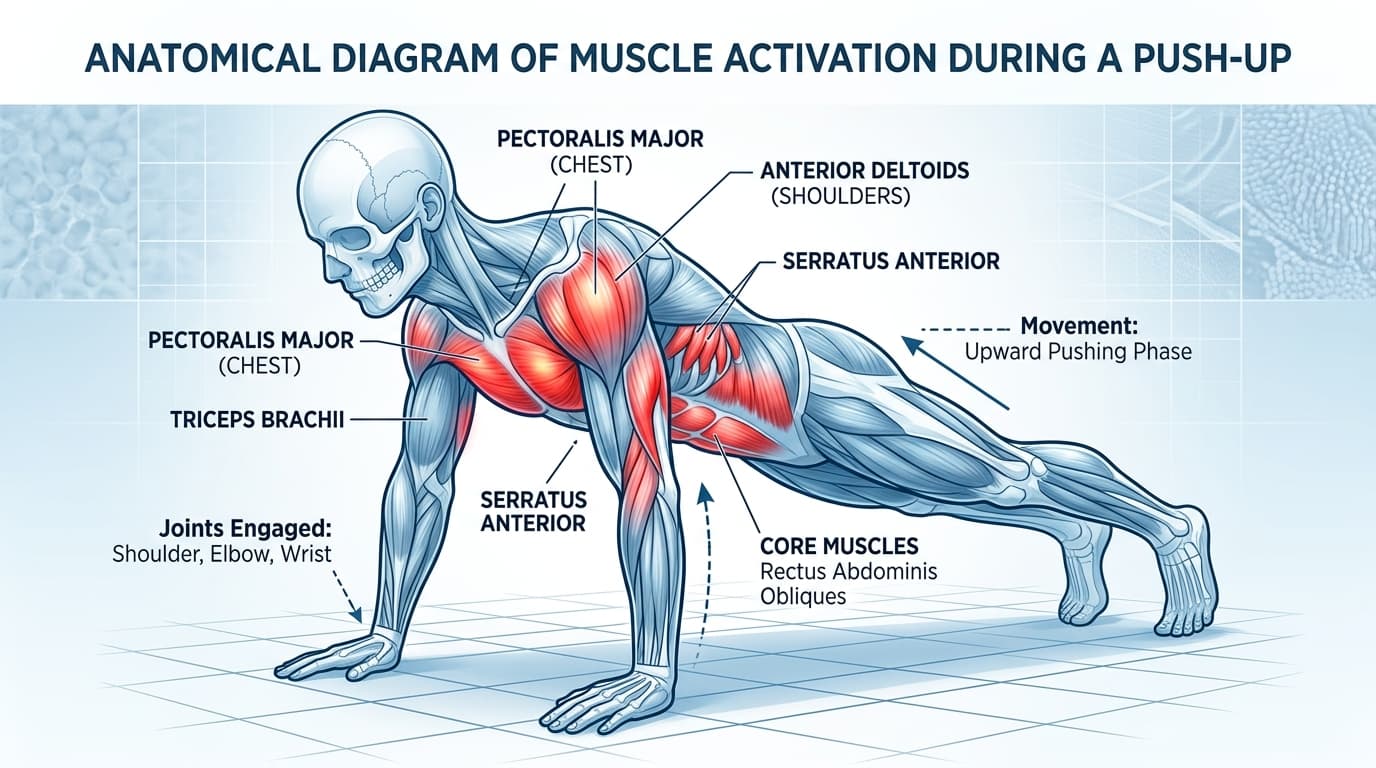
Anatomical diagram showing muscles engaged during push-ups: pectoralis major (chest), anterior deltoids (shoulders), triceps, serratus anterior, and core muscles with highlighted activation zones

Push-ups are a compound movement that simultaneously trains multiple muscle groups across the upper body and core. Understanding muscle activation helps you identify weaknesses and select progression variations strategically:

Primary Movers

  • Pectoralis Major (Chest): The large fan-shaped chest muscle that produces the majority of horizontal pushing force. Weakness here is the #1 limiting factor for push-up performance.
  • Anterior Deltoids (Front Shoulders): Shoulder muscles that assist with pushing and stabilize the shoulder joint throughout the movement. More active in decline and pike push-up variations.
  • Triceps Brachii: Back-of-arm muscles that extend the elbow during the push phase. Become dominant in close-grip and diamond push-up variations.

Secondary Stabilizers

  • Serratus Anterior: The "boxer's muscle" on your ribs that protracts the scapula (pushes shoulder blade forward). Critical for healthy shoulder mechanics and preventing winging.
  • Core (Abs, Obliques, Lower Back): Prevent sagging hips and maintain rigid body position throughout the movement. Weak core = poor push-up form.
  • Upper Back & Rhomboids: Stabilize shoulder blades and prevent excessive protraction. Essential for shoulder health during high pushing volume.
  • Glutes & Hip Flexors: Maintain plank position and prevent hip sag. Often overlooked but critical for proper alignment.

Identifying Your Weak Link

Most beginners fail at push-ups due to chest weakness (can't generate pushing force) or core weakness (hips sag mid-rep). Test yourself: Can you hold a plank for 60+ seconds? If no, prioritize core strength before advancing push-up difficulty. Can you do 10+ incline push-ups with perfect form? If no, your chest and pushing muscles need foundational strength development before attempting floor push-ups.

Perfect Push-Up Form: Step-by-Step Technique Guide

Proper push-up form prevents injury, maximizes muscle activation, and ensures progressive strength gains. Master these mechanics before progressing to harder variations:

1. Setup Position

  • Hand placement: Hands slightly wider than shoulder-width, fingers pointing forward or slightly outward
  • Shoulder position: Shoulders stacked directly over hands (vertical alignment)
  • Grip: Spread fingers wide, actively grip the ground, create tension through forearms
  • Feet: Feet together or hip-width apart (together is harder, requires more stability)

2. Body Alignment (Plank Position)

  • Straight line: Maintain rigid alignment from head to heels—no sagging hips or piked butt
  • Core engaged: Brace abs as if taking a punch, squeeze glutes to prevent hip drop
  • Neutral spine: Head in line with spine, eyes looking at ground 6-12 inches ahead
  • Shoulders: Shoulder blades slightly protracted (pushed apart), not pinched together

3. Descent Phase (Eccentric)

  • Tempo: Lower for 2-3 seconds in a controlled manner (no dropping)
  • Elbow position: Elbows track at 45-degree angle from body (not flared 90 degrees, not tucked tight)
  • Depth: Lower until chest touches ground or reaches 1-2 inches above (full range of motion)
  • Breathing: Inhale during descent, maintain core tension throughout

4. Ascent Phase (Concentric)

  • Drive: Press through entire hand (not just heel of palm), push ground away
  • Tempo: Push up explosively but controlled (1 second)
  • Maintain alignment: Keep plank position rigid—body moves as one unit
  • Breathing: Exhale forcefully during push phase
  • Top position: Full arm extension but don't hyperextend elbows (soft lockout)

The Perfect Rep Checklist

  • Hands slightly wider than shoulders, fingers spread
  • Straight body line from head to heels (plank position)
  • Core and glutes engaged throughout entire movement
  • Elbows at 45-degree angle (not flared or tucked)
  • Chest touches ground or reaches full depth
  • Controlled 2-3 second descent, explosive 1 second push
  • No hip sag, no butt pike, no neck strain

Assessing Your Push-Up Starting Point

Before beginning training, assess your current push-up ability. This determines which progression level is appropriate and sets realistic timelines:

Test 1: Plank Hold Duration

How: Hold high plank position (push-up top position) with perfect form and time how long you can maintain alignment before hips sag or form breaks.

  • 0-20 seconds: Absolute beginner—start with wall push-ups and plank work
  • 20-45 seconds: Beginner—start with incline push-ups
  • 45-60 seconds: Intermediate—ready for standard floor push-ups
  • 60+ seconds: Advanced—strong core, ready for harder variations

Test 2: Standard Push-Up Max Reps

How: From standard push-up position (hands shoulder-width, on floor), perform as many perfect-form push-ups as possible. Stop when form breaks.

  • 0 reps (can't do one): Start with incline progressions
  • 1-5 reps: Beginner—build volume before advancing
  • 6-15 reps: Intermediate—ready for harder variations
  • 15-25 reps: Advanced—progress to decline, tempo, or unilateral work
  • 25+ reps: Elite—focus on advanced progressions (one-arm, planche)

Test 3: Incline Push-Up Assessment

How: Place hands on elevated surface (kitchen counter, bench, or table ~36 inches high). Perform push-ups with perfect form. Count max reps.

  • 0-5 reps: Start with wall push-ups (highest incline)
  • 6-12 reps: Work at this incline height for 2-3 weeks
  • 12-20 reps: Lower incline height and repeat progression
  • 20+ reps: Move to next lower incline or floor push-ups

Test 4: Negative (Eccentric) Push-Up

How: Start at top of push-up position, lower yourself as slowly as possible to the ground. Time the descent.

  • Drop immediately: Not ready for floor push-ups—continue incline work
  • 1-3 seconds: Close—practice negatives to build strength
  • 3-5 seconds: Good control—continue building volume
  • 5+ seconds: Excellent control—ready for full push-ups and variations

Beginner Push-Up Progressions (Weeks 1-4)

These progressions build foundation strength for anyone who cannot yet perform 10+ standard floor push-ups with perfect form. Master each level before progressing:

Level 1: Wall Push-Ups (Easiest)

How: Stand arm's length from wall, place hands on wall at shoulder height and width. Lean forward, bend elbows to bring chest toward wall, push back to start. Maintain straight body line.

Why It Works: Reduces resistance to ~50% of bodyweight, allowing absolute beginners to learn pushing mechanics and build initial chest and shoulder strength without overwhelming muscles.

Progression Goal: 3 sets of 15-20 reps with perfect control and full range of motion before moving to next level.

Common Mistake: Standing too far from wall, causing excessive lean and poor shoulder alignment. Start closer than you think—focus on control, not difficulty.

Level 2: Elevated Incline Push-Ups (Kitchen Counter Height)

How: Place hands on kitchen counter, sturdy table, or bar at ~36-40 inch height. Step feet back until body is straight. Lower chest to counter, push back up. Maintain plank position throughout.

Why It Works: Increases resistance to ~60-70% bodyweight while still providing mechanical advantage. Trains the full push-up movement pattern with manageable load.

Progression Goal: 3 sets of 12-15 reps before lowering incline height.

Progression Tip: Once you hit 15+ reps, lower the incline height (use lower table, chair, or bench) and rebuild volume at new height. Gradually work toward floor level.

Level 3: Bench Incline Push-Ups (~18-24 inch height)

How: Place hands on bench, couch, or sturdy box at ~18-24 inch height. Feet extended back, body straight from head to heels. Lower chest to bench, press back to top position.

Why It Works: Increases load to ~75-80% bodyweight while maintaining some mechanical advantage. Significantly harder than counter height—requires real chest and triceps strength.

Progression Goal: 3 sets of 10-15 reps with controlled tempo (2-3 seconds down, 1 second up).

Form Check: At this height, hip sagging becomes common. If your hips drop during reps, add plank holds (3x45 seconds) to your warm-up to build core strength.

Level 4: Standard Floor Push-Ups (Foundation Mastery)

How: Hands on floor slightly wider than shoulders, body straight from head to heels. Lower until chest touches floor (or 1-2 inches above), push explosively back to top. Full range of motion with perfect form.

Why It Works: Full bodyweight resistance (~100% load) builds real pushing strength. The foundation for all advanced variations—master this before progressing further.

Progression Goal: 3 sets of 15 reps with strict form before advancing to intermediate variations. This ensures sufficient strength base.

Milestone Achieved: If you can perform 3 sets of 15 standard push-ups with perfect form (chest to floor, no sag, controlled tempo), you've built real functional strength. You're now ready for intermediate and advanced progressions.

Beginner Phase Training Schedule (Weeks 1-4)

Monday/Thursday: Current progression level × 3 sets (start with level you can complete 8-10 reps)

Tuesday/Friday: Same progression × 3 sets + Plank hold 3×30-45 seconds

Weekly Progression: Add 1-2 reps per set each week. When you reach progression goal (usually 15+ reps), move to next harder variation.

Rest Days: Wednesday, Saturday, Sunday (or 48 hours between sessions)

Intermediate Push-Up Variations (Weeks 5-8)

Once you can perform 3 sets of 15 standard push-ups, these intermediate variations increase difficulty through different angles, tempos, and hand positions:

Variation 1: Decline Push-Ups (Feet Elevated)

How: Place feet on bench, couch, or box (12-24 inches high), hands on floor in standard position. Perform push-ups with elevated feet, maintaining straight body line.

Why It Works: Shifts more weight to upper chest and shoulders (~110-120% effective load). Builds shoulder strength and upper chest development that standard push-ups don't emphasize.

Target Volume: 3-4 sets × 8-12 reps. Harder than standard push-ups—don't expect same rep counts initially.

Progression Path: Start with low elevation (12 inches), gradually increase height (18, then 24 inches) as strength builds. Higher elevation = more shoulder emphasis.

Variation 2: Diamond (Close-Grip) Push-Ups

How: Place hands close together directly under chest, forming diamond shape with index fingers and thumbs touching. Lower body keeping elbows close to sides. Push back to top position.

Why It Works: According to EMG research by Cogley et al. (2005), close-grip positions increase triceps activation by 20% compared to standard push-ups. Builds arm strength and lockout power.

Target Volume: 3 sets × 6-10 reps. Significantly harder than standard due to reduced stability and increased triceps demand.

Wrist Safety: If diamond position strains wrists, use parallel bars, dumbbells, or push-up handles to maintain neutral wrist alignment while keeping hands close together.

Variation 3: Tempo Push-Ups (Time Under Tension)

How: Standard push-up position, but control the tempo precisely: 3 seconds lowering (eccentric), 1 second pause at bottom, 1 second push (concentric), 1 second pause at top. Count in your head: 3-1-1-1 tempo.

Why It Works: Extended time under tension increases muscle fiber recruitment and metabolic stress—two key drivers of muscle growth. Builds control and eliminates momentum-based reps.

Target Volume: 3 sets × 5-8 reps. Fewer reps than standard push-ups but significantly harder due to slow tempo.

Programming Tip: Use tempo push-ups as a plateau-breaker. If you've stalled at certain rep counts, 2-3 weeks of tempo work builds strength that translates to higher standard push-up numbers.

Variation 4: Wide-Grip Push-Ups (Chest Emphasis)

How: Place hands significantly wider than shoulder-width (1.5-2x wider), fingers angled slightly outward. Lower chest to floor, press back up. Elbows will naturally flare more than standard push-ups.

Why It Works: Wide hand position increases chest activation and reduces triceps involvement. Emphasizes outer chest (pectoralis major lateral head) and builds pressing power.

Target Volume: 3 sets × 10-15 reps. Slightly easier than standard for most people due to reduced range of motion.

Shoulder Caution: Don't go too wide (beyond 2x shoulder width) as this increases shoulder strain. If you feel anterior shoulder discomfort, narrow hand position slightly.

Variation 5: Pike Push-Ups (Shoulder Development)

How: Start in downward dog position—hips high in air, body forming inverted V shape. Lower head toward floor by bending elbows, keeping hips elevated. Press back to start position.

Why It Works: Mimics overhead pressing movement, heavily emphasizing anterior deltoids (shoulders) with less chest involvement. The progression toward handstand push-ups.

Target Volume: 3 sets × 6-12 reps. Difficulty varies based on hip height—higher hips = more shoulder load.

Progression Path: Start with shallow pike (lower hips), gradually increase hip height. Eventually elevate feet on box for pike push-ups, then progress to wall-assisted handstand push-ups.

Intermediate Phase Training Schedule (Weeks 5-8)

Monday: Decline push-ups 4×8-12 + Diamond push-ups 3×6-10

Wednesday: Standard push-ups 3×15 + Tempo push-ups 3×5-8 (3-1-1-1)

Friday: Wide push-ups 3×12 + Pike push-ups 3×8-12

Progressive Overload: Each week, add 1 rep per set OR increase difficulty (higher decline, slower tempo, stricter form). Track all workouts.

Advanced Push-Up Progressions (Weeks 9-12+)

These advanced variations require significant unilateral strength, stability, and control. Only attempt after mastering intermediate progressions and building 6+ months of consistent training foundation:

Advanced Variation 1: Archer Push-Ups

How: Place hands extra wide (2x shoulder width). Lower body while shifting weight to one side—one arm bends (working side), other arm straightens (supporting side). Push back to center. Alternate sides each rep.

Why It Works: Builds unilateral (single-arm) pressing strength by loading one side heavily while the other provides minimal support. The bridge between standard push-ups and one-arm push-ups.

Target Volume: 4 sets × 5-8 reps per side. Much harder than any intermediate variation due to unilateral demand.

Form Cue: The supporting arm should remain nearly straight with hand flat on ground—it's assisting balance, not pressing. Focus all pushing force through the bent-arm side.

Advanced Variation 2: Pseudo-Planche Push-Ups

How: Start in standard push-up position, but lean forward significantly so shoulders move past hands (hands end up near lower ribs/abs area). Perform push-ups while maintaining forward lean.

Why It Works: Forward lean creates severe leverage disadvantage, massively increasing load on chest and shoulders. Builds straight-arm strength required for planche progressions.

Target Volume: 3-4 sets × 5-8 reps. Extremely demanding—even elite athletes struggle with high reps.

Progression Note: Start with slight forward lean (shoulders just past hands), gradually increase lean angle over months. Extreme lean requires elite strength.

Advanced Variation 3: One-Arm Push-Up Progressions

Progression Step 1—Elevated One-Arm: Place working hand on elevated surface (bench), feet wide apart, non-working arm behind back. Lower chest to surface, push back up. Master 3×8 before progressing.

Progression Step 2—Floor with Wide Stance: Working hand on floor, feet very wide (3+ feet apart) for stability, non-working arm behind back. Lower chest to floor, press back up. Master 3×5 before progressing.

Final Progression—Strict One-Arm: Working hand on floor, feet closer together (shoulder-width or narrower), non-working arm behind back. Full range of motion, minimal torso rotation.

Why It Works: One-arm push-ups require extreme unilateral pressing strength (pushing ~70% bodyweight with one arm) plus rotational core stability. One of the ultimate bodyweight pressing achievements.

Elite Achievement: If you can perform 3-5 strict one-arm push-ups per side (feet shoulder-width, chest to floor, minimal rotation), you possess elite relative strength. This typically requires 12-24 months of progressive training.

Advanced Variation 4: Clapping (Plyometric) Push-Ups

How: Standard push-up position. Lower to floor, then explosively push up with maximum force so hands leave ground. Clap hands in air, catch yourself with hands back on floor, immediately lower into next rep.

Why It Works: Develops explosive power and fast-twitch muscle fiber recruitment. According to plyometric research, explosive movements improve rate of force development—critical for athletic performance.

Target Volume: 3-4 sets × 3-6 reps. Low reps due to high neural demand and impact on wrists/joints.

Safety Note: Only attempt if you can do 20+ standard push-ups and have healthy wrists. Land with slight elbow bend (not locked) to absorb impact. Progress to double-clap or behind-the-back clap variations for advanced challenge.

Advanced Variation 5: Ring or TRX Push-Ups (Instability Training)

How: Hang gymnastic rings or TRX straps at ~12 inches off ground. Grab rings/handles, body straight, feet on floor. Perform push-ups while fighting to stabilize the unstable rings.

Why It Works: Instability massively increases stabilizer muscle activation (serratus anterior, rotator cuff, core). EMG studies show 40%+ greater stabilizer activation compared to floor push-ups. Builds bulletproof shoulder stability.

Target Volume: 3 sets × 8-12 reps. Harder than it looks—instability creates significant difficulty even for experienced athletes.

Progression Path: Start with rings high (easier), gradually lower ring height (harder). Eventually progress to ring push-ups with feet elevated, or rings turned out at top position (RTO) for extreme difficulty.

Complete 12-Week Push-Up Training Program

Program Overview: This program takes you from beginner push-up variations to advanced progressions over 12 weeks with 3-4 training sessions per week. Adjust starting point based on your assessment results. Progressive overload is key—every session should be slightly more challenging than the last.

1-4

Weeks 1-4: Foundation Phase

Goal: Build base pushing strength, core stability, and perfect push-up mechanics

Monday & Thursday:

  • Current progression level: 3 sets × 8-15 reps (incline or floor based on assessment)
  • Plank Hold: 3 sets × 30-60 seconds
  • Negative Push-Ups: 3 sets × 3-5 reps (3-5 second descent)

Tuesday & Friday:

  • One level easier variation: 3 sets × 10-15 reps (volume work)
  • Diamond Push-Ups (or knees): 3 sets × 5-8 reps
  • Shoulder Taps in Plank: 3 sets × 16-20 taps (core + stability)

Week 4 Check: Can you do 3 sets of 15 standard floor push-ups with perfect form (chest to floor, no sag, controlled)? If yes, move to Phase 2. If no, repeat weeks 3-4 programming.

5-8

Weeks 5-8: Intermediate Development Phase

Goal: Increase difficulty through angles, tempos, and specialized variations

Monday:

  • Decline Push-Ups: 4 sets × 8-12 reps
  • Diamond Push-Ups: 3 sets × 6-10 reps
  • Standard Push-Ups: 2 sets × max reps (burnout sets)

Wednesday:

  • Tempo Push-Ups: 4 sets × 5-8 reps (3-1-1-1 tempo)
  • Wide Push-Ups: 3 sets × 10-15 reps
  • Plank to Push-Up: 3 sets × 8-12 reps

Friday:

  • Pike Push-Ups: 4 sets × 8-12 reps
  • Archer Push-Ups (assisted): 3 sets × 5-8 reps per side
  • Negative One-Arm Push-Ups: 3 sets × 3 reps per side

Week 8 Check: Can you do 10+ decline push-ups, 8+ diamond push-ups, and 3+ archer push-ups per side? If yes, you're ready for advanced work in Phase 3.

9-12

Weeks 9-12: Advanced Mastery Phase

Goal: Master advanced progressions and build elite pressing strength

Monday:

  • Archer Push-Ups: 5 sets × 5-8 reps per side
  • Decline Diamond Push-Ups: 3 sets × 6-10 reps
  • Explosive Push-Ups: 4 sets × 5 reps (hands leave ground)

Wednesday:

  • Pseudo-Planche Push-Ups: 4 sets × 5-8 reps (progressive lean)
  • Pike Push-Ups (feet elevated): 3 sets × 8-12 reps
  • Ring/TRX Push-Ups: 3 sets × 8-12 reps (or floor if no equipment)

Friday:

  • One-Arm Push-Up Progressions: 5 sets × 3-5 reps per side (current level)
  • Archer Push-Ups: 3 sets × 8 reps per side (volume)
  • Clapping Push-Ups: 3 sets × 3-5 reps (explosive power)

Week 12 Assessment: Test your progress: Max standard push-ups (aim for 30+), archer push-ups per side (aim for 8+), one-arm push-up attempts. You've built elite pressing strength if you can complete these targets.

Important Programming Notes:

  • Rest 48-72 hours between push-focused training sessions (muscles grow during recovery)
  • If you fail to progress for 2 consecutive weeks, deload: reduce volume by 40% for one week
  • Track every workout: exercises, sets, reps, difficulty level, form quality
  • Balance with pulling exercises (rows, pull-ups) in a 1:1 ratio to prevent shoulder imbalances
  • Optional 4th session: Add light active recovery with easy variations (wall push-ups, mobility work)
  • Every 4-6 weeks, take a deload week (50% volume) to allow supercompensation

Common Push-Up Mistakes That Limit Progress

1. Hip Sagging (Broken Plank Position)

The Mistake: Allowing hips to drop toward floor due to weak core or glute activation. Creates spinal hyperextension and reduces chest activation while increasing lower back strain.

The Fix: Squeeze glutes hard throughout movement, brace abs as if taking a punch. If hips still sag, regress to easier variation (higher incline) or add dedicated plank work (3×45 seconds) to build core strength.

2. Flared Elbows (90-Degree Angle)

The Mistake: Elbows flare out perpendicular to body (T-shape) instead of 45-degree angle. Places excessive stress on shoulder joint and rotator cuff, increasing injury risk while reducing pressing efficiency.

The Fix: Keep elbows at 45-degree angle from torso (arrow shape, not T). Think "elbows toward hips" during descent. Film yourself from above to verify angle—most people flare more than they realize.

3. Partial Range of Motion

The Mistake: Only lowering halfway or not reaching full depth (chest 1-2 inches from floor). Half-reps build half strength—limits muscle development and creates strength gaps in stretched positions.

The Fix: Lower until chest touches floor (or at most 1-2 inches above). Place object (foam roller, yoga block) under chest as depth marker. If you can't reach full depth with control, regress to easier variation.

4. Using Momentum Instead of Control

The Mistake: Bouncing at bottom or using snake-like movement to get back up. Momentum-based reps reduce time under tension and bypass the strength-building eccentric (lowering) phase.

The Fix: Implement tempo: 2-3 seconds lowering, 1 second pause at bottom, 1 second push, 1 second pause at top. If you can't control the tempo, reduce reps or use easier variation. Quality over quantity.

5. Head Position Errors (Looking Up or Down)

The Mistake: Looking up (neck hyperextended) or looking straight down (neck flexed). Both create cervical spine misalignment and can cause neck strain or headaches.

The Fix: Maintain neutral spine from head to tailbone—head in line with spine, eyes looking at floor 6-12 inches ahead of hands. Imagine balancing book on back of head throughout movement.

6. Progressing Too Fast (Skipping Steps)

The Mistake: Jumping to harder variations before mastering current level. Attempting one-arm push-ups when you can only do 10 standard push-ups. Creates form breakdown and injury risk.

The Fix: Follow progression guidelines: master 3 sets of 15 reps with perfect form before advancing to next difficulty level. Build foundation strength—there are no shortcuts.

7. Training Push-Ups Every Day (Overtraining)

The Mistake: Doing intense push-up training daily, thinking more volume = faster results. Actually prevents recovery, causes overuse injuries, and leads to strength plateaus or regression.

The Fix: Train push-ups 3-4 times per week maximum with 48-72 hours recovery between sessions. Muscles grow during rest. If progress stalls, add rest day, don't add more volume.

8. Ignoring Wrist Pain or Shoulder Discomfort

The Mistake: Pushing through sharp wrist or shoulder pain, hoping it will "work itself out." Pain is a signal—continuing creates chronic injuries that sideline training for months.

The Fix: Stop immediately if you feel sharp joint pain. Wrist pain: use push-up handles, parallettes, or fists to maintain neutral wrist position. Shoulder pain: check elbow angle (reduce flare), reduce range of motion, or regress difficulty. If pain persists beyond 1 week, consult physical therapist.

Nutrition and Recovery for Push-Up Strength Development

Training provides the stimulus for adaptation, but nutrition and recovery determine whether you actually get stronger. These factors are frequently neglected by beginners:

Protein for Muscle Repair

Target: 0.7-1.0g protein per pound of bodyweight daily to support muscle protein synthesis and recovery. A 160lb person needs 112-160g protein per day.

  • Post-workout protein: 20-40g within 2 hours of training
  • Distribute protein across 3-4 meals (better than one large dose)
  • Quality sources: chicken, fish, eggs, Greek yogurt, legumes, tofu, protein powder

Caloric Balance Strategy

For Muscle Building: Eat at maintenance calories or slight surplus (200-300 above maintenance). Difficult to maximize strength gains in a caloric deficit.

For Fat Loss + Strength: Modest deficit (300-500 calories below maintenance) with high protein (1.0g/lb). Progress will be slower but still achievable. Prioritize progression over perfection.

Sleep Quality Requirements

Target: 7-9 hours per night in dark, cool environment. Sleep is when growth hormone releases, muscle repair occurs, and nervous system recovers. Poor sleep = poor gains.

  • Consistent sleep schedule (same bedtime and wake time)
  • Cool room temperature (65-68°F optimal for sleep quality)
  • Avoid screens 60 minutes before bed (blue light disrupts melatonin)

Active Recovery Methods

Between Sessions: Light movement promotes blood flow and nutrient delivery without adding fatigue. Don't sit completely still on rest days.

  • Walking 20-30 minutes daily (improves circulation)
  • Mobility work and dynamic stretching (shoulder circles, arm swings)
  • Light yoga or bodyweight movement (easy variations, no intensity)

Hydration Impact on Performance

Target: Half your bodyweight in ounces daily (160lb person = 80oz water). Dehydration reduces strength performance by 10-15% and increases injury risk.

Pre-training: Drink 16-20oz water 2 hours before workout. During: Sip water between sets. Post-training: Rehydrate with 16-24oz within first hour.

Strategic Deload Weeks

Every 4-6 Weeks: Reduce training volume by 40-50% for one week. This allows accumulated fatigue to dissipate and facilitates supercompensation (coming back stronger).

Deload ≠ complete rest. Perform same exercises with reduced sets/reps/intensity. Maintain movement patterns without adding fatigue. You'll return with increased performance.

The 80/20 Rule: Focus on What Matters Most

Perfect is the enemy of good. Focus on the 20% that drives 80% of results: consistent training 3-4x/week, adequate protein intake (0.7-1.0g/lb), and 7+ hours quality sleep. Don't obsess over supplements, precise meal timing, or advanced recovery protocols until you've mastered these basics for at least 3 months.

Frequently Asked Questions

How long does it take to progress from beginner push-ups to advanced variations?
Most beginners can progress from wall push-ups to standard push-ups in 4-8 weeks with consistent training (3-4 sessions per week). Reaching advanced variations like one-arm push-ups or planche push-ups typically requires 6-12 months of progressive training. Your timeline depends on starting strength, body composition, training consistency, and progressive overload application. The key is mastering each progression level before advancing.
Can I build muscle with just push-ups and no weights?
Yes, push-ups can build significant muscle mass when performed with progressive overload. Research published in the Journal of Exercise Science & Fitness (2019) found that bodyweight training produces comparable muscle hypertrophy to weighted training when volume and intensity are matched. To continue building muscle, progress to harder variations (decline, archer, one-arm) rather than just doing more reps of the same variation.
What muscles do push-ups work and how do I target specific areas?
Push-ups primarily work the chest (pectoralis major), shoulders (anterior deltoids), and triceps. Secondary muscles include the core (abs and obliques), serratus anterior, and upper back stabilizers. To emphasize chest, use wider hand positions and decline angles. For triceps, use narrow diamond hand positions. For shoulders, elevate your feet and move hands forward. For core, add instability with single-arm or feet-elevated variations.
Why can't I do a single push-up even though I'm not weak?
Push-ups require a specific strength pattern that other exercises don't develop. They demand relative strength (lifting your body weight), core stability to maintain plank position, and scapular control to protect shoulders. Many people who can lift weights struggle with push-ups due to poor core engagement, weak scapular stabilizers, or insufficient practice with the movement pattern. The solution is starting with incline progressions and building foundation strength.
Should I do push-ups every day or take rest days?
For strength and muscle building, train push-ups 3-4 times per week with 48-72 hours rest between sessions. Muscles grow during recovery, not training. Daily push-ups work for skill practice or endurance (using easy variations), but not for building maximum strength. If you plateau or feel persistent fatigue, you're likely overtraining. Implement rest days and deload weeks (reduced volume) every 4-6 weeks for optimal progress.
What's the difference between push-up variations and which should I learn first?
Push-up variations differ in difficulty, muscle emphasis, and skill requirements. Start with incline push-ups (hands elevated) to build base strength, then progress to standard floor push-ups. After mastering 3 sets of 15+ standard push-ups, branch into specialized progressions: decline push-ups (feet elevated) for upper chest and shoulders, diamond push-ups for triceps, archer push-ups for unilateral strength, or pseudo-planche push-ups for advanced pushing power.

Ready to Build Legendary Pressing Strength?

Odin guides you through progressive push-up training with structured programs, video demonstrations for every variation, and tracking to measure your strength gains. No equipment needed—just download the app and start building your upper body strength today.

Download on the App Store
✓ Train anywhere✓ No equipment✓ Progressive tracking