
Your First 30 Days of Calisthenics: A Complete Roadmap
A step-by-step, day-by-day guide for complete beginners to build strength, master foundational bodyweight movements, and establish lifelong fitness habits—no equipment required.
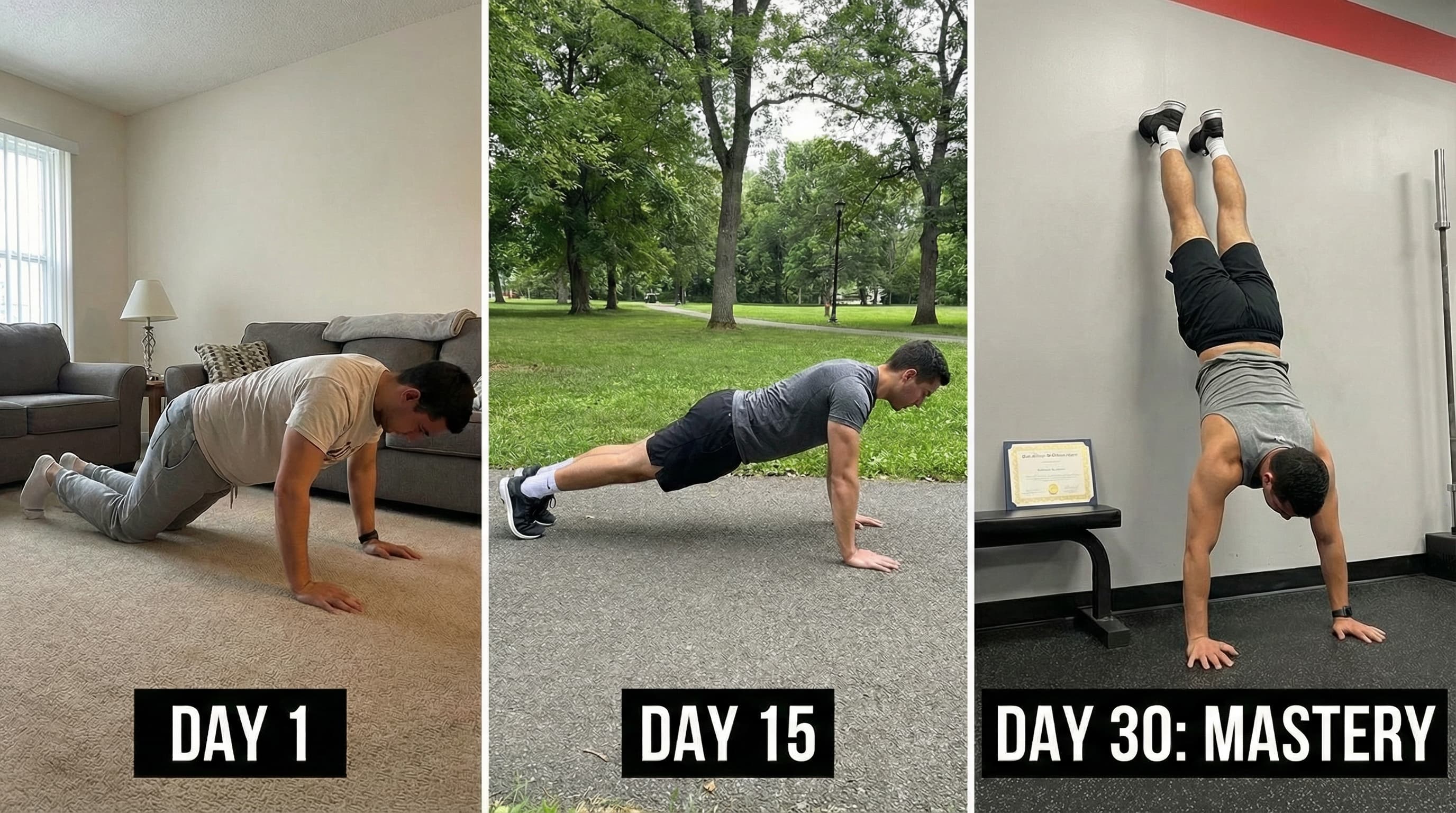
TL;DR — Key Takeaways
- 30 days is enough to build a lasting calisthenics foundation — you won't look like an athlete, but you'll have the movement patterns and habit to get there.
- Train 3–4 days per week, 20–30 minutes per session — Week 1 focuses on movement quality; Week 4 introduces progressive overload. No equipment needed.
- Every exercise has an easier version — can't do a push-up? Start with wall push-ups. Can't do a squat? Use a chair. Start where you are, not where you think you should be.
What to Expect in Your First 30 Days of Calisthenics
The First 30 Days Reality: Your first month of calisthenics training is about building the foundation—both physical and habitual—that enables long-term success. You won't achieve a six-pack or master advanced skills, but you will develop proper movement patterns, build functional strength, establish a sustainable workout routine, and prove to yourself that consistent training works.
Starting calisthenics as a complete beginner requires realistic expectations. Research on strength training adaptation shows that the first 2-4 weeks produce primarily neural adaptations (your brain learning to activate muscles efficiently), not visible muscle growth. You'll feel stronger and movements will become easier, but dramatic physique changes typically appear after 6-8 weeks of consistent training.
What You WILL Achieve
- Master foundational movement patterns (push, pull, squat, core)
- Build base strength (2-3x improvement in reps for beginners)
- Establish a consistent workout habit and routine
- Improve mobility, balance, and body control
- Develop mind-muscle connection and movement awareness
- Build confidence and prove to yourself you can do this
What You WON'T Achieve (Yet)
- Dramatic visible muscle growth or "transformation" photos
- Advanced skills (handstands, muscle-ups, planche)
- Significant weight loss (1-4 pounds is typical)
- High-rep capacity (50+ push-ups, 20+ pull-ups)
- Effortless workouts (they should still feel challenging)
The most important outcome of your first 30 days isn't what your body looks like—it's proving to yourself that consistent training produces results. Every workout makes you stronger. Every rep builds the habit. By Day 30, you'll have established the foundation for long-term success.
"The people who fail their first 30 days almost never fail because of the exercises—they fail because they judged Day 3 against Day 30's expectations. The whole point of a beginner program is that Week 1 is supposed to feel awkward. If it doesn't feel a little humbling, you probably skipped the regression you actually needed."
Before You Start: Essential Preparation
Success in your first 30 days starts before your first workout. These preparation steps significantly increase your chances of completing the full program:
1. Set Your Training Schedule
Recommended Pattern: 3-4 workouts per week, alternating with rest days. Example schedules:
- 3-Day Schedule: Monday, Wednesday, Friday (ideal for absolute beginners)
- 4-Day Schedule: Monday, Tuesday, Thursday, Saturday (more volume)
Critical: Block this time in your calendar now. Treat workouts like non-negotiable appointments. Choose the same times each day to build automatic habits. Prefer not to pick the schedule yourself? Our weekly bodyweight planner builds one from your goal, available days, and experience.
2. Prepare Your Training Space
You need minimal equipment, but setup matters:
- Clear floor space: 6x6 feet minimum for bodyweight movements
- Sturdy chair: For assisted squats, dips, and incline push-ups
- Wall access: For wall push-ups and balance exercises
- Optional but helpful: Yoga mat ($15-30), resistance bands ($15-25), pull-up bar ($25-40)
3. Take Baseline Measurements
Track progress objectively from Day 1:
- Performance tests: Max push-ups (any variation), max bodyweight squats, max plank hold time
- Photos: Front, side, back in consistent lighting (for personal tracking)
- Body measurements: Chest, waist, arms, thighs (optional but motivating)
- Weight: If relevant to your goals
Pro tip: Don't obsess over measurements during the 30 days. Re-measure on Day 31 to see true progress without daily fluctuations creating false signals.
4. Set Realistic Goals
Your primary goal for 30 days should be completing all scheduled workouts. Secondary goals might include:
- Perform 10 knee push-ups or 5 regular push-ups with good form
- Hold a plank for 60 seconds
- Complete 20 bodyweight squats in a row
- Do 30 seconds of dead hang (if you have access to a bar)
The 5 Foundational Exercises You'll Master
Your first 30 days focus on five fundamental movement patterns that build total-body strength. Every advanced calisthenics skill builds from these foundations:
Week 1: Foundation and Movement Learning
Days 1-7: Your primary goal this week is learning proper form and establishing your workout routine.
Week 1 Focus Points
Perfect Form Over Everything:
Do NOT rush through reps. Each repetition should be controlled and deliberate. Poor form builds bad habits that are hard to unlearn.
Mind-Muscle Connection:
Focus on feeling the target muscles work. During push-ups, actively think about your chest and triceps. During squats, feel your quads and glutes.
Breathing Pattern:
Exhale during the hard part (pushing up, standing up), inhale during the easy part (lowering down). Never hold your breath.
Track Everything:
Write down every workout—which exercises, how many sets, how many reps, how you felt. Tracking creates accountability and shows progress.
Week 2: Building Consistency
Days 8-14: This week increases volume and introduces variations. Your body adapts quickly—time to challenge it.
Week 2 Progression Notes
Push-Up Progression:
Moving from wall to incline increases resistance by approximately 40%. If chair-height feels too hard, use a higher surface like a desk or counter.
Volume Increase:
You're doing 4 workouts instead of 3, and more total reps per exercise. This is intentional progressive overload.
New Exercise:
Glute bridges target posterior chain (back side of body) that beginners often neglect. Strong glutes improve squats, lunges, and prevent lower back pain.
Week 3: Progressive Challenge
Days 15-21: You're no longer a beginner. Time to test harder progressions and build real strength.
Week 3 Key Developments
Strength Gains Are Obvious:
By Week 3, most beginners can do 2-3x the reps they could in Week 1. Neural adaptations (your brain learning to recruit muscle efficiently) peak around Day 14-21.
Tempo Training:
Slowing down the eccentric (lowering) phase builds more strength than fast reps. Tempo squats create more time-under-tension, forcing adaptation.
Advanced Variations:
Plank shoulder taps add anti-rotation challenge. Side planks target obliques. Mountain climbers add cardio + core. You're ready for complexity.
Week 4: Solidifying Skills
Days 22-30: Master what you've learned, test your limits, and build confidence for the next phase.
Week 4 Focus: Testing Your Limits
Week 4 is about discovering how far you've come and what you're capable of:
Max Effort Sets:
For push-ups, go to absolute failure (while maintaining form). This tests your true capacity and builds mental toughness.
Explosive Movements:
Jump squats and burpees add power development. These are advanced progressions that require the base strength you now have.
Unilateral Progressions:
Archer rows (one-arm emphasis) and Bulgarian split squats (single-leg) build asymmetrical strength and expose weaknesses.
Recovery, Nutrition, and Common Challenges
Training is only part of the equation. How you recover and fuel your body determines whether you actually get stronger:
Sleep: The Non-Negotiable
Target: 7-9 hours per night. During sleep, your body releases growth hormone, repairs muscle tissue, and consolidates motor learning (movement patterns).
- A 2022 study by Knowles et al. found 9 nights of restricted sleep (5 hours/night) increased training distress by 84% and perceived exertion by 11% during resistance training in women
- Prioritize consistent sleep schedule over optimizing everything else — see our 7-day sleep reset protocol
- If you sleep poorly, reduce workout intensity that day—don't push through
Protein Intake
Target: 0.7-1.0g per pound of bodyweight daily. A 150lb person needs 105-150g protein. See our complete protein intake guide for the full breakdown.
- Protein provides amino acids for muscle repair and growth
- Distribute across 3-4 meals (20-30g per meal optimal)
- Sources: chicken, fish, eggs, Greek yogurt, beans, lentils, tofu
- Protein supplements (whey, plant-based) are convenient but not required
Hydration
Target: Half your bodyweight in ounces daily. A 150lb person needs 75oz (about 9 cups).
- A 2007 study by Judelson et al., published in Medicine & Science in Sports & Exercise found dehydration of 3-4% body mass reduced strength by 3%, power by 4.8%, and high-intensity muscular endurance by 10%
- Drink 16-20oz water 1-2 hours before training
- Sip water during workouts
- Urine should be pale yellow (dark yellow = dehydrated)
Active Recovery
On Rest Days: Do light activity that promotes blood flow without adding fatigue.
- Walking 15-30 minutes (low-intensity cardio enhances recovery)
- Gentle stretching or yoga (improves mobility and reduces soreness)
- Foam rolling major muscle groups (if you have access to foam roller)
- Avoid intense activity—rest means rest, not different hard training
Common Challenges (And How to Overcome Them)
"I'm too sore to work out"
Solution: Extreme soreness (DOMS) peaks 48-72 hours after first workouts then decreases dramatically. Light movement actually reduces soreness faster than complete rest. After Week 1, soreness becomes minimal. Push through Week 1 soreness—it's temporary.
"I don't have time"
Solution: These workouts are 20-30 minutes. You have time—you lack prioritization. Schedule workouts like meetings. Wake up 30 minutes earlier. Cut 30 minutes of social media. Time is a choice, not a constraint.
"I'm not seeing results"
Solution: Define "results." Are you tracking performance (reps, hold times)? Performance improves first, visible physique changes take 6-8+ weeks. Compare Day 30 to Day 1 objectively—strength gains will be undeniable.
"I missed a workout, now I've failed"
Solution: One missed workout doesn't matter. Missing two in a row starts a pattern. If you miss a day, don't try to "make it up" by doubling the next workout—just resume the schedule. Consistency = completing 80% of workouts, not 100%.
What Happens After Day 30? Your Next Steps
Completing 30 days is an accomplishment. But it's the beginning, not the destination. Here's how to continue progressing:
Option 1: Continue Building Foundation
Best for: If you're not yet comfortable with regular push-ups, can't hold a 60-second plank, or struggle with bodyweight squats.
Repeat Weeks 3-4 for another 2-4 weeks, progressively adding reps, sets, or reducing rest times. Master the fundamentals before advancing to skill-based training.
Option 2: Progress to Skill Training
Best for: If you can comfortably do 10+ push-ups, 60+ second plank, and 20+ squats with good form.
Begin training for specific skills: first pull-up (8-12 week program), handstand progressions, L-sit holds, or advanced push-up variations (archer, pseudo planche).
Option 3: Add Structured Programs
Best for: If you want continued progression without planning every workout yourself.
Follow structured calisthenics programs designed for progressive overload. Programs provide periodization (wave intensity), deload weeks, and clear progression paths.
Option 4: Focus on Specific Goals
Best for: If you have a specific outcome you want to achieve.
Choose a goal: first pull-up, first handstand, 50 consecutive push-ups, or visible muscle definition. Design training around that specific goal with targeted progressions and dedicated practice.
Frequently Asked Questions
What if I've never exercised before? Can I still start calisthenics?
How long should my workouts be in the first 30 days?
What equipment do I need to start calisthenics at home?
How much muscle can I build in 30 days with bodyweight training?
Should I train every day or take rest days?
What should I eat to support my calisthenics training?
How do I know if I'm progressing or should move to harder exercises?
Build Your First Week of Calisthenics
Choose your training days, time available, and experience level, and Odin will create a beginner-friendly bodyweight schedule.
Build My Free Weekly Plan