
The Complete Guide to Starting Calisthenics: From Zero to First Pull-Up
A research-backed, step-by-step program to achieve your first pull-up in 8-12 weeks. No gym required—just your body, consistency, and the right progressions.
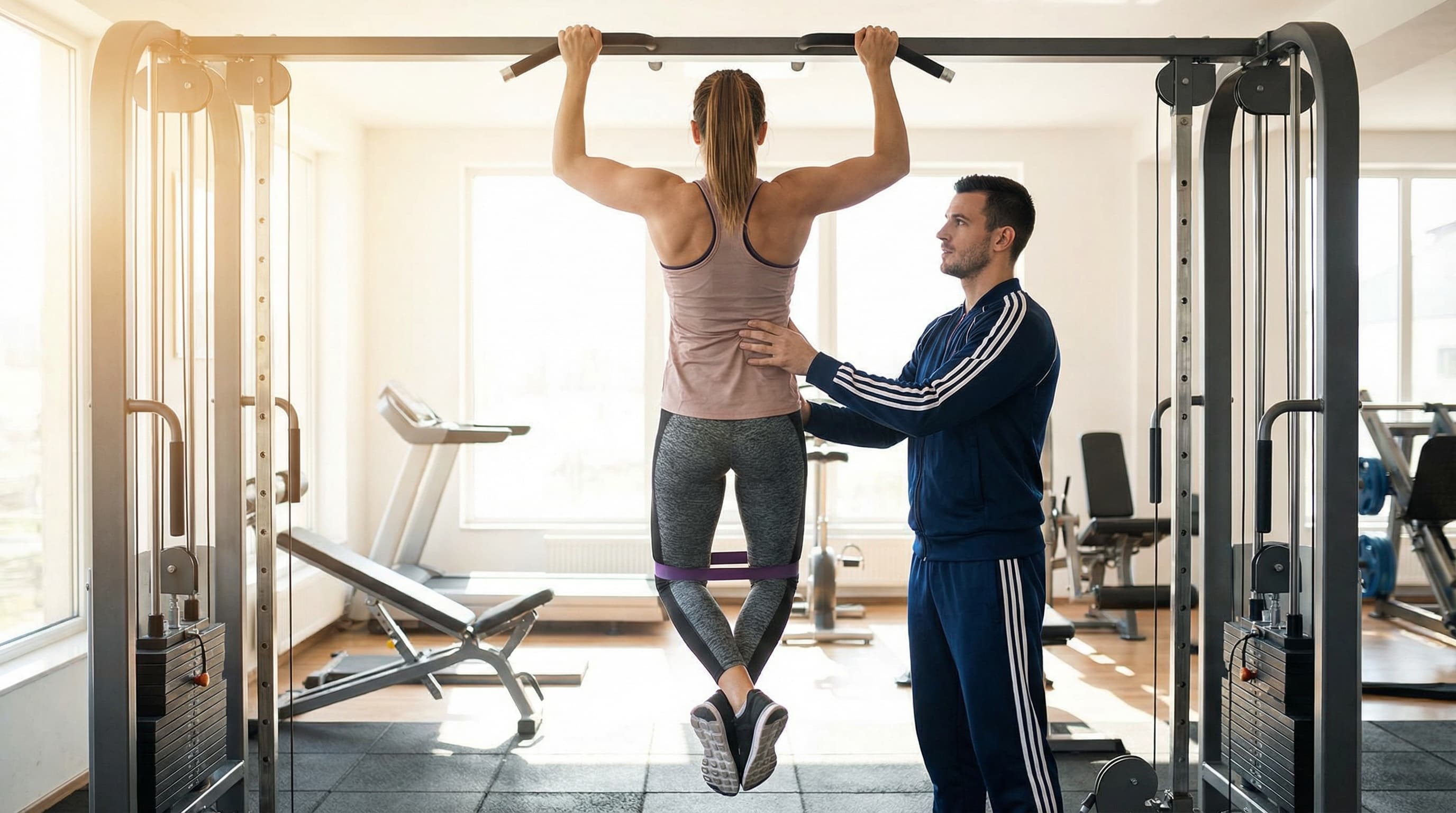
TL;DR — Key Takeaways
- Most beginners get their first pull-up in 8–12 weeks of consistent training (3–4 sessions/week) — heavier individuals or those with less upper body strength may need 12–16 weeks.
- The 5 essential exercises: dead hangs, scapular pull-ups, Australian rows, negative pull-ups, and band-assisted pull-ups — do them in this order.
- You don't need a gym — a $25–40 doorway pull-up bar is enough. The biggest mistake is skipping negative pull-ups (the eccentric phase builds strength fastest).
What is Calisthenics and Why Pull-Ups Matter
Definition: Calisthenics is a form of resistance training that uses your own body weight to build strength, muscle, and functional fitness without external equipment. The pull-up is considered the gold standard of calisthenics movements because it requires significant upper body strength, engages multiple muscle groups simultaneously, and serves as a gateway to advanced skills like muscle-ups and front levers.
The pull-up represents a fundamental human movement pattern—vertical pulling—that most modern lifestyles have eliminated. Unlike isolation exercises in a gym, pull-ups build functional strength that translates to real-world activities: climbing, lifting yourself up, and developing the back strength that prevents poor posture from desk work.
Achieving your first pull-up is transformative because it proves to yourself that consistent training produces results. It's a clear, objective milestone that requires genuine strength—you either can pull your bodyweight up, or you can't. No equipment requirements, no excuses, just you versus gravity.
The Science of Pull-Ups: Biomechanics & Muscle Activation Research
Understanding the biomechanics and research behind pull-up training helps you train smarter and avoid common plateau points:
EMG Studies: Muscle Activation Patterns
Electromyography (EMG) research by Youdas et al. (2010), published in the Journal of Strength and Conditioning Research, measured muscle activation during pull-ups and chin-ups. The latissimus dorsi activated at 117-130% of maximum voluntary contraction (MVIC) — the highest of any muscle tested — followed by the biceps brachii (78-96% MVIC) and infraspinatus (71-79% MVIC). Chin-ups activated the biceps and pectoralis major significantly more than pull-ups, while pull-ups produced greater lower-trapezius activation. Understanding which muscles activate most helps you select assistance exercises that target your weakest links.
Progressive Overload Principles
A comprehensive review by Schoenfeld (2010), published in the Journal of Strength and Conditioning Research, identified mechanical tension, muscle damage, and metabolic stress as the three primary drivers of strength and hypertrophy adaptations — and found that eccentric (lowering) muscle actions produce greater muscle damage than concentric (lifting) actions. For pull-ups, this means gradually increasing time under tension, improving eccentric control, and reducing assistance over time—not just doing more reps of easier variations.
Bodyweight Training Effectiveness
A controlled study by Thomas et al., published in Isokinetics and Exercise Science, put 28 men through an 8-week calisthenics-only program with no equipment. Compared to a non-training control group, the calisthenics group significantly improved posture (p < 0.001 with eyes open, p < 0.05 with eyes closed) alongside measurable gains in strength and body composition—evidence that bodyweight-only training produces real, measurable adaptations without a gym.
Strength-to-Weight Ratio Impact
Studies on relative strength show that pull-up ability correlates strongly with strength-to-weight ratio rather than absolute strength. Kotarsky et al. (2018), published in the Journal of Strength and Conditioning Research, put 23 trained men through 4 weeks of either progressive bodyweight push-up training or traditional barbell bench press. Both groups significantly increased their 1-rep max strength—but the bodyweight group saw significantly larger gains in push-up performance itself, confirming that progressive bodyweight training builds strength just as effectively as external load for a matched movement pattern. The same principle applies to pull-ups: moving your own bodyweight through a full range of motion is what the strength adapts to.
"The biggest mistake we see is athletes treating negatives as an afterthought instead of the main event. Once someone makes the negative pull-up their primary movement instead of just trying—and failing—full reps, they almost always get their first strict pull-up within 3-4 weeks."
What Muscles Do Pull-Ups Work?
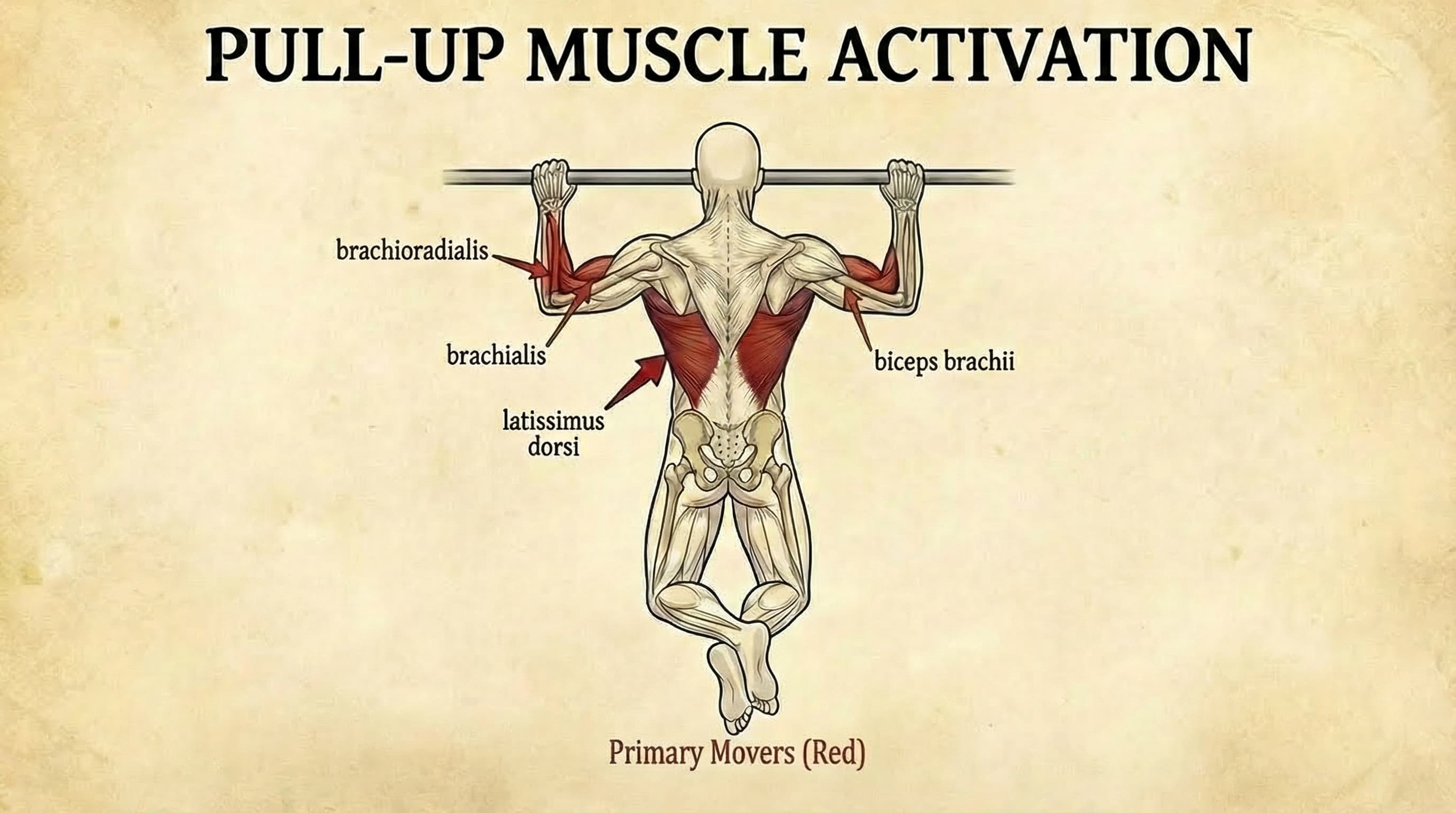
Pull-ups are a compound movement that simultaneously trains multiple muscle groups. Understanding which muscles do the work helps you identify weaknesses and select complementary exercises:
Primary Movers
- Latissimus Dorsi (Lats): The large V-shaped back muscles that produce the majority of pulling force. Weakness here is the #1 reason beginners can't do pull-ups.
- Biceps Brachii: Arm flexors that assist with pulling and become more dominant in chin-up variations (palms facing you).
- Brachialis & Brachioradialis: Deep arm muscles that provide elbow flexion strength throughout the movement.
Secondary Stabilizers
- Rhomboids & Trapezius (Mid-Back): Retract and stabilize your shoulder blades, especially at the top of the movement.
- Rear Deltoids: Shoulder stabilizers that prevent shoulder strain and maintain proper pulling mechanics.
- Core (Abs & Obliques): Prevent swinging and maintain rigid body position throughout the pull.
- Forearms & Grip: Often the limiting factor for beginners—if you can't hang, you can't pull.
Assessing Your Starting Point
Before beginning training, assess where you currently stand. This determines which progression level is appropriate and sets realistic timelines:
Test 1: Dead Hang Hold
How: Hang from a pull-up bar with arms fully extended. Time how long you can hold before grip fails.
- 0-10 seconds: Absolute beginner—start with grip strength work
- 10-30 seconds: Beginner—start with basic progressions
- 30-60 seconds: Intermediate—ready for assisted pull-ups
- 60+ seconds: Advanced—focus on negative pull-ups
Test 2: Scapular Pull-Up
How: Hang from bar, then pull shoulder blades down and back (shrugging in reverse) without bending elbows. This engages your lats.
- Can't do it: Need to develop mind-muscle connection with lats
- 1-3 reps: Lat activation is weak—prioritize this movement
- 5-10 reps: Good foundation—proceed with standard progressions
- 10+ reps: Strong activation—ready for more advanced work
Test 3: Negative Pull-Up (Eccentric)
How: Jump or step to the top position (chin over bar), then lower yourself as slowly as possible. Time the descent.
- Drop immediately: Not ready yet—build more base strength
- 3-5 seconds: Close—negatives will be your primary progression
- 5-10 seconds: Very close—you'll likely achieve pull-up in 4-6 weeks
- 10+ seconds: You're ready—attempt full pull-up today
Test 4: Inverted Row (Australian Pull-Up)
How: Hang under a sturdy table or low bar with body straight, feet on ground. Pull chest to bar. Count max reps.
- 0-3 reps: Absolute beginner—this is your starting exercise
- 5-10 reps: Beginner—ready for mixed progressions
- 10-15 reps: Intermediate—add harder progressions
- 15+ reps: Strong horizontal pull—focus on vertical progressions
8-12 Week Progressive Pull-Up Program
Get a Weekly Plan Built Around Your First Pull-Up
Choose your current level, available days, and equipment, and Odin will schedule pulling practice alongside balanced full-body training.
Build My Pull-Up PlanPull-Up Exercise Progressions: Beginner to First Rep
These progressions build the specific strength and movement patterns needed for pull-ups. Master each level before progressing to the next:
Common Mistakes That Prevent Pull-Up Progress
Skipping Progressive Steps
The Mistake: Attempting full pull-ups before building foundation strength. Repeatedly failing doesn't build strength—it builds frustration.
The Fix: Follow the progression ladder. Master dead hangs and scapular pulls before attempting negatives. There are no shortcuts—each step builds specific strength.
Training Too Frequently
The Mistake: Doing pull-up training every day, thinking more = faster progress. Actually causes overtraining and prevents recovery.
The Fix: Train pull-ups 3-4 times per week maximum. Muscles grow during rest, not during training. Allow 48-72 hours between pull-up sessions.
Using Too Much Assistance for Too Long
The Mistake: Staying comfortable with heavy resistance bands or assisted machines. The assistance is doing too much work—you're not building real strength.
The Fix: Progressively reduce assistance every 1-2 weeks. If you can do 10+ reps with a band, it's time to use lighter assistance or switch to negatives.
Neglecting Eccentric (Negative) Training
The Mistake: Only practicing concentric pulling (trying to pull up) while ignoring lowering strength. Negatives build strength faster.
The Fix: Make negative pull-ups your primary progression once you've built basic strength. Aim for 10+ second controlled descents. This is the fastest path to your first pull-up.
Using Momentum/Kipping
The Mistake: Swinging, kicking, or using leg drive to complete reps. This isn't building strength—it's compensating for weakness.
The Fix: Master strict, controlled pull-ups first. Kipping is an advanced technique for conditioning (used in CrossFit), not strength building. Strict form = strength gains.
Ignoring Bodyweight Management
The Mistake: Trying to build pull-up strength while gaining significant weight. Every pound of bodyweight makes pull-ups harder.
The Fix: You don't need to be shredded to do pull-ups, but maintaining a reasonable body composition helps. Focus on building muscle while staying at a stable weight or slight deficit.
Poor Scapular Control
The Mistake: Pulling with arms only, not engaging lats and scapula first. This creates shoulder strain and limits pulling power.
The Fix: Every pull-up starts with scapular engagement (shoulder blade depression). Practice scapular pull-ups until it's automatic. Think "shoulders down and back" before bending elbows.
Nutrition and Recovery for Pull-Up Strength Gains
Training provides the stimulus, but nutrition and recovery determine whether you actually get stronger. These factors are often overlooked by beginners:
Protein Requirements
Target: 0.7-1.0g protein per pound of bodyweight daily for muscle repair and growth. A 150lb person needs 105-150g protein per day. See our complete protein intake guide for the full breakdown.
- Focus on post-workout protein (20-30g within 2 hours)
- Distribute protein across 3-4 meals (not all at once)
- Good sources: chicken, fish, eggs, Greek yogurt, beans, tofu
Caloric Balance
For Strength Gain: Eat at maintenance or slight surplus (200-300 calories above maintenance). Hard to build muscle in a deficit.
For Weight Loss + Strength: Modest deficit (300-500 calories below maintenance) with high protein. Progress will be slower but still achievable.
Sleep Requirements
Target: 7-9 hours per night. Sleep is when muscle repair and nervous system recovery occur. Poor sleep = poor gains. See our complete sleep schedule guide for a 7-day reset protocol.
- Consistent sleep schedule (same bedtime/wake time)
- Cool, dark room (65-68°F optimal)
- Avoid screens 1 hour before bed
Active Recovery
Between Sessions: Light activity promotes blood flow and recovery without adding fatigue. Don't sit completely still on rest days.
- Walking (20-30 minutes)
- Mobility work and stretching
- Light yoga or bodyweight movement
Hydration
Target: Half your bodyweight in ounces daily (150lb person = 75oz water). Dehydration reduces strength and increases injury risk.
Drink 16-20oz water 2 hours before training. Sip water during workout. Rehydrate afterward.
Deload Weeks
Every 4-6 Weeks: Reduce training volume by 40-50% for one week. This allows full recovery and prevents accumulated fatigue.
Deload ≠ rest completely. Do same exercises with less volume/intensity. You'll come back stronger.
Frequently Asked Questions
How long does it take to go from zero to first pull-up?
Can I learn pull-ups without any equipment at home?
What muscles do pull-ups work and how should I train them?
Should I lose weight before attempting pull-ups?
What's the difference between chin-ups and pull-ups for beginners?
Why can't I do a pull-up even though I'm strong in other exercises?
Build a Week That Moves You Toward Your First Pull-Up
Choose whether you have a pull-up bar, plus your schedule and experience, and Odin will create a balanced weekly progression plan.
Build My Free Weekly Plan