
The Science of Progressive Overload with Bodyweight Training
Build muscle and strength without weights using research-backed progressive overload methods. Learn the science behind bodyweight training adaptations and 8 proven strategies for continuous gains.
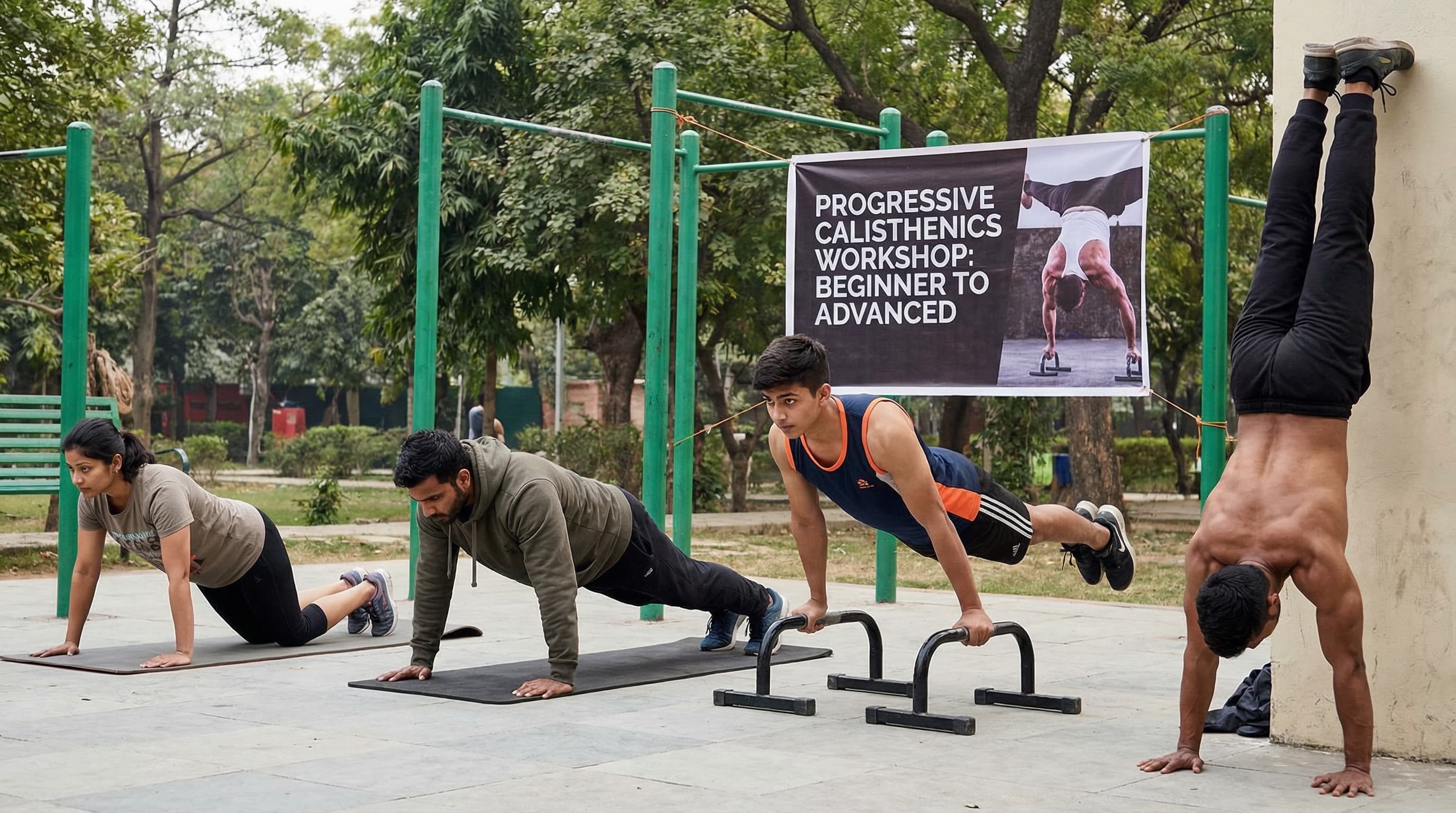
TL;DR — Key Takeaways
- Progressive overload is non-negotiable for muscle growth — in calisthenics, you increase difficulty rather than add weight, using 8 proven methods.
- The 8 methods: reps, sets, tempo, leverage, range of motion, isometrics, rest periods, and external load — each works independently or in combination.
- Use the double-progression model: increase reps within your range first (e.g. 8→12), then advance to a harder variation and reset — the most sustainable method for beginners and intermediates.
What is Progressive Overload?
Definition: Progressive overload is the gradual increase of stress placed on the body during training. It is the fundamental principle behind all strength and muscle gains—by systematically challenging your muscles beyond their current capacity, you force physiological adaptations that result in increased strength, muscle mass, and performance.
The concept is simple but powerful: to continue improving, you must make your training progressively more demanding over time. Your muscles adapt to the specific demands placed on them (a principle called Specific Adaptation to Imposed Demands, or SAID). If you do the same workout with the same difficulty month after month, your body has no reason to change—it's already adapted to that level of stress.
In traditional weightlifting, progressive overload is straightforward: add more weight to the bar. You bench press 135 lbs this month, 140 lbs next month, 145 lbs the month after. The progression is linear and measurable. But with bodyweight training, you can't simply "add more bodyweight." This leads many people to mistakenly believe that calisthenics has limited progression potential. The truth is the opposite—bodyweight training offers more progression variables than weights, you just need to understand how to manipulate them.
The Science of Muscle Adaptation: How Progressive Overload Builds Strength
Understanding the mechanisms behind progressive overload helps you train more effectively and troubleshoot when progress stalls:
Mechanical Tension (Primary Driver)
Research by Schoenfeld (2010), published in the Journal of Strength and Conditioning Research identified mechanical tension as the most important stimulus for muscle growth. When you perform a challenging exercise, the mechanical load creates tension in muscle fibers, triggering molecular signaling pathways (mTOR, particularly) that initiate protein synthesis. Time under tension—how long muscles work against resistance—is a key variable in bodyweight training.
Metabolic Stress
Metabolic stress occurs when muscles work to the point of significant metabolite accumulation (lactate, hydrogen ions, inorganic phosphate). This creates the "burn" you feel during high-rep sets. Schoenfeld (2013), published in Sports Medicine outlines how this contributes to hypertrophy through increased fiber recruitment, elevated hormonal response, and cell swelling. Higher-rep bodyweight work excels at creating metabolic stress.
Muscle Damage and Recovery
Exercise-induced muscle damage (micro-tears in muscle fibers) triggers repair processes that result in stronger, larger muscles. Eccentric (lowering) training creates more muscle damage than concentric (lifting) training. A study in the Journal of Sports Science & Medicine found eccentric muscle damage can be up to 3.7 times greater per unit of muscle worked than the equivalent concentric load, depending on the muscle group—slow negatives in bodyweight exercises (like 5-10 second push-up descents) tap directly into this adaptation.
Neural Adaptations
Early strength gains (first 4-8 weeks) come primarily from neural adaptations: improved motor unit recruitment, rate coding, and inter-muscular coordination. Del Vecchio et al. (2019), published in The Journal of Physiology directly measured this: after just 4 weeks of strength training, force gains were driven by increased motor unit discharge rate and lower recruitment thresholds—your nervous system learning to activate more muscle fibers simultaneously, crucial for skill-based calisthenics progressions.
The practical takeaway: Your body doesn't know whether resistance comes from a barbell or your own bodyweight. It only knows that muscles are working against resistance. As long as you progressively increase that resistance through any of the methods we'll discuss, you'll trigger the same adaptation mechanisms that drive muscle and strength gains. A controlled study by Thomas et al., published in Isokinetics and Exercise Science put 28 men through 8 weeks of calisthenics-only training and found significant strength, posture, and body composition gains compared to a non-training control group—confirming that equipment-free training produces real, measurable adaptations.
"The plateau I see most often isn't a strength plateau, it's a variety plateau. Someone's been doing the same push-up for three months and wondering why nothing changes—but they've never touched tempo, leverage, or range of motion. Reps are just one of eight levers. Most people are only pulling one."
Progressive Overload: Bodyweight vs. Weights
Understanding the differences in how progressive overload applies to bodyweight training versus weight training helps you leverage the unique advantages of calisthenics:
| Variable | Weight Training | Bodyweight Training |
|---|---|---|
| Adding Resistance | Simple: add weight plates incrementally (2.5-5 lb jumps) | Complex: change leverage, angles, stability, or add external weight |
| Progression Measurement | Precise: exact weight lifted (135 lbs → 140 lbs) | Qualitative: variation difficulty (regular push-up → archer push-up) |
| Equipment Requirements | High: barbell, plates, rack, bench, space | Low to none: pull-up bar optional, otherwise just floor space |
| Skill Component | Low: most movements are straightforward | High: advanced variations require significant skill and coordination |
| Progression Variables | Limited: mainly weight, reps, sets, tempo | Extensive: leverage, tempo, range of motion, stability, variations, isometrics, reps, sets |
| Accessibility | Low: requires gym membership or home equipment investment | High: train anywhere with minimal to no equipment |
| Joint Stress | Higher: external load can exceed safe joint capacity | Lower: self-limiting (can't load beyond bodyweight without intent) |
| Functional Carryover | Moderate: specific to movement patterns trained | High: movements closely mirror real-world activities |
The Bodyweight Advantage
While weights offer simple, linear progression, bodyweight training provides more progression variables and greater accessibility. The challenge isn't whether you can progress with bodyweight—it's understanding which progression method to use and when. The skill development required for advanced calisthenics also builds exceptional body control and coordination that weight training often neglects.
8 Methods to Progressive Overload with Bodyweight Training
These are the primary methods to progressively overload calisthenics exercises. Use them individually or combine multiple methods for optimal results:
- Increase Reps (Volume Progression)
What It Is: Performing more repetitions of the same exercise while maintaining proper form. This is the most straightforward progression method.
How to Apply: Choose a rep range based on your goal (8-12 for hypertrophy, 5-8 for strength, 15-20+ for endurance). Start at the bottom of the range. Each week, add 1-2 reps per set until you hit the top of the range.
Example: Week 1: 3 sets × 8 push-ups. Week 2: 3 sets × 9 push-ups. Week 3: 3 sets × 10 push-ups... Week 5: 3 sets × 12 push-ups. Then progress to harder variation.
Research Backing: Studies show that increasing volume (sets × reps) within a session or across weeks is one of the most reliable methods for hypertrophy. A 2017 meta-analysis by Schoenfeld, Ogborn & Krieger in the Journal of Sports Sciences found a significant dose-response relationship (p = 0.002): each additional weekly set was associated with roughly a 0.37% increase in muscle growth.
- Increase Sets (Volume Progression)
What It Is: Adding more sets to your workout, increasing total volume while keeping reps per set constant.
How to Apply: Start with 2-3 sets per exercise. Every 1-2 weeks, add an additional set (up to 4-6 sets for main movements). More sets = more total work = greater adaptation stimulus.
Example: Week 1-2: 3 sets × 10 pull-ups. Week 3-4: 4 sets × 10 pull-ups. Week 5-6: 5 sets × 10 pull-ups.
Important Note: There's a point of diminishing returns. Beyond 6-8 hard sets per muscle group per session, additional sets may cause more fatigue than they provide benefit. Quality over quantity.
- Decrease Leverage (Mechanical Disadvantage)
What It Is: Changing body position or limb placement to make the exercise mechanically harder without changing reps or sets. This is the most powerful bodyweight progression method.
How to Apply: Move hands/feet wider, narrower, higher, lower, or to one side. Reduce points of contact (two-arm to one-arm). Change body angle relative to gravity.
Examples:
- Push-ups: Regular → Feet Elevated → Diamond → Archer → One-Arm
- Squats: Regular → Bulgarian Split → Shrimp → Pistol
- Rows: High Angle → Horizontal → Archer → One-Arm
- Planks: Forearms → Extended Arms → Single Arm → Single Arm + Leg
Why This Works: By changing leverage, you alter the resistance curve and moment arm length, effectively increasing the load your muscles must overcome. Physics research shows that moving from two-arm to one-arm movements doesn't just halve the load—it often increases it due to stability demands.
- Slow Down Tempo (Time Under Tension)
What It Is: Controlling the speed of each rep phase (concentric, isometric, eccentric) to increase time under tension (TUT). Muscles work longer, creating more metabolic stress.
How to Apply: Use tempo notation: 3-1-3-1 means 3 seconds lowering (eccentric), 1 second pause at bottom, 3 seconds raising (concentric), 1 second pause at top. Slow eccentrics (5-10 seconds) are especially effective.
Example: Regular push-ups become significantly harder with 5-second descent. A set of 8 push-ups goes from ~15 seconds to ~60 seconds of work.
Research Support: A 2017 systematic review and meta-analysis by Schoenfeld et al. in the Journal of Strength and Conditioning Research found eccentric-focused training (slow negatives) produced greater increases in muscle girth than concentric-focused training. Tempo manipulation is particularly effective for bodyweight exercises.
- Increase Range of Motion (ROM)
What It Is: Performing exercises through a greater distance of movement, increasing the work done and muscle stretch.
How to Apply: Use deficit positions (hands on blocks for deeper push-ups), increase depth (ass-to-grass squats vs. parallel), or add stretching components (archer push-ups with deep stretch).
Examples:
- Push-ups: Hands on floor → Hands on parallettes (4-6 inches deeper ROM)
- Pull-ups: Chin over bar → Chest to bar → Sternum to bar
- Dips: Partial ROM → 90° elbow bend → Deep dip (shoulder below elbow)
Hypertrophy Benefit: A 2020 systematic review in SAGE Open Medicine (6 studies, 135 participants) found training through a full range of motion produces superior lower-body muscle growth compared to partial ROM, particularly due to increased muscle stretch under load.
- Add Isometric Holds/Pauses
What It Is: Pausing at the most difficult point of an exercise (often the bottom position or mid-range) to increase time under tension and eliminate momentum.
How to Apply: Add 2-5 second pauses at strategic points: bottom of push-up, bottom of squat, chin-over-bar position on pull-up, top of dip, etc.
Example: Regular squats → Pause squats (3-second hold at bottom). Pull-ups → Pull-ups with 2-second hold at top. These pauses dramatically increase difficulty.
Strategic Benefit: Pauses eliminate the stretch reflex and momentum, forcing muscles to produce force from a dead stop. This builds "sticking point" strength and increases difficulty without changing exercises.
- Decrease Rest Time (Density Training)
What It Is: Reducing rest periods between sets while maintaining the same reps/sets, increasing work density and metabolic demand.
How to Apply: Start with 2-3 minute rest between sets. Each week, reduce rest by 15-30 seconds. Eventually work down to 60-90 seconds for hypertrophy, 30-60 seconds for endurance.
Example: Week 1: 3 sets × 10 push-ups, 2 min rest. Week 2: 3 sets × 10 push-ups, 90 sec rest. Week 3: 3 sets × 10 push-ups, 60 sec rest. Same work, less time = greater intensity.
Best For: This method excels for conditioning and work capacity. However, it shouldn't be your primary progression method for strength—shorter rest can compromise performance on subsequent sets.
- Add External Load
What It Is: Adding weight to bodyweight exercises through weighted vests, resistance bands, weight plates, or other implements.
How to Apply: Once you can perform 12-15 reps of a bodyweight exercise with perfect form, add 5-10 lbs and work back up through your rep range. Common methods: weighted vest for push-ups/pull-ups/dips, backpack with books/weight plates, resistance bands for squats.
Examples:
- Pull-ups: Bodyweight × 15 reps → +10 lbs × 8 reps → +10 lbs × 12 reps → +20 lbs × 8 reps
- Push-ups: Add weight vest or have partner place plate on back
- Pistol squats: Hold dumbbell or kettlebell
Hybrid Approach: Adding external load to bodyweight exercises gives you the best of both worlds: the functional movement patterns of calisthenics with the precise progressive overload of weights. This is particularly effective for pull-ups, dips, and push-ups.
Practical Application: Creating Your Progression Plan
Understanding progression methods is useless without a plan to apply them. Here's how to structure progressive overload in your bodyweight training:
The Double Progression Method (Recommended for Beginners)
How it works: Progress reps first, then exercise difficulty. This is the simplest, most sustainable approach.
Step 1: Choose an exercise variation you can perform for 8-12 reps with good form.
Step 2: Each week, add 1-2 reps per set while maintaining form.
Step 3: When you can complete 3 sets of 12 reps (top of range), progress to a harder variation.
Step 4: Drop back to 8 reps with the new variation and repeat the cycle.
Example: Push-up Progression
- Week 1-3: Incline push-ups, progress 8→12 reps
- Week 4-7: Regular push-ups, progress 8→12 reps
- Week 8-11: Diamond push-ups, progress 8→12 reps
- Week 12-15: Archer push-ups, progress 8→12 reps
Linear Periodization (Intermediate to Advanced)
How it works: Cycle through different rep ranges (strength, hypertrophy, endurance) across training blocks, manipulating multiple variables.
Strength Phase (4 weeks)
- • Harder variations
- • 5-8 reps
- • 4-5 sets
- • 3-4 min rest
- • Slow tempo (4-2-1)
Hypertrophy Phase (4 weeks)
- • Moderate variations
- • 8-12 reps
- • 3-4 sets
- • 60-90 sec rest
- • Controlled tempo
Endurance Phase (4 weeks)
- • Easier variations
- • 15-20+ reps
- • 2-3 sets
- • 30-60 sec rest
- • Faster tempo
Sample 12-Week Progressive Overload Program
Here's a complete example showing how to combine multiple progression methods:
| Weeks | Push-ups | Pull-ups | Squats | Progression Method |
|---|---|---|---|---|
| 1-3 | 3×8-12 Regular | 3×5-8 Negatives | 3×12-15 Regular | Increase reps |
| 4-6 | 3×8-12 Diamond | 3×3-5 Full | 3×8-12 Bulgarian | Harder variation, increase reps |
| 7-9 | 4×8-12 Diamond (tempo 3-1-3) | 4×5-8 Full | 3×8-12 Pistol (assisted) | Add set, add tempo, increase reps |
| 10-12 | 4×8-12 Archer | 4×8-12 Full (+5 lbs) | 3×8-12 Pistol (full) | Harder variation, add weight, increase reps |
Tracking Progress and Measuring Gains
Progressive overload requires tracking. What gets measured gets managed. Here's how to track bodyweight training progress effectively:
Workout Log (Essential)
Record: Date, exercise variation, sets, reps, tempo, rest time, subjective difficulty (RPE 1-10)
Example Entry:
Jan 15, 2026
Diamond Push-ups: 3×10, 3×9, 3×8 (tempo 2-0-2, 90s rest)
RPE: 8/10
Notes: Last set form breakdown on rep 8
Performance Benchmarks
Test monthly: Max reps of standard exercises (push-ups, pull-ups, squats, dips) to gauge overall strength progress
- Max push-ups in one set
- Max pull-ups in one set
- Max bodyweight squats in 2 minutes
- Plank hold duration
- Dead hang duration
Body Measurements
Measure biweekly: While performance is primary, body composition changes indicate muscle growth
- Bodyweight (same time/conditions)
- Chest, arms, waist, thighs circumference
- Progress photos (same lighting/pose)
- Body fat % (if accessible)
Skill Progressions
Track milestones: Achieving new exercise variations is a clear progression marker unique to calisthenics
- First pull-up achieved
- First pistol squat
- First archer push-up
- First L-sit hold (5+ seconds)
- First handstand against wall (30+ seconds)
Common Progressive Overload Mistakes with Bodyweight Training
Progressing Too Fast (Ego Training)
The Mistake: Jumping to harder variations before mastering current ones. Attempting one-arm push-ups when you can barely do 10 regular push-ups. Sacrificing form for difficulty.
The Fix: Meet progression criteria before advancing: 3 sets of 12 reps with perfect form, controlled tempo, full ROM. If your form breaks down, you're not ready. Master fundamentals first.
Not Tracking Workouts
The Mistake: Training without a log, doing "whatever feels right," can't remember last week's numbers. Progressive overload requires knowing what to progress from.
The Fix: Use a simple notebook, spreadsheet, or app (like Odin). Record every workout. Review previous session before training. Aim to beat at least one metric each session.
Only Increasing Reps (Volume Trap)
The Mistake: Doing 50+ push-ups per set instead of progressing to harder variations. Endless reps build endurance, not strength or muscle beyond a point.
The Fix: Once you hit 15-20 reps, progress to a harder variation and drop back to 8-12 reps. Exception: if your goal is specifically endurance, high reps are appropriate.
Ignoring Recovery
The Mistake: Training same muscles daily without rest. "More is better" mentality. Muscles grow during recovery, not during training.
The Fix: Train each muscle group 3-4 times per week maximum. Allow 48-72 hours between sessions. Prioritize sleep (7-9 hours) and nutrition (adequate protein and calories).
Inconsistent Training
The Mistake: Training intensely for 2 weeks, then skipping 2 weeks. Sporadic effort produces sporadic results. Progressive overload requires consistency.
The Fix: Commit to minimum viable consistency: 3 sessions per week, every week, for 12 weeks minimum. Missing one session is fine; missing patterns is problematic. Build habits, not heroic efforts.
Neglecting Weak Points
The Mistake: Only training movements you're good at. Avoiding weaknesses leads to imbalances and injury.
The Fix: Identify weak patterns (typically: vertical pulling for most people, single-leg work). Dedicate specific training volume to weaknesses. Balance push/pull, upper/lower, bilateral/unilateral movements.
No Deload Weeks
The Mistake: Pushing hard every week without planned recovery. Accumulated fatigue eventually leads to plateau, injury, or burnout.
The Fix: Every 4-6 weeks, take a deload week: reduce volume by 40-50% (fewer sets), maintain intensity (same exercises). Your body supercompensates during deloads—you'll come back stronger.
Frequently Asked Questions
What is progressive overload in bodyweight training?
How do you apply progressive overload without weights?
Is progressive overload necessary for building muscle with calisthenics?
How often should I increase difficulty in bodyweight training?
Can you build muscle with progressive overload and no equipment?
What's the difference between progressive overload and progressive calisthenics?
How do I know if I'm progressing too fast or too slow?
Apply Progressive Overload Across Your Week
Choose your goal, schedule, and experience level, and Odin will create a bodyweight plan with clear progression guidance.
Build My Free Weekly Plan