
Can You Build Muscle With Bodyweight Training?
The short answer is yes—and the research backs it up. Learn the science of calisthenics muscle growth, how progressive overload works without weights, and exactly how to program for maximum hypertrophy.
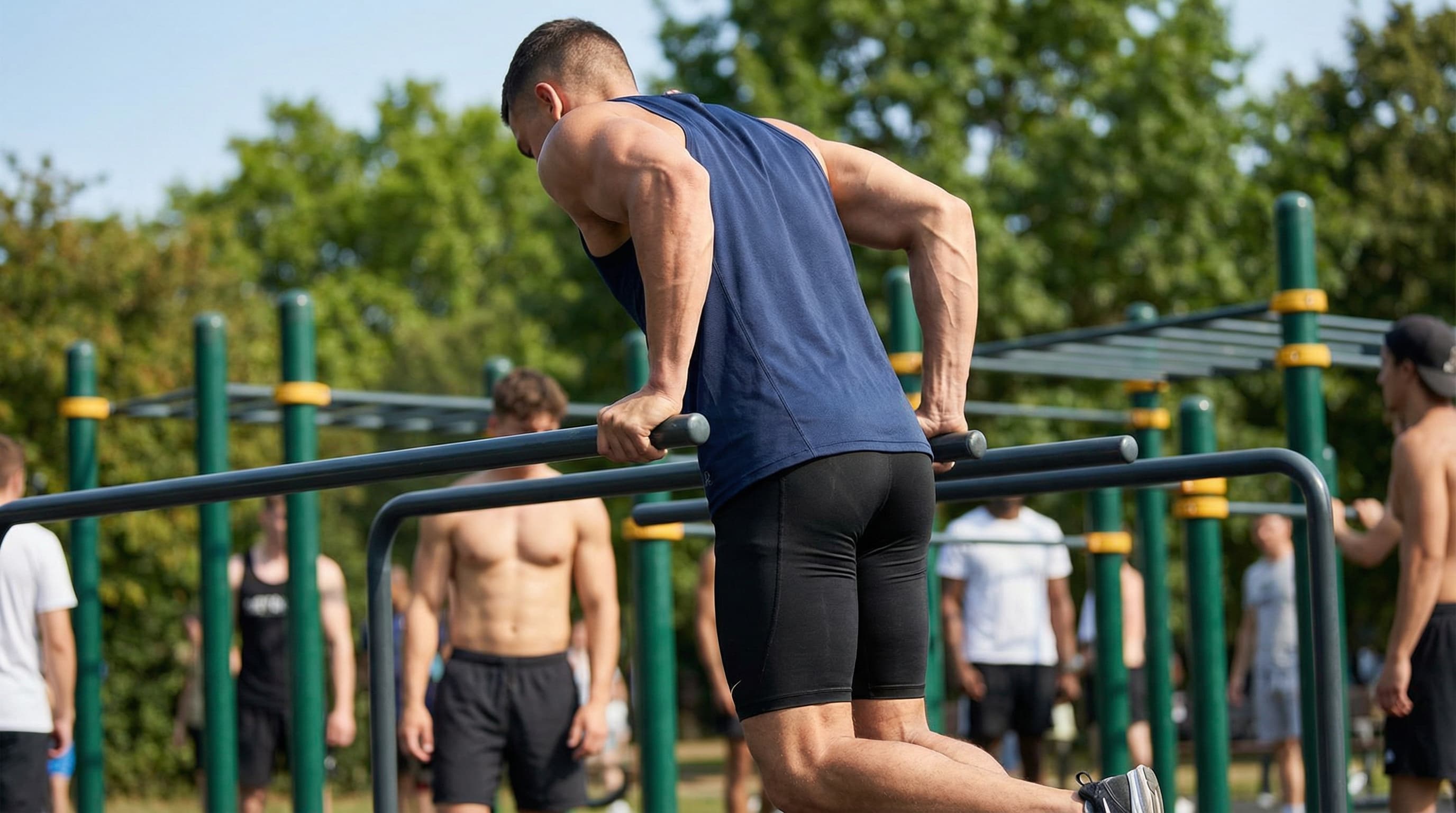
TL;DR: Can You Build Muscle With Bodyweight Training?
- Yes, definitively. A 2017 load-matched study found push-ups produced strength and muscle-thickness gains statistically similar to the bench press over 8 weeks.
- Progressive overload—not equipment—is the mechanism that drives muscle growth. Bodyweight training has more progression variables than weights.
- Upper body gains (chest, back, shoulders, arms) are fully achievable. Lower body development requires deliberate progression to unilateral exercises (pistol squats, Nordic curls).
- Beginners typically notice strength changes in 4–6 weeks and visible muscle growth in 8–12 weeks of consistent training.
- Nutrition (1.6–2.2 g protein/kg bodyweight) and sleep (7–9 hours) are non-negotiable—training stimulus alone is insufficient.
What Does the Research Say About Bodyweight Training and Muscle Growth?
The direct answer: Yes, bodyweight training builds real, measurable muscle. A 2017 study by Kikuchi and Nakazato in the Journal of Exercise Science & Fitness load-matched push-ups against the bench press at 40% of one-rep max and found both produced statistically similar gains in strength and muscle thickness over an 8-week period.
The persistent myth that bodyweight training is only for cardio or weight loss—not muscle building—is contradicted by decades of exercise science. Muscles cannot distinguish between resistance from a barbell and resistance from a challenging bodyweight movement. What matters is mechanical tension, metabolic stress, and progressive overload—all of which are achievable with calisthenics.
What the research also confirms is that beginners gain muscle fastest, regardless of training method. The first weeks of any resistance training program—bodyweight or barbell—are dominated by neural adaptations: your nervous system gets better at recruiting the muscle fibers you already have, which is why strength climbs quickly before visible size follows. That means your starting point is an advantage, not a liability.
How Do Muscles Actually Grow? The Science of Hypertrophy
Muscle hypertrophy is the increase in muscle fiber size resulting from training stress. According to Schoenfeld (2010) in the Journal of Strength and Conditioning Research, three primary mechanisms drive muscle growth—all of which bodyweight training triggers effectively:
Mechanical Tension
The primary driver of muscle growth. When muscles work against resistance under stretch and contraction, tension activates mechanosensitive pathways (particularly mTORC1) that trigger protein synthesis. Challenging bodyweight movements—archer push-ups, pistol squats, pull-ups—create high mechanical tension without external weight.
Metabolic Stress
The accumulation of metabolites (lactate, hydrogen ions, inorganic phosphate) during high-rep sets creates a hormonal environment favorable to growth. This is the "pump" and burn you feel during bodyweight circuits. Schoenfeld's (2010) review describes this as a secondary contributor to hypertrophy through cell swelling and anabolic hormone release, working alongside—not instead of—mechanical tension.
Muscle Damage
Microscopic tears in muscle fibers (particularly during the eccentric/lowering phase) trigger a repair response that produces larger, stronger fibers, per the same Schoenfeld (2010) review. Slow eccentrics increase time under tension and are a reasonable way to bias this mechanism, though a 2022 study in Biology of Sport found eccentric tempo made little difference to overall leg hypertrophy—so treat slow eccentrics as one useful tool, not a requirement.
How Does Progressive Overload Work Without Weights?
Progressive overload is the systematic increase of training stress over time. It is the single non-negotiable requirement for building muscle—more important than any specific exercise, rep range, or training style. Without it, your body has no reason to adapt.
With weights, progression is linear: add 2.5–5 lbs to the bar. With bodyweight training, progression is multidimensional. This is actually an advantage—bodyweight training offers more progression variables than traditional weightlifting:
Exercise Variation Progression
Move to mechanically harder versions of the same movement. Regular push-up → Diamond push-up → Archer push-up → One-arm push-up. Each variation increases the load on target muscles without adding external weight.
Example: Push-up → Diamond → Archer → One-Arm
Rep and Set Progression
Increase total volume within a session. Start at 3 × 8, progress to 3 × 12, then add a fourth set, or progress to a harder variation. Research confirms a dose-response relationship between training volume and hypertrophy.
Example: 3 × 8 → 3 × 12 → 4 × 12 → harder variation
Tempo Manipulation
Slowing the eccentric (lowering) phase from 1 second to 5 seconds increases time under tension on the same movement. Evidence on whether this alone boosts hypertrophy is mixed—a 2022 study found tempo made little difference to overall leg growth—but it remains a useful way to add difficulty without a harder exercise variation.
Example: Normal speed → 3-second eccentric → 5-second eccentric
Leverage Changes
Changing body position alters the effective load. Feet-elevated push-ups shift more weight to the shoulders. Narrow-grip pull-ups increase bicep recruitment. Single-leg progressions nearly double the load on each leg.
Example: Two-arm → Archer (75% one-arm) → One-arm
Isometric Holds
Adding 2–5 second pauses at the hardest point of the movement (bottom of push-up, chin over bar) eliminates momentum and dramatically increases muscular demand without changing the exercise.
Example: Standard pull-up → Pull-up with 3-second top hold
Range of Motion Expansion
Deficit push-ups (hands on parallettes or books) increase depth, working the chest through a greater stretch. Research indicates that full range of motion training produces superior hypertrophy compared to partial ROM.
Example: Floor push-up → Parallette push-up (4+ inches deeper)
Bodyweight vs. Weights: Which Builds More Muscle?
A direct comparison of bodyweight training versus weight training for muscle hypertrophy, based on current exercise science:
| Factor | Bodyweight Training | Weight Training |
|---|---|---|
| Upper Body Hypertrophy | Excellent — push/pull progressions match gym results | Excellent — straightforward loading |
| Lower Body Hypertrophy | Good — requires advanced unilateral progressions (pistol squats, Nordic curls) | Excellent — barbell loading is straightforward |
| Equipment Cost | Zero to minimal (optional pull-up bar: ~$30) | $500–$2,000+ (home gym) or $40–$80/month (gym membership) |
| Location Flexibility | Train anywhere — hotel rooms, parks, home | Requires access to gym or home equipment |
| Progression Clarity | Requires understanding exercise variation ladders | Simple: add weight to the bar |
| Joint Safety | Self-limiting load reduces injury risk | External load can exceed safe joint capacity |
| Functional Strength Carryover | High — movements mirror real-world activities | Moderate — specific to loaded movement patterns |
| Skill Development | High — handstands, muscle-ups, planches add athleticism | Limited beyond technique refinement |
| Research-Proven Muscle Growth | Yes (Kikuchi & Nakazato, 2017) | Yes (extensive literature) |
"The question we get most isn't 'can bodyweight training build muscle'—it's whether people will actually stick with it long enough to find out. The exercise science already says yes on the first question. Program design solves the second."
How Much Muscle Can You Actually Build With Bodyweight Training?
Muscle gain rates are determined primarily by training experience, genetics, nutrition, and consistency—not by whether you use weights or bodyweight. Research provides realistic benchmarks:
1–2 lbs
Per Month (Beginner)
0–2 years of training. Highest rate of muscle gain. Neural adaptations drive rapid early strength improvements before visible hypertrophy.
0.5–1 lb
Per Month (Intermediate)
2–5 years of training. Consistent progressive overload becomes critical. Gains are slower but still significant over a 12-month horizon.
0.25 lb
Per Month (Advanced)
5+ years of training. Approaching genetic ceiling. Periodization and advanced techniques (loaded calisthenics, skill work) maintain progress.
These rates assume optimal conditions: adequate protein intake, a slight caloric surplus (200–300 calories above maintenance), 7–9 hours of sleep, and consistent progressive overload. The protein figure comes from a 2018 meta-analysis by Morton et al. in the British Journal of Sports Medicine, which found additional muscle gains plateau above roughly 1.6 g/kg/day, with a 95% confidence interval extending to about 2.2 g/kg/day. The monthly muscle-gain figures above are commonly cited practitioner benchmarks rather than a single study's output—actual rates vary by individual.
The Best Bodyweight Exercises for Building Muscle
Effective muscle-building requires compound movements that recruit multiple muscle groups and offer clear progression ladders. These are the most effective bodyweight exercises organized by movement pattern:
Horizontal Push (Chest, Shoulders, Triceps)
Push-Up Progression
Progression: Wall → Incline → Regular → Diamond → Feet-Elevated → Archer → One-Arm
Slow 3-second descents maximize chest activation. Keep elbows at 45° to protect shoulders.
Vertical Pull (Back, Biceps)
Pull-Up Progression
Progression: Dead Hang → Negatives → Jumping Pull-Ups → Full Pull-Ups → Chest-to-Bar → Archer → One-Arm
Pull-ups build more back thickness than any weight machine. Supinated grip (chin-up) increases bicep recruitment.
Horizontal Pull (Upper Back, Rear Delts)
Row Progression
Progression: High-Angle Inverted Row → Horizontal Row → Feet-Elevated Row → Archer Row → One-Arm Row
Use a sturdy table or low bar. Rows build the mid-back muscles that pull-ups alone neglect.
Vertical Push (Shoulders, Triceps)
Pike Push-Up / Handstand Push-Up Progression
Progression: Pike Push-Up → Elevated Pike → Headstand Hold → Wall Handstand Push-Up → Freestanding Handstand Push-Up
Pike push-ups are one of the most underutilized shoulder builders. Progress slowly—these load the shoulders significantly.
Squat / Knee-Dominant (Quadriceps, Glutes)
Squat Progression
Progression: Bodyweight Squat → Pause Squat → Bulgarian Split Squat → Shrimp Squat → Assisted Pistol → Pistol Squat
Pistol squats rival barbell squats for quadricep activation. Add a counterweight (hold a water bottle in front) when learning.
Hip Hinge / Posterior Chain (Hamstrings, Glutes)
Hip Hinge Progression
Progression: Glute Bridge → Hip Thrust → Single-Leg RDL → Nordic Hamstring Curl (eccentric) → Full Nordic Curl
Nordic hamstring curls are research-proven to produce greater hamstring hypertrophy than leg curls. Start with just the eccentric (lowering) phase.
How to Structure a Bodyweight Muscle-Building Program
An effective bodyweight muscle-building program applies the same programming principles as elite strength training: sufficient frequency, volume, intensity, and progressive overload. Here is a complete framework:
Nutrition for Bodyweight Muscle Growth: What the Science Requires
Training is the stimulus; nutrition is the raw material. No amount of progressive overload builds muscle in a sustained caloric deficit with insufficient protein. The International Society of Sports Nutrition (ISSN) Position Stand on protein and exercise (Jäger et al., 2017) and a 2018 meta-analysis in the British Journal of Sports Medicine provide the following evidence-based recommendations:
Protein: 1.6–2.2 g/kg
For a 75 kg (165 lb) person, this is 120–165 grams of protein per day. Protein provides the amino acids required for muscle protein synthesis. Distribute across 3–5 meals with 20–40 g per meal for optimal absorption.
Calories: Slight Surplus
Eat 200–300 calories above your maintenance intake for lean muscle gain. Larger surpluses increase fat gain without accelerating muscle growth in natural athletes. If you prefer body recomposition (muscle gain + fat loss simultaneously), eat at maintenance—possible for beginners and those returning after a break.
Timing: Around Training
Consume 20–40 g of protein within 2 hours post-workout to maximize muscle protein synthesis. Pre-workout protein also supports performance. Overall daily protein intake matters more than precise timing, but peri-workout nutrition provides an additional edge.
Common Myths About Bodyweight Training and Muscle Growth
Myth: Bodyweight training only builds endurance, not muscle
Reality: False. Muscle hypertrophy is driven by mechanical tension and progressive overload—not by the source of resistance. Research confirms comparable muscle growth between calisthenics and weight training at matched volumes. The confusion arises because many people plateau at easy variations (20 regular push-ups) and never progress to harder movements, effectively turning strength training into endurance work.
Myth: You need to lift heavy to get big
Reality: False. The 2017 Schoenfeld, Grgic, Ogborn, and Krieger meta-analysis cited above found comparable hypertrophy between lower-load and higher-load training when sets are taken close to failure. "Heavy" is relative—a one-arm push-up loads the chest at approximately 70% of bodyweight, equivalent to a challenging barbell press.
Myth: Bodyweight training can't build leg muscle
Reality: Partially false. Bodyweight leg training does require deliberate progression to advanced unilateral movements. Pistol squats load each quadricep at approximately the same force as a heavy barbell squat. Nordic hamstring curls produce greater hamstring hypertrophy than machine leg curls in research comparisons. The limitation is real but is manageable with the right exercise selection.
Myth: You need to feel sore to know you've built muscle
Reality: False. Delayed onset muscle soreness (DOMS) is caused by novel movement patterns and eccentric loading—not muscle growth per se. As your body adapts, soreness decreases while muscle growth continues. Absence of soreness does not indicate an ineffective workout. Progressive overload is the measure of training quality, not soreness.
Myth: Bodyweight training is only for beginners—advanced athletes need weights
Reality: False. Elite gymnasts and calisthenics athletes develop extraordinary muscle mass through bodyweight training alone. Athletes competing in events like the CrossFit Games, gymnastics, and parkour demonstrate physiques built primarily on bodyweight movements. The progression ceiling of calisthenics (planche, one-arm pull-ups, human flag) exceeds what most people will ever reach.
Frequently Asked Questions
Can you build muscle with bodyweight training alone?
How long does it take to build muscle with bodyweight exercises?
Is bodyweight training as effective as weight training for building muscle?
How many reps should I do for muscle growth with bodyweight exercises?
What are the best bodyweight exercises for building muscle mass?
Do you need protein supplements to build muscle with bodyweight training?
Build Your Weekly Muscle-Gain Plan
Choose your experience, available days, and session length to get a balanced bodyweight plan built around muscle growth.
Build My Free Weekly Plan