
The Simplest Diet for Building Muscle
Master muscle-building nutrition without tracking macros or complex meal plans. Learn the 3 essential principles, simple meal framework, and evidence-based strategies that actually work—no calorie counting required.
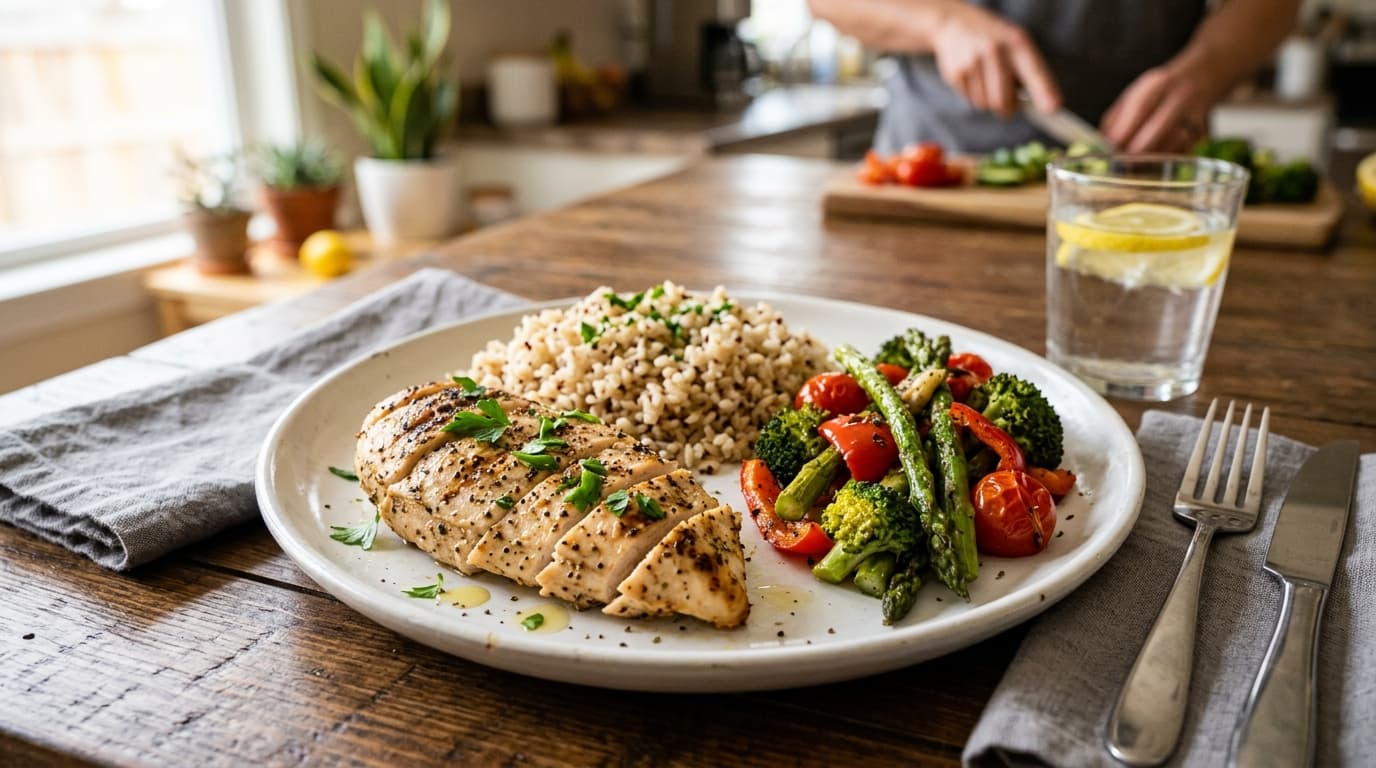
TL;DR — Key Takeaways
- Protein is king: 0.7-1g per pound of bodyweight daily (105-150g for a 150lb person)
- Eat in a slight surplus: 200-500 calories above maintenance for lean muscle gain
- Use the Plate Method: 1/2 vegetables, 1/4 protein, 1/4 carbs—no tracking needed
- Timing doesn't matter much: Total daily protein beats post-workout windows
- Supplements are optional: Only protein powder and creatine have strong research support
- Consistency wins: 8+ weeks of steady nutrition + training beats perfection
What Makes a Muscle-Building Diet "Simple"?
Definition: The simplest diet for building muscle is one that maximizes protein intake, provides adequate calories for growth, and can be followed consistently without complex tracking, restrictive rules, or constant decision fatigue. Simplicity is a feature, not a compromise—the easier a diet is to follow, the more likely you are to stick with it long enough to see results.
Most muscle-building diets fail not because they're ineffective, but because they're unsustainable. Weighing every meal, tracking macros in apps, meal prepping 12 containers every Sunday, eating the same foods on repeat, timing every meal perfectly—this works for professional bodybuilders and fitness influencers because it's literally their job. For the rest of us with actual jobs, families, and lives, complexity is the enemy of consistency.
The scientific reality is this: muscle building has a surprisingly low barrier to entry. You don't need pharmaceutical-grade precision. You need to nail a few key principles consistently over months. The difference between "optimal" and "good enough" nutrition for muscle building is marginal once the fundamentals (protein, calories, consistency) are in place. But the difference between following a simple diet for 12 months versus quitting a complex diet after 6 weeks is everything.
This guide focuses on the 20% of nutrition principles that drive 80% of muscle-building results. High protein. Calorie surplus. Whole foods. Consistency. If you master these fundamentals, you'll build muscle. The rest is optimization for people who've already mastered the basics.
The Science of Muscle Protein Synthesis: How Diet Builds Muscle
Understanding the basic mechanism of muscle growth helps you cut through diet noise and focus on what matters:
Muscle Protein Synthesis (MPS)
Muscle tissue is constantly being broken down (muscle protein breakdown) and rebuilt (muscle protein synthesis). When MPS exceeds breakdown over time, you build muscle. Resistance training stimulates MPS for roughly 24-48 hours post-workout. Dietary protein provides the amino acid building blocks necessary for this synthesis to occur.
The Role of Leucine
Leucine is the amino acid that triggers muscle protein synthesis via the mTOR pathway. Moore and colleagues' dose-response research found MPS was maximally stimulated around 20g of high-quality protein (roughly 2-2.5g of leucine) per dose. This is why protein distribution across meals matters—not for magical "anabolic windows," but for repeatedly triggering synthesis.
Energy Availability (Calories)
Building new tissue requires energy. While muscle can be built in a calorie deficit (especially for beginners), it's significantly slower and more limited. A calorie surplus provides the energy and hormonal environment (higher insulin, testosterone, IGF-1) conducive to muscle growth. Iraki and colleagues' nutrition review for off-season bodybuilders recommends a 10-20% calorie surplus to optimize muscle gain while minimizing fat accumulation.
Carbohydrates and Performance
While not directly building muscle, carbohydrates fuel training intensity. Higher training volumes and loads create greater muscle damage and adaptation stimulus. Adequate carbohydrate intake (a common recommendation is 3-5g/kg bodyweight for those training regularly) helps sustain training quality across a session, allowing you to train harder and build more muscle indirectly.
"Every client who says their diet 'isn't working' is either not eating enough protein or not eating enough, period. It's never the seventh supplement they're missing."
The 3 Essential Nutrition Principles for Building Muscle
Master these three principles and you've mastered 90% of muscle-building nutrition. Everything else is detail work:
Prioritize Protein in Every Meal
Why: Protein provides the amino acids necessary for muscle repair and growth. Without adequate protein, training stimulus is wasted—your body literally cannot build muscle tissue.
How much: 0.7-1.0g per pound of bodyweight daily. For a 150lb person, that's 105-150g. For a 180lb person, 126-180g.
How to implement: Include a palm-sized portion of protein at every meal (chicken, fish, eggs, Greek yogurt, tofu, legumes) and one protein-rich snack. This distributes protein across the day for optimal muscle protein synthesis.
Research Support: A 2018 meta-analysis in the British Journal of Sports Medicine found that protein intake of 1.6g/kg (0.73g/lb) of bodyweight maximized muscle protein synthesis in resistance-trained individuals. Going beyond 2.2g/kg (1g/lb) provided no additional benefit for muscle growth.
Eat in a Slight Calorie Surplus
Why: Building muscle tissue requires energy. A calorie surplus creates an anabolic (growth-promoting) environment by ensuring energy isn't diverted to basic survival functions.
How much: 200-500 calories above maintenance. This translates to gaining 0.5-1 lb per week (half muscle, half fat for most people). Faster gains = more fat gain.
How to implement (no tracking): Eat until comfortably satisfied (not stuffed) at each meal. If you're not gaining weight after 2 weeks, add one extra snack or slightly larger portions. If gaining too fast (>1 lb/week), reduce portions slightly.
Be Consistent Over Time
Why: Muscle building is a slow biological process. You need weeks of sustained positive protein balance to see meaningful changes. Perfect nutrition for 2 weeks followed by chaos loses to "good enough" nutrition maintained for 12 weeks.
How to implement: Follow an 80/20 rule: 80% of your meals hit protein and calorie targets, 20% can be flexible. Don't restart every Monday. Don't crash diet after one week of poor eating. Just get back on track the next meal.
Mindset shift: Think in months, not days. One missed workout or imperfect meal doesn't matter. One missed month does.
Reality Check: Most people underestimate how long muscle building takes. Natural muscle gain is approximately 2-4 lbs per month for beginners, 1-2 lbs for intermediates, and 0.5-1 lb for advanced lifters. Consistency over 6-12 months produces transformations. Erratic effort over 6 weeks produces frustration.
Simple Meal Framework (No Tracking Required)
The Plate Method is the simplest way to structure muscle-building meals without counting calories or weighing food. This visual approach ensures balanced nutrition while maintaining a calorie surplus conducive to muscle growth. Originally developed by diabetes educators, it's been adapted by sports nutritionists for muscle building because it naturally regulates portion sizes while ensuring adequate protein.
How to Build Every Meal
1/2 Plate: Vegetables & Some Fruit
Fill half your plate with non-starchy vegetables: leafy greens, broccoli, peppers, asparagus, zucchini, cauliflower, carrots. These provide fiber, vitamins, minerals, and volume without excessive calories.
Examples: Large salad, roasted vegetables, steamed broccoli, sautéed spinach, raw vegetable sticks
1/4 Plate: Protein Source
One palm-sized portion (about the size and thickness of your palm) of protein-rich food. This provides approximately 25-35g of protein per meal.
Examples: Chicken breast, fish (salmon, tilapia, cod), lean beef, turkey, eggs (4-5 whole eggs), Greek yogurt (1.5 cups), tofu, tempeh, lentils (1.5 cups cooked)
1/4 Plate: Starchy Carbohydrates
Complex carbohydrates fuel training and recovery. Choose whole food sources over processed options for sustained energy and better satiety.
Examples: Rice (white or brown), potatoes (sweet or regular), quinoa, oats, whole grain bread, pasta, beans
+ Healthy Fats (Moderate Amount)
Add 1-2 thumb-sized portions of healthy fats. These support hormone production, vitamin absorption, and increase meal satisfaction.
Examples: Olive oil (cooking/drizzle), avocado (1/4-1/2), nuts (small handful), nut butter (1-2 tbsp), cheese (moderate)
Sample Day Using the Plate Method
Breakfast (7:00 AM)
- Protein: 4 eggs scrambled
- Carbs: 2 slices whole grain toast
- Vegetables: Spinach, tomatoes, peppers mixed into eggs
- Fat: 1/4 avocado
- ~35g protein, ~450 calories
Lunch (12:30 PM)
- Protein: Grilled chicken breast (palm-sized)
- Carbs: 1 cup brown rice
- Vegetables: Large mixed salad with olive oil dressing
- Fat: Olive oil in dressing
- ~40g protein, ~550 calories
Snack (3:30 PM - Pre-Workout)
- 1 cup Greek yogurt with berries and granola
- ~20g protein, ~300 calories
Dinner (7:00 PM)
- Protein: Salmon fillet (palm-sized)
- Carbs: Roasted sweet potato
- Vegetables: Roasted broccoli and asparagus
- Fat: Salmon contains healthy fats
- ~35g protein, ~500 calories
How Much Protein Do You Actually Need to Build Muscle?
The definitive answer from sports nutrition research: 0.7-1.0g of protein per pound of bodyweight daily (or 1.6-2.2g per kg). This range maximizes muscle protein synthesis for the vast majority of people engaged in resistance training. Going below 0.7g/lb compromises muscle growth. Going significantly above 1.0g/lb provides minimal additional benefit for muscle building—excess protein is simply used for energy or converted to other compounds.
| Bodyweight | Minimum (0.7g/lb) | Optimal (0.8g/lb) | Maximum (1.0g/lb) |
|---|---|---|---|
| 130 lbs (59 kg) | 91g daily | 104g daily | 130g daily |
| 150 lbs (68 kg) | 105g daily | 120g daily | 150g daily |
| 170 lbs (77 kg) | 119g daily | 136g daily | 170g daily |
| 190 lbs (86 kg) | 133g daily | 152g daily | 190g daily |
| 210 lbs (95 kg) | 147g daily | 168g daily | 210g daily |
Protein Distribution: How to Spread It Throughout the Day
Total daily protein matters most, but distribution matters too. Research shows that spreading protein across 3-4 meals with 20-40g per meal maximizes muscle protein synthesis better than eating all your protein in 1-2 meals.
Why 20-40g per meal? Each dose of protein triggers muscle protein synthesis for several hours. Consuming 20-40g provides enough leucine (~2-3g) to maximize this response. According to Stokes and colleagues' review in Nutrients, the stimulating effect of protein on MPS beyond roughly 20-30g per meal is marginal—excess amino acids are oxidized for energy rather than used for muscle building.
For the deeper dive on protein timing, distribution, and exact targets by training status, see our complete protein intake guide.
High-Protein Foods: Quick Reference
Animal Sources
- Chicken breast (4 oz): 35g protein
- Salmon (4 oz): 25g protein
- Ground beef 90/10 (4 oz): 28g protein
- Eggs (4 large): 24g protein
- Greek yogurt (1 cup): 20g protein
- Cottage cheese (1 cup): 25g protein
- Whey protein powder (1 scoop): 20-25g protein
Plant Sources
- Tofu (1 cup firm): 20g protein
- Tempeh (1 cup): 31g protein
- Lentils (1 cup cooked): 18g protein
- Chickpeas (1 cup cooked): 15g protein
- Black beans (1 cup cooked): 15g protein
- Edamame (1 cup): 17g protein
- Plant protein powder (1 scoop): 15-25g protein
Calorie Surplus: How Much and Why It Matters
To build muscle efficiently, you need to eat slightly more calories than your body burns daily—this is called a calorie surplus. The surplus provides the energy needed for muscle protein synthesis and creates an anabolic hormonal environment conducive to growth. Too small a surplus and muscle gain is unnecessarily slow. Too large a surplus and you gain excess fat alongside muscle.
The Goldilocks Zone: 200-500 Calorie Surplus
Research-backed recommendation: Aim for a daily surplus of 200-500 calories above your maintenance level. This translates to gaining approximately 0.5-1 lb per week (2-4 lbs per month). For most people, about half of this weight gain will be muscle and half will be fat—this ratio is unavoidable even with perfect training and nutrition.
| Surplus Size | Weight Gain/Week | Result |
|---|---|---|
| 0 calories (maintenance) | 0 lbs | Minimal muscle gain (beginners only) |
| +200-300 calories | 0.5 lbs | Slow, lean muscle gain (minimal fat) |
| +300-500 calories ✓ | 0.5-1 lbs | Optimal muscle gain with manageable fat gain |
| +700-1000 calories | 1.5-2 lbs | Excessive fat gain (dirty bulk) |
How to Establish a Surplus Without Counting Calories
You don't need to track calories precisely. Use this simple feedback loop:
Establish Baseline
Weigh yourself 3-4 times in one week at the same time (morning, after bathroom, before eating). Calculate the average. This is your baseline.
Eat Consistently
Follow the Plate Method for 3-4 meals daily. Eat until comfortably satisfied (not stuffed, not hungry). Include 1-2 snacks if needed.
Monitor Weekly Weight
Weigh yourself weekly under the same conditions. Calculate weekly averages to smooth out daily fluctuations.
Adjust Based on Progress
Not gaining (0-0.25 lb/week)? Add one extra snack or increase portion sizes by ~20%.
Gaining too fast (>1 lb/week)? Reduce portions slightly or remove one snack.
Gaining 0.5-1 lb/week? Perfect—keep doing what you're doing.
Meal Timing: Myths vs. What Actually Matters
Good news: meal timing is far less important than the fitness industry wants you to believe. Total daily protein and calories matter exponentially more than when you consume them. That said, there are a few timing principles worth considering—not because they're mandatory, but because they can optimize training performance and recovery.
What Actually Matters for Meal Timing
Pre-Workout Fueling (Practical, Not Critical)
Eating 1-3 hours before training can improve performance by providing readily available energy (carbs) and amino acids (protein). If you train fasted and feel fine, keep doing it. If you feel weak or lightheaded, add a pre-workout meal.
Protein Every 4-6 Hours (Mild Optimization)
Eating protein every 4-6 hours (3-4 meals daily) keeps muscle protein synthesis elevated throughout the day. This is marginally better than eating all protein in 1-2 meals. Worth doing if convenient, not worth obsessing over.
Personal Preference and Adherence (Most Important)
The best meal timing is the one you can stick to consistently. If you're not hungry in the morning, skip breakfast. If you train better fasted, train fasted. If you prefer eating most calories at dinner, do that. As long as total daily targets are met, timing flexibility improves adherence.
Supplements That Actually Work (and What's Overrated)
Let's be clear: you don't need supplements to build muscle. Whole food sources of protein, carbohydrates, and fats provide everything your body needs for muscle growth. That said, a few supplements have strong research support and can provide convenience or marginal performance benefits. Most supplements marketed for muscle building are minimally effective or outright scams.
Tier 1: Proven and Worth Using
Protein Powder (Whey, Casein, or Plant-Based)
Purpose: Convenience for hitting daily protein targets, especially post-workout or as a snack.
Research support: Extensive. Whey protein is rapidly absorbed and high in leucine, making it effective for muscle protein synthesis. Meta-analyses show protein supplementation enhances muscle gains when combined with resistance training.
Recommendation: Use 1-2 scoops daily if you struggle to eat enough protein from whole foods. Not necessary if you easily hit protein targets with meals.
Creatine Monohydrate
Purpose: Increases muscle creatine stores, improving strength, power output, and muscle mass over time.
Research support: Overwhelming. Creatine is the most researched supplement in sports nutrition with hundreds of studies showing it increases strength (5-15%), work capacity, and lean body mass (1-2 kg over 8-12 weeks).
Recommendation: Take 5g daily (no loading phase needed). Inexpensive, safe, and effective. Works for 70-80% of people (non-responders exist).
Tier 2: Helpful But Not Essential
Caffeine
Purpose: Improves training performance, focus, and endurance. Indirectly supports muscle gain by enabling harder training.
Dose: 3-6mg per kg bodyweight (200-400mg for most people) 30-60 min pre-workout. Coffee works fine.
Vitamin D (if deficient)
Purpose: Supports testosterone production, immune function, and muscle recovery. Most people are deficient, especially in winter.
Dose: 2,000-4,000 IU daily if you don't get regular sun exposure.
Tier 3: Overrated or Ineffective
BCAAs (Branched-Chain Amino Acids): Unnecessary if you consume adequate protein. Whole protein sources already contain BCAAs. Research shows no additional benefit to BCAA supplementation when protein intake is sufficient.
Testosterone Boosters: Most over-the-counter "test boosters" (tribulus, fenugreek, D-aspartic acid) show minimal to no effect on testosterone levels in healthy individuals. If your testosterone is actually low, see a doctor—supplements won't fix it.
Glutamine: Once popular for recovery, research now shows glutamine supplementation provides no benefit for muscle building or performance in healthy individuals eating adequate protein.
Most Pre-Workouts: Expensive blends of caffeine, beta-alanine (causes tingling but minimal performance benefit), and proprietary "energy matrices." Save money: drink coffee and eat a banana.
Common Diet Mistakes That Kill Muscle Gain
Not Eating Enough Protein (Most Common)
The Mistake: Eating 50-80g of protein daily when you need 120-150g. Thinking protein shakes are "cheating" or unnatural. Relying on carb-heavy meals without protein.
The Fix: Make protein the centerpiece of every meal. Track your protein intake for one week to see where you actually stand—most people drastically underestimate. Aim for 0.8g per pound bodyweight as a non-negotiable baseline.
Trying to Build Muscle in a Calorie Deficit
The Mistake: Eating 1,500 calories while training hard, expecting to gain muscle. Trying to "stay lean" while building mass. Cutting carbs too aggressively.
The Fix: Pick one goal. If you want to build muscle, eat in a 200-500 calorie surplus. If you want to lose fat, eat in a deficit and accept slower muscle gains (or maintenance). You cannot optimally do both simultaneously unless you're a complete beginner.
Inconsistent Eating Patterns
The Mistake: Eating well Monday-Friday, then skipping meals or eating junk all weekend. Training hard but forgetting to eat enough on busy days. No meal structure or routine.
The Fix: Establish a meal routine: same number of meals at roughly the same times each day. Prep high-protein snacks for busy days (Greek yogurt, protein bars, hard-boiled eggs). Aim for 80% consistency across the week, not 100% perfection Monday-Thursday followed by chaos.
Overcomplicating the Diet
The Mistake: Tracking every macro to the gram. Buying 15 different supplements. Worrying about meal timing windows. Making elaborate meal prep plans you can't sustain.
The Fix: Stick to the Plate Method. Hit your protein target. Eat in a slight surplus. That's 90% of results. Add complexity only if you've mastered the basics and progress has stalled—not as a starting point.
Relying on "Clean Eating" Without Enough Calories
The Mistake: Eating only chicken, broccoli, and rice in tiny portions because it's "clean." Avoiding calorie-dense foods. Not gaining weight but insisting the diet is perfect.
The Fix: Clean eating is great, but you still need calories. Add calorie-dense whole foods: nuts, nut butter, avocado, olive oil, whole milk, granola, dried fruit. You can eat "clean" and still be in a surplus—it just requires strategic food choices.
Expecting Results Too Fast
The Mistake: Changing your diet every 2 weeks because you don't "see results." Hopping between strategies (keto, paleo, IF, carb cycling) without giving any approach time to work.
The Fix: Commit to one approach for at least 8-12 weeks. Take progress photos every 4 weeks. Track strength increases in training—this is often the first sign of muscle gain before visual changes. Be patient. Natural muscle building is slow. 2-4 lbs per month for beginners, 1-2 lbs for intermediates.
Frequently Asked Questions
What is the simplest diet for building muscle without counting calories?
How much protein do I really need to build muscle?
Do I need to eat immediately after working out to build muscle?
Can I build muscle while eating in a calorie deficit for fat loss?
What's the best muscle-building diet: high carb, low carb, or keto?
Do I need supplements to build muscle, or is food enough?
Pair the Simple Diet With a Simple Training Week
Choose your availability and muscle-building goal, and Odin will create a personalized bodyweight schedule to match.
Build My Free Weekly Plan