
Pistol Squat Progression: Complete Guide from Beginner to Mastery
Master the ultimate bodyweight leg exercise with this evidence-based progression guide. Learn the complete pathway from beginner regressions to advanced pistol squat variations, mobility requirements, and programming strategies.
TL;DR: Pistol Squat Progression
- Timeline: 8-16 weeks from beginner to first pistol squat with consistent training (3-4x/week)
- Key Requirements: Ankle dorsiflexion mobility, hip flexor strength, single-leg balance, baseline strength (20+ bodyweight squats)
- Progression Path: TRX-assisted → Box pistols (high to low) → Counterbalance pistols → Full bodyweight pistols → Advanced variations
- Most Common Mistake: Skipping mobility work and rushing to full pistols before mastering regressions
- Best Accessories: Ankle mobility drills, hip flexor strengthening, single-leg balance work, glute activation
What is a Pistol Squat?
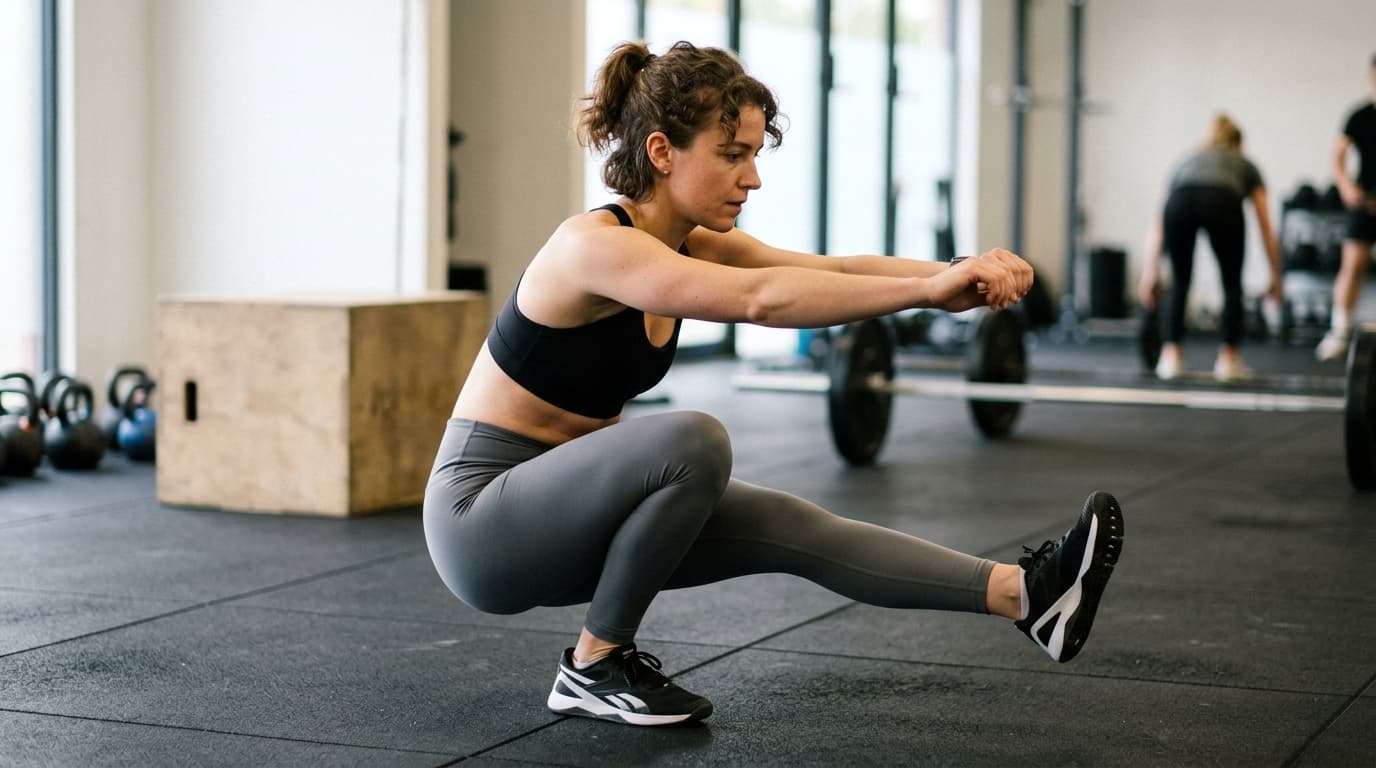
Definition: A pistol squat is a single-leg squat performed to full depth (glute to calf contact) with the non-working leg extended parallel to the ground in front of the body. It is considered one of the most challenging bodyweight leg exercises, requiring exceptional strength, balance, mobility, and coordination.
The pistol squat is named for its visual resemblance to a pistol when viewed from the side—the extended leg forms the barrel, the torso forms the handle, and the squatting leg forms the trigger mechanism. A 2005 study in the Journal of Strength and Conditioning Research by McCurdy et al. found that short-term unilateral (single-leg) resistance training was just as effective as bilateral training for building leg strength and power—while also demanding more balance, core stability, and per-leg coordination along the way. In other words, you're not sacrificing strength gains by training one leg at a time; you get the same strength stimulus plus the added stability demand for free.
Unlike traditional squats where weight is distributed across both legs, the pistol squat requires one leg to support your entire bodyweight through the full range of motion. This creates approximately 1.5-2x your bodyweight equivalent in loading on the working leg, making it comparable to a heavy barbell squat in terms of strength demand—but requiring zero equipment.
The pistol squat tests and develops four key physical attributes simultaneously:
- Unilateral leg strength (quadriceps, glutes, hamstrings)
- Hip flexor strength (to hold extended leg parallel)
- Ankle mobility (deep dorsiflexion at bottom position)
- Dynamic balance (maintaining stability on one leg through full ROM)
Why Master the Pistol Squat? Evidence-Based Benefits
The pistol squat offers unique advantages that make it a cornerstone of bodyweight leg training:
Builds Exceptional Unilateral Strength
Pistol squats require each leg to support 100% of bodyweight through the full range of motion—roughly double the per-leg load of a bodyweight bilateral squat. Since research consistently shows unilateral training builds strength at least as effectively as bilateral training (see the research note above), that per-leg loading translates to improved bilateral squat performance, sprinting power, and jump height without ever touching a barbell.
Corrects Strength Imbalances
Most people have a dominant leg that compensates during bilateral exercises. A 2020 study in Medicina measuring bilateral strength asymmetry in young elite athletes found average side-to-side differences of 5-9%, with values above 10-15% flagged as a clinically significant imbalance. Pistol squats force each leg to work independently, surfacing exactly this kind of asymmetry so you can address it directly instead of letting your stronger leg quietly compensate.
Develops Functional Mobility
The pistol squat requires and develops exceptional ankle dorsiflexion, hip flexion, and overall lower body mobility. A 2012 study in the Journal of Sport Rehabilitation by Macrum et al. found that restricting ankle dorsiflexion during a squat increased knee valgus (inward knee collapse) and reduced quadriceps activation—meaning the ankle mobility you build training pistol squats directly protects your knees during every other squatting movement you do.
Builds Elite Balance and Proprioception
Maintaining balance through the full pistol squat ROM develops exceptional proprioception (body awareness in space). Strength coaches increasingly describe unilateral training as a built-in fall-prevention tool, since training each leg independently forces the small stabilizer muscles around the ankle, knee, and hip to work in a way bilateral exercises never demand—the same stabilizers responsible for catching you when you trip or step awkwardly.
Zero Equipment Required
Once mastered, pistol squats provide leg strength training equivalent to heavy barbell squats—without requiring gym access, equipment, or external load. This makes them ideal for travelers, minimalists, and home training. The progression can be done anywhere with basic household items (doorframe, box, backpack).
Sport-Specific Transfer
Most athletic movements (running, jumping, changing direction) occur predominantly on one leg at a time. Pistol squats train the movement pattern, stability demands, and force production required for these actions—making them highly transferable to sports performance.
Prerequisites and Mobility Requirements
Before beginning pistol squat progressions, assess whether you meet these baseline requirements. Lacking these prerequisites will make progression unnecessarily difficult and increase injury risk:
Baseline Strength Assessment
Bilateral Squat Proficiency
Requirement: Perform 20+ consecutive bodyweight squats to full depth (hip crease below knee) with heels down and upright torso.
Why it matters: This indicates sufficient baseline leg strength and squat pattern proficiency.
Single-Leg Balance
Requirement: Stand on one leg for 30+ seconds with eyes open, minimal wobbling, without holding support.
Why it matters: Balance is a primary limiting factor in pistol squats. Master static balance before adding movement.
Hip Flexor Endurance
Requirement: While seated on floor, extend one leg parallel to ground and hold for 30+ seconds without leg dropping.
Why it matters: Weak hip flexors are the #1 reason people can't keep the extended leg up during pistol squats.
Critical Mobility Requirements
Ankle Dorsiflexion (Most Important)
Test: Stand facing wall, place toes 4-5 inches from wall. Bend knee forward to touch wall while keeping heel down. Can you do this without heel lifting?
Why it's critical: Pistol squats require substantial ankle dorsiflexion. Limited ankle mobility forces you to lean forward excessively, making balance nearly impossible. As the Macrum et al. (2012) study cited above found, restricted ankle dorsiflexion changes your squat mechanics at the knee, not just at the ankle—so this test matters for more than just pistol squats.
Hip Flexion Mobility
Test: Perform a bodyweight squat to full depth (ass-to-grass) while keeping heels flat, torso relatively upright, and knees tracking over toes. Can you achieve hip crease well below knee level?
Why it's critical: Pistol squats require deep hip flexion. Limited hip mobility forces compensations (excessive forward lean, rounded lower back) that compromise safety and performance.
Hamstring Flexibility
Test: Sit on floor with both legs extended. Can you reach forward and touch your toes while keeping legs straight?
Why it matters: Tight hamstrings limit your ability to extend the non-working leg fully parallel to the ground, compromising pistol squat form.
"We see this constantly in the app's progress data: athletes who spend two honest weeks on ankle and hip mobility before touching pistol squat regressions end up reaching a full bodyweight pistol faster than athletes who skip straight to strength work and fight their own range of motion the whole way. Mobility isn't a detour from the progression—it is the first stage of it."
Complete Pistol Squat Progression: 5 Levels from Beginner to Advanced
This progression pathway takes you from assisted pistol squats to advanced variations. Spend 2-4 weeks at each level before progressing. The key criteria: complete 3 sets of 10-12 reps per leg with perfect form before moving to the next level.
Essential Mobility Drills for Pistol Squat Progression
Perform these mobility and accessory exercises 4-6 times per week, ideally before pistol squat training sessions or as separate mobility work:
Ankle Mobility Work
Wall Ankle Mobilizations
Face wall, place foot 4-5 inches away, drive knee forward to touch wall while keeping heel down. Hold 2 seconds, repeat 15-20 reps per side. Gradually move foot farther from wall as mobility improves.
Elevated Calf Stretches
Place ball of foot on elevated surface (step, book), drop heel below level of toes, hold 30-60 seconds per side. Do both straight knee (gastrocnemius) and bent knee (soleus) variations.
Hip Mobility Work
Deep Squat Holds
Hold bottom of bodyweight squat for 2-5 minutes. Use hands on floor in front for balance if needed. This builds hip flexion mobility and comfort in deep positions.
90/90 Hip Stretches
Sit on floor with front leg at 90° (knee bent, shin parallel to body), rear leg at 90° (knee bent behind you). Lean forward over front leg, hold 30-60 seconds, switch sides. Targets hip internal/external rotation.
Hip Flexor Strengthening
Seated Leg Raises
Sit on floor or chair, extend one leg straight out parallel to ground, hold 30-60 seconds. Progress to 3 sets × 60+ seconds per leg. This directly builds hip flexor endurance for holding extended leg during pistols.
Lying Leg Raises
Lie on back, raise one leg to 90° and hold for 20-30 seconds, or perform 15-20 slow raises. Builds hip flexor strength and control.
Balance and Stability Work
Single-Leg Balance Holds
Stand on one leg for 60+ seconds, progress to eyes closed for increased difficulty. Practice weight shifts, reaching, and small movements while balanced.
Single-Leg Romanian Deadlifts
Stand on one leg, hinge at hip while extending opposite leg behind for balance, touch floor with hands, return to standing. 3 sets × 8-12 reps per leg. Builds single-leg stability and posterior chain strength.
Programming and Training Frequency
How you structure pistol squat training within your weekly routine significantly impacts progression speed and injury prevention:
Optimal Training Frequency
Recommended: 3-4 Sessions Per Week
A 2016 meta-analysis in Sports Medicine by Schoenfeld, Ogborn, and Krieger found that training a muscle group two or more times per week produced superior strength and hypertrophy outcomes compared to once-weekly training, when total volume was equated. Pistol squats add a skill-acquisition component on top of that strength stimulus, which is why 3-4 sessions per week—enough repetition to reinforce the movement pattern without overloading recovery—works well in practice.
Sample Weekly Split:
- Monday: Pistol squat progression + accessories
- Tuesday: Mobility work only
- Wednesday: Pistol squat progression + accessories
- Thursday: Rest or upper body training
- Friday: Pistol squat progression + accessories
- Weekend: Mobility work + active recovery
Sample Training Session Structure
Warm-Up (5-10 minutes)
General movement (light cardio, jumping jacks, leg swings), then specific warm-up: bodyweight squats × 15, lunges × 10 per side, ankle circles, hip circles
Mobility Drills (5 minutes)
Wall ankle mobilizations, deep squat holds, hip flexor stretches
Primary Skill Work: Pistol Squat Progression (15-20 minutes)
Current progression level (e.g., box pistols, counterbalance pistols, or full pistols): 3 sets × 8-12 reps per leg, 2-3 minutes rest between sets
Accessory Exercises (10-15 minutes)
Choose 2-3 exercises:
- Single-leg Romanian deadlifts: 3 sets × 10 reps per side
- Bulgarian split squats: 3 sets × 12 reps per side
- Single-leg glute bridges: 3 sets × 15 reps per side
- Calf raises: 3 sets × 15-20 reps
Cool-Down (5 minutes)
Static stretching: quads, hip flexors, hamstrings, calves (30 seconds per muscle group per side)
Progression Timeline Expectations
| Starting Level | Expected Timeline | Key Factors |
|---|---|---|
| Complete Beginner (cannot do 20 bodyweight squats) | 16-20 weeks | Need to build baseline strength first |
| Intermediate (can do 20+ squats, limited mobility) | 12-16 weeks | Mobility work is the primary focus |
| Advanced (strong bilateral squatter, good mobility) | 8-12 weeks | Mainly building single-leg balance and skill |
| Elite (experienced calisthenics athlete) | 4-8 weeks | May already have prerequisite strength and mobility |
Add Pistol-Squat Practice Without Overtraining Your Legs
Choose your level and training days, and Odin will balance single-leg practice with upper-body work, mobility, and recovery.
Plan My Training WeekCommon Pistol Squat Mistakes and How to Fix Them
Skipping Mobility Work
The Mistake: Attempting pistol squat progressions without adequate ankle dorsiflexion, hip mobility, or hamstring flexibility. This leads to poor form compensations (excessive forward lean, heel lift, rounded back) that limit progress and increase injury risk.
The Fix: Spend 2-4 weeks exclusively on mobility work if you fail the prerequisite tests. Do mobility drills daily (10-15 minutes). Ankle mobility and deep squat comfort are non-negotiable prerequisites. Once mobility is addressed, your progression will be dramatically faster.
Rushing Through Progressions
The Mistake: Attempting full pistol squats after only 2-3 weeks of training, skipping intermediate progressions (box pistols, counterbalance), sacrificing form quality to achieve the "cool" movement.
The Fix: Spend 2-4 weeks at each progression level before advancing. Master 3 sets × 12 reps with perfect form before moving to the next level. Remember: rushing leads to injury, plateaus, and poor movement patterns that are hard to unlearn. Quality over ego.
Knee Caving Inward (Valgus Collapse)
The Mistake: Allowing the knee to cave inward during the descent or ascent. This places dangerous stress on knee ligaments (ACL/MCL) and indicates weak hip stabilizers (glute medius).
The Fix: Actively push knee outward (tracking over toes) throughout the movement. Add glute activation exercises: clamshells (3 sets × 20), side-lying hip abduction (3 sets × 15), lateral band walks (3 sets × 15 steps per direction). Film yourself from the front to identify knee valgus and cue correction.
Extended Leg Dropping During Descent
The Mistake: The non-working leg drops below parallel to the ground during the squat, or you can't keep it extended at all. This indicates insufficient hip flexor strength and makes the movement significantly easier (not a true pistol squat).
The Fix: Build hip flexor endurance with seated leg raises (hold extended leg parallel for 60+ seconds) and lying leg raises (15-20 reps slow). During pistols, focus on actively pulling extended leg up and forward. Use a mirror or film yourself from the side to verify leg height.
Heel Lifting Off Ground
The Mistake: The heel of the working leg lifts off the floor at the bottom of the squat. This shifts load to the toes, reduces glute/hamstring activation, and indicates severe ankle mobility limitations.
The Fix: Prioritize ankle mobility work (wall mobilizations, calf stretches) daily for 2-4 weeks. In the short term, elevate heel on small wedge (1-2 inch plate) to compensate while you build mobility. Gradually reduce wedge height as ankle dorsiflexion improves. Never force full depth with heel lift—it's a sign to regress and work mobility.
Excessive Forward Lean / Balance Issues
The Mistake: Leaning torso excessively forward (45+ degrees from vertical), losing balance backward, or needing to touch down with extended leg. This indicates balance deficits and potentially weak anterior core.
The Fix: Use counterbalance progression (hold light weight in front) for 4-6 weeks. Practice single-leg balance drills daily (60+ seconds per side). Strengthen core with planks (3 sets × 60 seconds) and hollow body holds (3 sets × 30 seconds). Film yourself from the side to monitor torso angle and make adjustments.
Training Through Pain
The Mistake: Continuing to train despite sharp knee pain, ankle pain, or hip discomfort. Confusing muscle burn (normal) with joint pain (warning signal).
The Fix: Muscle burn and fatigue are normal. Sharp, stabbing, or persistent joint pain is not. If you experience joint pain, stop immediately, rest 3-5 days, then regress 1-2 levels in the progression. Build back up slowly. If pain persists, consult a physical therapist or sports medicine professional—pushing through joint pain leads to serious injury.
Pistol Squats for Your Lifestyle
The pistol squat progression above works no matter who you are — but how you fit it into your week depends on your daily constraints. Here's how to apply it if you fall into one of these common situations.
Pistol Squats for Side Sleepers
Side sleeping compresses the hip on your dominant side overnight, which can leave that hip flexor and glute tighter and weaker than the other — a common cause of pistol squat asymmetry between legs. Spend an extra 60-90 seconds per side on the 90/90 hip stretch and single-leg glute bridges (see the mobility section above) before training, and expect your non-dominant-side leg to lag slightly behind in strength — that's normal, train it first in each session while it's freshest.
Pistol Squats for Travelers
The pistol squat is one of the few leg exercises that needs zero equipment and almost no floor space, making it ideal for hotel rooms and airport layovers. Swap the box and TRX regressions for a sturdy chair or bed edge (box pistols) and a doorframe (assisted pistols) — both are available in nearly any hotel room. Keep a 10-15 minute "travel version" of the mobility routine above (skip the equipment-based drills) to maintain ankle and hip mobility even when you can't train the full session.
Pistol Squats for Engineers and Desk Workers
Long sitting hours shorten your hip flexors and weaken your glutes — exactly the two things a pistol squat demands most. If you sit most of the day, prioritize the hip flexor strengthening and deep squat hold drills above, and take a 2-minute break every hour to hold a deep squat or do 10 bodyweight squats. This keeps your hips from tightening back up between training sessions and speeds up progression.
Pistol Squats for Digital Nomads
Inconsistent environments and time zones make it hard to stick to a fixed 3-4 day split. Instead, anchor the progression to how you feel rather than a fixed calendar: train pistol squats any day you have 20 minutes and haven't trained legs in the last 48 hours. The progression stages (assisted → box → counterbalance → bodyweight) travel with you since none require equipment beyond a doorframe, chair, or step.
Pistol Squats for Heavy and Light Sleepers
Sleep quality directly affects how fast you progress through the pistol squat levels, since strength and balance gains consolidate during deep sleep. If you're a light sleeper, avoid training pistol squats in the evening — the balance and coordination demands are stimulating and can delay sleep onset. Heavy sleepers who train early can lean on a slightly longer warm-up (add 2-3 minutes of light cardio) since balance and proprioception take longer to switch on before you're fully alert.
Frequently Asked Questions
How long does it take to learn a pistol squat?
What ankle mobility do I need for a pistol squat?
What are the progressions before a pistol squat?
What muscles does a pistol squat work?
Why can't I do a pistol squat even though I'm flexible?
What's the difference between a pistol squat and a shrimp squat?
Can pistol squats damage your knees?
Do I need to be able to squat a certain weight before attempting pistol squats?
Build a Week Around Your Pistol-Squat Goal
Choose your schedule and level, and Odin will balance single-leg strength work with the rest of your weekly bodyweight training.
Build My Free Weekly Plan