
The Busy Professional's Guide to Maintaining Fitness While Traveling
Don't let business travel derail your fitness. Practical, research-backed strategies for staying strong in hotel rooms, airports, and anywhere your work takes you.
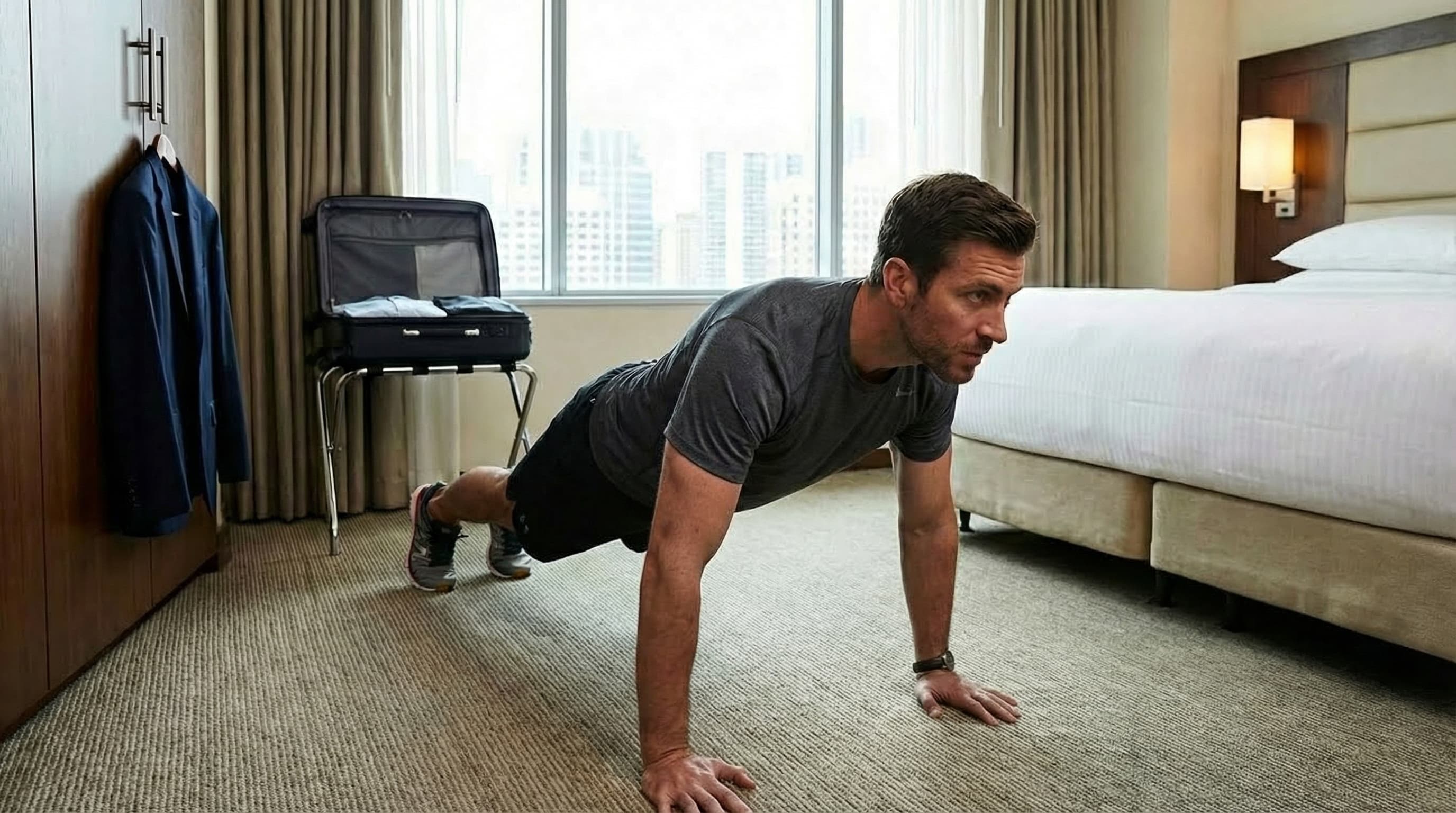
Why Travel Disrupts Fitness (And Why It Doesn't Have To)
Definition: Travel fitness refers to maintaining consistent exercise and healthy habits while away from home, typically during business travel, vacations, or periods of frequent movement. For busy professionals, maintaining fitness while traveling means adapting workout routines to hotel rooms, airports, and unpredictable schedules without access to traditional gym equipment or facilities.
The reality of business travel fitness is this: Most professionals don't fail because they lack willpower. They fail because traditional fitness advice assumes stable routines, consistent environments, and access to equipment. Business travel eliminates all three.
Research published in the Journal of Occupational and Environmental Medicine tracked over 13,000 employees and found that extensive business travelers (20+ nights/month) were nearly twice as likely to be obese (odds ratio 1.92) and 2.6x more likely to rate their own health as fair or poor compared to light travelers. A 2018 follow-up study by the same research group found extensive travelers were nearly twice as likely to report sedentary behavior (prevalence ratio 1.95) as those traveling 1-6 nights per month.
The pattern in both studies wasn't about travel itself—it was about what travel does to routine. Sedentary behavior and disrupted eating drive the health gap, not the flying. A flexible, equipment-free system that works in a hotel room closes that gap without requiring gym access.
This guide provides exactly that system. Not aspirational advice about "finding time for the hotel gym," but practical strategies for maintaining real strength with just your body, a hotel room, and 15-30 minutes.
The Science: How Much Exercise Do You Need to Maintain Strength?
Understanding the minimum effective dose for maintaining fitness while traveling helps you focus on what actually matters:
Maintenance Volume Research
A 2011 study in Medicine & Science in Sports & Exercise by Bickel et al. had adults train 3 days per week for 16 weeks, then cut volume to one-third or even one-ninth for a 32-week maintenance phase. Younger adults fully preserved their strength and muscle gains at the reduced volume. (Older adults needed a slightly higher dose to hold onto their gains—worth knowing if you're training family members into this plan too.) Translation: if you train 3x per week at home, a single focused session while traveling can be enough to hold your ground.
Intensity Over Duration
A 2014 study in BMC Public Health by Heinrich et al. compared high-intensity functional training against traditional aerobic-and-resistance training. The high-intensity group trained 39.3 minutes per week total versus 189.8 minutes for the traditional group—roughly a fifth of the time—while every high-intensity participant planned to keep training afterward, versus just 55.6% of the traditional group. For travelers, this is the point: you don't need hours—you need focused effort.
Bodyweight Training Efficacy
A controlled study by Thomas et al., published in Isokinetics and Exercise Science, put 28 men through 8 weeks of calisthenics-only training with zero equipment. Compared to a non-training control group, the calisthenics group significantly improved strength, posture, and body composition—confirming that equipment-free training produces real, measurable adaptations, exactly what a hotel room can offer.
Detraining Timeline
Research on detraining shows that strength begins declining after approximately 2-3 weeks of zero training. However, the decline is gradual: Week 1-2 of no training shows minimal loss, weeks 3-4 show 5-10% decline, weeks 5-8 show 10-20% decline. The takeaway: A week-long trip with zero training won't destroy your progress, but frequent travel requires consistent maintenance.
"Every traveling client who's stayed consistent for a full year has told me the same thing: the trip that broke their streak wasn't the one with zero time—it was the one where they told themselves they'd 'make up for it' when they got home. The 10-minute session on a bad day protects the habit. Skipping it quietly erodes it."
The Mindset Shift: From Perfection to Consistency
The biggest mental barrier to travel fitness isn't laziness—it's the perfectionist mindset that says "If I can't do my full workout, why bother?" This all-or-nothing thinking is the enemy of consistency. See our guide to building a workout habit that sticks for the full system behind fixing this.
Home Workout Mindset
- • Must complete full 60-minute routine
- • Need specific equipment and weights
- • Training must happen at optimal time
- • Skip if conditions aren't perfect
- • Focus on progressive overload and PRs
Travel Workout Mindset
- • Any session (even 10 min) beats zero
- • Body weight is sufficient for maintenance
- • Training happens whenever possible
- • Adapt to conditions rather than skip
- • Focus on maintaining, not maximizing
Redefining Success on the Road
At home, success = progress. You're trying to get stronger, build muscle, hit new PRs.
While traveling, success = maintenance. You're preserving the strength you've built so you don't start from scratch when you return.
This isn't settling for less—it's being strategic. Frequent travelers who embrace maintenance mode during trips and progression mode at home make more long-term progress than those who try to progress constantly, burn out, and quit during busy travel periods.
Complete Hotel Room Workout Routines (No Equipment)
These workouts require only 6x6 feet of space (smaller than most hotel bathrooms) and zero equipment. Each routine takes 15-30 minutes and provides full-body strength maintenance. For a more structured version of this same idea, see our 20-minute calisthenics system for traveling professionals.
Workout 1: The Quick Morning Routine (15 minutes)
Perfect for: Early meetings, time-crunched mornings
Format
- Circuit style - complete all exercises in sequence, rest 1 minute, repeat 3 rounds
1. Push-Ups (15-20 reps)
Standard push-ups or modify to incline (hands on bed) if needed. Focus on controlled descent and full range of motion.
2. Bodyweight Squats (20 reps)
Feet shoulder-width, squat until thighs parallel to ground. Keep chest up and weight on heels.
3. Plank Hold (45-60 seconds)
Forearms on ground, body straight from head to heels. Engage core, don't let hips sag.
4. Lunges (10 reps per leg)
Alternate legs, step forward into lunge position, back knee almost touching ground. Maintain upright torso.
5. Mountain Climbers (30 seconds)
High plank position, drive knees to chest alternately. Maintain flat back and engaged core.
Total Time: 12-15 minutes (3 rounds + rest). Muscles Worked: Chest, shoulders, core, legs, cardiovascular system. Difficulty: Beginner to Intermediate
Workout 2: The Strength Maintenance Session (25 minutes)
Perfect for: Maintaining muscle, evening workouts
Format
- Straight sets - complete all sets of one exercise before moving to next. Rest 60-90 seconds between sets.
1. Diamond Push-Ups (4 sets × 8-12 reps)
Hands close together forming diamond shape. Targets triceps and inner chest more than standard push-ups.
2. Single-Leg Squats to Chair (3 sets × 6-8 reps per leg)
Stand on one leg, lower to tap chair with glutes, return to standing. Use wall for balance if needed. Builds leg strength effectively.
3. Pike Push-Ups (3 sets × 10-12 reps)
Hands and feet on ground, hips high forming inverted V. Lower head toward ground. Targets shoulders heavily—excellent for overhead pressing strength.
4. Bulgarian Split Squats (3 sets × 10 reps per leg)
Back foot elevated on bed, front leg lunges down. Challenging single-leg movement for glutes and quads.
5. L-Sit Hold (3 sets × 15-30 seconds)
Sit on ground, hands beside hips. Press into ground lifting body up, legs extended forward. Intense core and hip flexor work.
Total Time: 22-25 minutes. Muscles Worked: Full body with emphasis on strength over endurance. Difficulty: Intermediate to Advanced
Workout 3: The High-Intensity Travel Burner (20 minutes)
Perfect for: Stress relief, jet lag recovery, maximizing limited time
Format
- EMOM (Every Minute On the Minute) - Start new exercise every minute. Work for 40 seconds, rest 20 seconds. Cycle through 5 exercises for 4 rounds (20 minutes total).
Minute 1: Burpees (40 seconds work)
Full burpee: squat, hands down, jump feet back, push-up, jump feet forward, explosive jump up. Total body conditioning.
Minute 2: Jump Squats (40 seconds work)
Bodyweight squat, explosive jump at top, land softly. Builds leg power and cardiovascular endurance.
Minute 3: Push-Up to T (40 seconds work)
Push-up, at top rotate to side plank reaching arm to ceiling. Alternate sides. Works chest, core, and stability.
Minute 4: High Knees (40 seconds work)
Run in place driving knees to chest height. Fast pace for cardiovascular challenge.
Minute 5: Plank Shoulder Taps (40 seconds work)
High plank, alternate tapping opposite shoulder while maintaining stable hips. Anti-rotation core work.
Total Time: Exactly 20 minutes (4 rounds of 5 exercises). Intensity: High - expect elevated heart rate and sweat. Benefits: Maintains strength + cardio + burns stress
Airport & Layover Fitness Strategies
Airports are dead time for most travelers, but they're opportunities for movement if you're strategic. These tactics keep your body active during long travel days:
The Terminal Walking Strategy
Method: Instead of sitting at your gate for 2 hours, walk the terminal at a brisk pace with your carry-on. Many major airports have walking paths spanning 1-2 miles.
- 30 minutes of walking = ~1.5 miles = ~150 calories burned
- Reduces sitting time (counteracts prolonged flight sitting)
- Improves circulation before long flights (reduces DVT risk)
- Return to gate 30 minutes before boarding—never risk missing flight
Airport Bathroom/Family Restroom Workouts
For layovers 2+ hours: Use the larger single-occupancy family restroom for a quick 10-minute bodyweight session during long layovers.
Quick Airport Circuit (10 minutes):
- Push-ups × 15 reps
- Squats × 20 reps
- Lunges × 10 per leg
- Plank hold × 30 seconds
- Rest 60 seconds, repeat 3 rounds
Note: Always be respectful of shared spaces. Keep sessions brief during busy times. Some airports have dedicated yoga rooms or fitness areas—check airport maps.
In-Flight Movement Routine
Every 60-90 minutes on flights over 3 hours: Stand, walk to bathroom, perform 2-3 minute movement sequence in galley area (when not obstructing service).
- Calf raises × 20 reps (prevents swelling)
- Standing hip circles × 10 each direction (mobility)
- Overhead reaches × 10 (counteracts hunched posture)
- Deep breathing × 5 breaths (reduces stress and improves circulation)
Airport Stairs Strategy
Skip the escalator. Use stairs whenever available. If you have a long layover and the airport has multiple levels, stairs become a legitimate workout:
- 10 minutes of stair walking = ~100 floors = significant leg work
- Carry-on provides added resistance (weighted vest effect)
- Low-impact cardio that doesn't leave you sweaty for your flight
The Mindset: Movement Over Sitting
Travel days typically involve 8-12 hours of sitting (flights, waiting, taxis, meetings). Research shows prolonged sitting increases fatigue, reduces circulation, and decreases next-day energy. By choosing movement during layovers—walking instead of sitting, stairs instead of escalators—you arrive at your destination feeling better and maintain your active identity even on travel days.
Eating Well on the Road: Practical Nutrition for Travelers
Travel nutrition doesn't require perfection—it requires strategy. These practical tactics help you maintain reasonable eating habits without obsessing over every meal.
The Airport Food Strategy
Goal: Protein + vegetable/fruit, minimize processed carbs — see our protein intake guide for your daily target
- Best options: Protein boxes, Greek yogurt + nuts, salads with chicken, burrito bowls (skip rice, extra protein)
- Avoid: Pastries, pizza, oversized muffins, candy—they spike blood sugar then crash, worsening jet lag
- Pack backup: Protein bars, nuts, jerky in carry-on for poor airport options
Restaurant Ordering Rules
Simple framework for business dinners:
- Order protein-focused entree (steak, fish, chicken)
- Replace fries/bread with vegetables or salad (just ask)
- Split dessert or skip entirely (saves calories without looking difficult)
- Limit alcohol to 1-2 drinks maximum (sleep quality)
- Drink water throughout meal (often mistaken for hunger)
Hotel Room Nutrition Hacks
Pack or buy locally:
- Protein powder (mix with water for easy breakfast or post-workout)
- Instant oatmeal packets (hot water from coffee maker)
- Nut butter packets + fruit (from hotel breakfast or local store)
- Greek yogurt, hard-boiled eggs, string cheese (hotel mini-fridge)
- Pre-cut vegetables + hummus (grocery store near hotel)
Having one healthy meal you control (breakfast in room) makes dining out for lunch/dinner more sustainable.
The 80/20 Travel Rule
Aim for: 80% of meals reasonably healthy (protein + vegetables), 20% flexible for social situations or local experiences.
This means on a 5-day trip with 15 meals, 12 are protein-focused and reasonable, 3 are whatever you want (client dinner, local specialty, etc.). This balance maintains progress without making you the difficult dining companion or missing local food experiences.
Hydration Strategy
Target: 8-10 glasses (64-80oz) water daily, more if flying
- Bring empty water bottle through security, fill at fountain
- Drink 8oz water immediately upon waking (counters overnight dehydration)
- Order water with every meal out (reduces liquid calories)
- Airplane air is extremely dry—drink 8oz per hour of flight
Dehydration increases fatigue, hunger signals, and reduces workout performance. Water is the cheapest performance enhancer.
Alcohol Moderation
Business travel often involves drinks. Strategies for moderation without awkwardness:
- Order one alcoholic drink, switch to sparkling water with lime (looks like drink)
- Alternate: alcohol, water, alcohol pattern at events
- Avoid airport drinking (dehydrates before flight, disrupts sleep)
- If drinking, drink 8oz water per alcoholic beverage before bed
Research shows even 2-3 drinks significantly disrupts sleep quality, which compounds across multi-day trips. Limiting alcohol improves energy, workout quality, and decision-making during business travel.
The Realistic Approach
You will not eat perfectly while traveling. Client dinners involve rich food. Airport options are limited. Late flights mean fast food. That's fine. The goal isn't perfection—it's making the best choice available most of the time. Ordering grilled chicken instead of fried, choosing fruit over pastry at breakfast, drinking water instead of soda—these small decisions compound over frequent travel. Don't aim for flawless; aim for better than you used to be.
Recovery, Sleep, and Managing Travel Fatigue
Training and nutrition matter, but recovery determines whether you maintain fitness or burn out. Travel disrupts sleep more than any other fitness variable—here's how to minimize the damage. See our complete sleep schedule guide for the full reset protocol once you're back home.
Sleep Optimization in Hotels
Control Your Environment:
- Temperature: Set AC to 65-68°F (optimal for sleep). Most hotels run warm.
- Darkness: Use binder clips or clothespins to seal curtain gaps (or pack sleep mask)
- Noise: White noise app or fan app on phone. Earplugs if near elevator/ice machine.
- Clock position: Turn alarm clock away from bed (light + time anxiety disrupt sleep)
Pre-Sleep Routine:
- No screens 30 minutes before bed (blue light disrupts melatonin)
- 10-minute stretch or mobility routine (reduces muscle tension from travel)
- Shower before bed (body temperature drop after shower promotes sleep)
- Read physical book or listen to podcast (screen-free wind-down)
Jet Lag Management
For time zone changes 3+ hours:
Before Travel:
- Shift sleep schedule 1 hour per day toward destination (3 days before)
- For eastward travel: go to bed earlier, wake earlier
- For westward travel: go to bed later, wake later
Upon Arrival:
- Immediate adjustment: Set watch to local time on plane. Start thinking in new time zone.
- Light exposure: Get 30+ minutes outdoor light within 2 hours of waking (resets circadian rhythm)
- Exercise timing: Morning workout in new time zone accelerates adjustment
- Stay awake: Don't nap until local bedtime (even if exhausted)
Recovery Timeline:
Research shows approximately 1 day recovery per 1 hour time zone change. A 6-hour change takes ~6 days for full adjustment. For short trips (3-4 days), sometimes staying partially on home schedule is more practical than fully adjusting.
Active Recovery During Travel
Not every day requires hard training. Active recovery maintains movement without adding fatigue:
- Morning walks (20-30 minutes at conversational pace)
- Mobility flow (10-15 minutes of dynamic stretching)
- Swimming if hotel has pool (low-impact, full-body movement)
- Yoga or bodyweight flow (movement-focused, not intensity-focused)
Active recovery improves circulation, reduces muscle stiffness from sitting, and maintains your exercise habit on days when hard training isn't appropriate.
When to Skip Your Workout
Sometimes, rest is smarter than training:
- Slept less than 5 hours: Training on severe sleep deprivation increases injury risk and provides minimal benefit
- Feeling actually sick: Not just tired, but fever, severe congestion, or body aches—rest accelerates recovery
- 3+ consecutive hard training days: Accumulated fatigue requires recovery, especially during travel stress
Missing one workout due to legitimate recovery needs won't hurt long-term progress. Training when you shouldn't can lead to injury or illness that costs weeks.
The Sleep Priority Hierarchy
If you must sacrifice something due to travel demands, sacrifice in this order: 1) Nutrition perfection (most flexible), 2) Workout duration (shorter is fine), 3) Workout intensity (lighter if needed), 4) Sleep (protect this at all costs). Sleep affects everything else—mood, decision-making, workout quality, recovery, immune function. A well-rested traveler who misses a workout is better off than an exhausted traveler who forces training.
The Minimalist Travel Fitness Packing List
Everything you need to maintain fitness while traveling fits in your carry-on. This packing list ensures you're prepared for workouts anywhere.
Essential (Always Pack)
- Workout clothes (2 sets minimum): T-shirt or tank, shorts or leggings. Quick-dry fabric. Roll tightly to save space.
- Athletic shoes: Wear them on flight to save luggage space. Should work for bodyweight training and walking.
- Reusable water bottle: Collapsible bottle saves space. Fill after security. Hydration is crucial.
- Resistance band (light): Optional but weighs 2oz. Adds variety to hotel workouts. Loop band for pull-apart movements.
- Small workout towel: Hotel towels are large. Pack microfiber towel for workouts (dries fast, packs small).
Nice to Have (If Space Allows)
- +Jump rope: Lightweight cardio option. Works in parking lots, parks, or large hotel rooms (not on carpet).
- +Foam roller (travel size): Compact versions available. Helps with muscle soreness from sitting and sleeping in hotel beds.
- +Doorway pull-up bar: If you travel frequently and prioritize pull-ups. Portable versions available (check-in luggage).
- +Protein powder packets: Single-serve packets for convenience. Mix with water for easy protein source when food options limited.
- +Headphones: For workout music/podcasts. Noise-canceling helps in hotel gyms or shared spaces.
Recovery & Sleep Items
- Sleep mask: Hotels have light leaks. Quality sleep mask is game-changing for recovery.
- Earplugs: Hotel noise (hallways, neighbors, ice machines). Foam earplugs or reusable silicone.
- Magnesium supplement: Supports sleep quality and muscle recovery. Magnesium glycinate 400mg before bed.
- Melatonin (1-3mg): For jet lag or shifted sleep schedules. Take 30 minutes before desired bedtime in new time zone.
Digital Tools to Prepare Before Travel
- Weekly plan: Copy your weekly plan into your notes before travel so your hotel-room sessions stay available without WiFi.
- Timer app: For interval training and workout timing. Most phones have built-in timer.
- White noise app: For sleep quality in hotels. Download sounds offline for airplane mode sleeping.
Frequently Asked Questions
How do I stay motivated to work out while traveling for work?
What are the best exercises to do in a small hotel room with no equipment?
How many days per week should I exercise while traveling?
What should I do if my hotel doesn't have a gym or my room is too small?
How can I maintain my strength gains while traveling frequently?
What's the best time of day to work out while traveling?
Build a Training Plan That Travels With You
Choose your available days, session length, and equipment access to get a bodyweight plan that works wherever the week takes you.
Build My Free Weekly Plan