
Why Bodyweight Training Builds Better Functional Strength Than Weightlifting
A comprehensive comparison backed by biomechanics research, real-world applications, and movement science. Discover why calisthenics often produces superior strength for daily life.
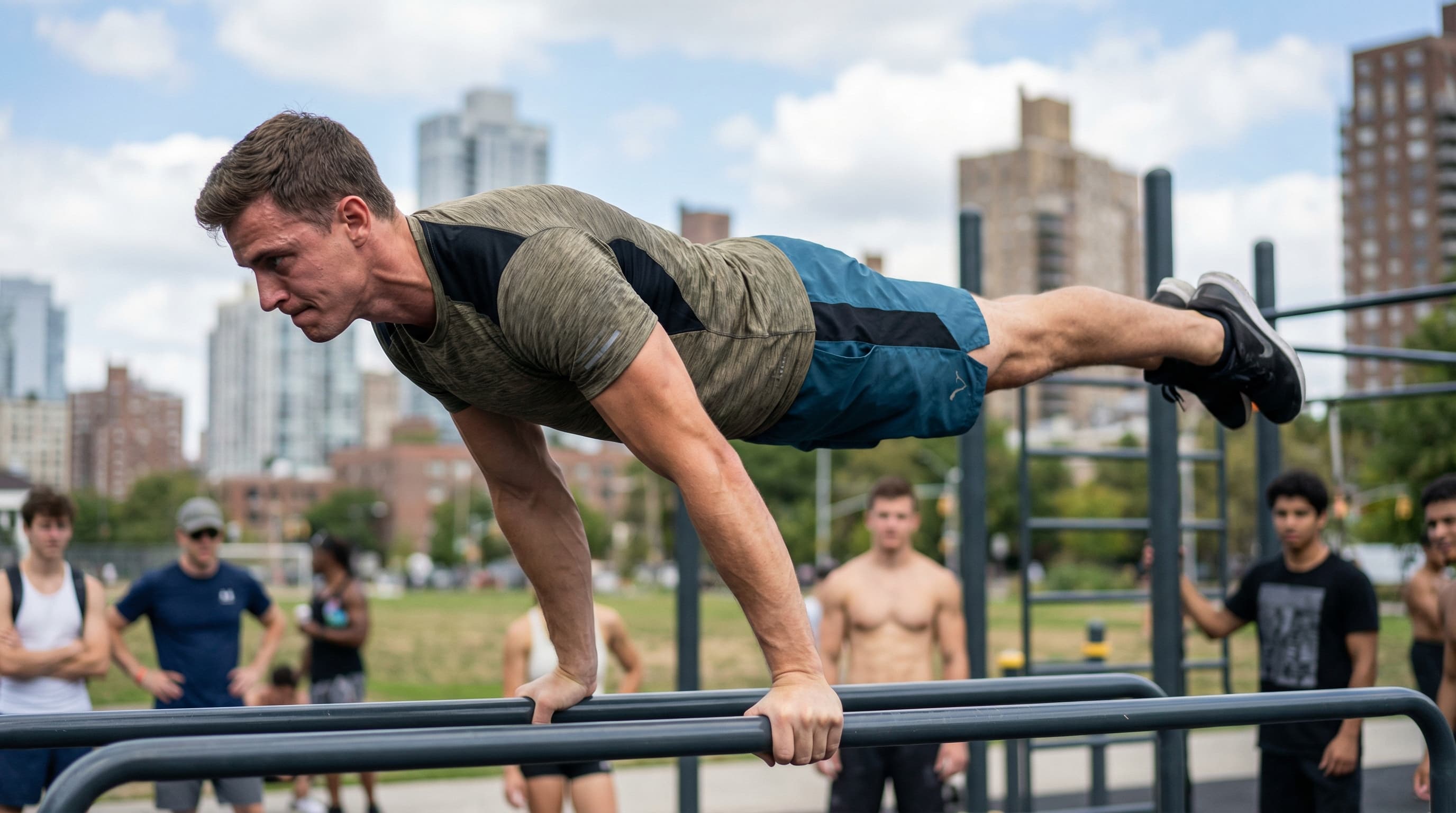
What is Functional Strength? (Definition & Science)
Functional Strength Definition: Functional strength is the ability to generate force through integrated, multi-joint movement patterns that translate to real-world activities. Unlike isolated strength (moving heavy weight in a single plane), functional strength combines force production with stability, coordination, balance, and mobility across multiple muscle groups simultaneously.
Key Characteristics: Multi-planar movement, full-body integration, balance under load, transferable to daily activities, and maintained throughout natural ranges of motion.
The fitness industry often conflates strength with force production alone. You can bench press 300 pounds but struggle to carry groceries up stairs while opening a door. You can squat heavy but lack the stability to climb on furniture safely. You can deadlift impressive weight but can't lift a child overhead without back strain.
This disconnect exists because traditional weightlifting optimizes for maximum force production in stable, predictable environments. Machines guide your movement path. Benches support your body. Barbells move in straight lines. Your stabilizer muscles don't need to work—the equipment does that job.
Real life has no bench, no guided bar path, no stable platform. You lift objects from the ground at awkward angles. You push heavy doors while balancing on one leg. You climb over obstacles. You catch yourself from falling. You move in three dimensions simultaneously while maintaining balance and control.
Bodyweight training builds strength in this context—force production that occurs alongside stability, balance, proprioception, and coordination. Every bodyweight exercise requires you to control your entire body through space, engaging dozens of stabilizer muscles that weightlifting often neglects. This is functional strength: strength that actually functions when you need it.
The Research: Bodyweight vs Weightlifting Studies
Academic research increasingly supports bodyweight training's effectiveness for functional strength development. Here's what the science shows:
Comparable Muscle Activation
A 2020 study in the Journal of Sports Science & Medicine by Alizadeh et al. tested 20 resistance-trained adults on push-ups and bench press performed with equivalent relative load. Prime-mover activation was comparable between the two exercises—but the push-up is a closed-chain movement that also requires you to stabilize your own bodyweight, a demand the bench (which supports your entire torso) removes entirely.
Scapular & Core Stabilizer Recruitment
Research by Ludewig et al. (2004), published in the American Journal of Sports Medicine, found the standard push-up drives serratus anterior activation up to 123% of maximum voluntary contraction with a low upper-trapezius-to-serratus ratio (<0.2)—a scapular-stabilizer demand the bench press, which fixes your shoulder blades against a pad, doesn't replicate. To be balanced about it: this isn't a blanket rule. Research on loaded instability training shows heavy free-weight lifts like squats and deadlifts can match or exceed unstable bodyweight work for core activation—the real advantage of bodyweight training is stabilizer recruitment without any external load at all.
Enhanced Proprioception
A controlled study by Thomas et al., published in Isokinetics and Exercise Science, put 28 men through 8 weeks of calisthenics-only training. Compared to a non-training control group, the calisthenics group significantly improved posture (p < 0.001 with eyes open, p < 0.05 with eyes closed) alongside measurable strength and body composition gains—evidence that unloaded, full-body movement training builds real proprioceptive and postural control, qualities essential for injury prevention.
Transfer to Athletic Performance
A 2021 systematic review in Frontiers in Physiology screened 145 studies down to 9 that met eligibility criteria and found functional training—movement-pattern-based training emphasizing core stability and multi-joint coordination, the same qualities bodyweight training develops—produced significant gains in sprint speed, vertical jump power, balance, and agility. Not every metric moved (body composition showed no significant change), but the movement-quality gains were consistent across studies.
Critical Research Note: Most strength research historically focused on weightlifting because it's easier to quantify and standardize. Recent studies examining functional strength—not just force production—consistently show bodyweight training produces equal or superior outcomes for real-world movement patterns. The key metric isn't "how much weight can you lift?" but rather "can you control your body through complex movements?"
7 Ways Bodyweight Training Builds Superior Functional Strength
Integrated Stabilization Requirements
Every bodyweight exercise requires full-body stabilization that weightlifting often eliminates.
The Difference: When you do a push-up, you must simultaneously maintain a rigid plank position (core stability), prevent shoulder blade winging (scapular control), keep hips level (anti-rotation), and control the pushing movement. Your entire body works as an integrated unit.
Compare this to a bench press: you lie on a stable bench that supports your entire body. Your core doesn't need to stabilize—the bench does that. Your only job is to push the bar. This builds isolated pushing strength but neglects the stabilization systems you need for real-world movements.
Real-World Application: Pushing a heavy door while carrying groceries, catching yourself from falling, climbing over obstacles—all require integrated stability that bodyweight training develops naturally.
Relative Strength Development
Bodyweight training optimizes your strength-to-weight ratio, the most functional measure of strength.
The Science: Relative strength (strength per pound of bodyweight) is more predictive of functional performance than absolute strength (total force production). You carry your bodyweight everywhere—up stairs, into bed, through your day. The ability to control and move your own body is fundamental to all movement.
Weightlifting can build high absolute strength while your relative strength decreases (if you gain weight faster than strength). Bodyweight training inherently optimizes relative strength—if you can't move your body, you need to either get stronger or lighter, both of which improve function.
Example: An athlete who can bench press 300lbs but can't do 10 pull-ups has high absolute strength but poor relative strength. An athlete doing 20+ pull-ups may bench less but has superior functional pulling strength for climbing, hanging, and bodyweight control.
Multi-Planar Movement Patterns
Life happens in three dimensions; bodyweight training prepares you for that reality.
The Movement Science: Most weightlifting occurs in the sagittal plane (forward and backward). Barbell squats, bench press, deadlifts—straight up and down, forward and back. But human movement is three-dimensional: sagittal (forward/back), frontal (side-to-side), and transverse (rotational).
Bodyweight training naturally incorporates all three planes. Side planks (frontal), rotational movements (transverse), lunges in multiple directions (all planes), crawling patterns (complex multi-planar). This builds strength that transfers to the unpredictable, multi-directional nature of real movement.
Athletic Insight: Elite athletes in every sport—from gymnastics to football—incorporate extensive bodyweight training specifically for its multi-planar strength development. You rarely move in perfectly straight lines in sports or life.
Natural Range of Motion Training
Bodyweight exercises respect your individual biomechanics instead of forcing you into standardized patterns.
The Biomechanics: Barbells and machines dictate your movement path. Your body must adapt to the equipment, even if that pattern doesn't match your natural biomechanics. This is why some people feel shoulder pain from barbell bench press or knee pain from leg extensions—the fixed path creates joint stress.
Bodyweight training allows natural movement paths. Your shoulders can move how they want during push-ups. Your knees track naturally during squats. Your spine moves through its designed ranges during planks. This reduces injury risk while building strength through functional, individual-specific ranges of motion.
Injury Prevention: Physical therapists increasingly prescribe bodyweight exercises for rehabilitation because they build strength without forcing compromised joints through fixed, potentially harmful movement patterns.
Proprioception and Body Awareness
Controlling your body through space develops neuromuscular coordination that machines can't replicate.
The Neuroscience: Proprioception—your sense of where your body is in space—is developed through unstable, full-body movements. Every handstand, pistol squat, or L-sit requires precise proprioceptive feedback. Your nervous system learns to sense tiny position changes and make instant corrections.
Weightlifting on stable equipment provides less proprioceptive demand. The machine or bench stabilizes you, so your nervous system doesn't develop the same body awareness. This is functional strength's hidden advantage: the ability to sense and respond to your body's position in real-time.
Fall Prevention: Research shows bodyweight training significantly reduces fall risk in older adults by improving proprioception and reactive balance—critical functional abilities that machine-based training doesn't develop as effectively.
Compound Movement by Default
Nearly every bodyweight exercise is compound, training multiple muscle groups simultaneously.
The Efficiency: A single push-up trains chest, shoulders, triceps, core, serratus anterior, and glutes. A pull-up works lats, biceps, forearms, core, and scapular stabilizers. A squat engages quads, glutes, hamstrings, core, and calves. You can't isolate muscles effectively with bodyweight training—and that's the point.
Gyms offer isolation exercises: bicep curls, leg extensions, pec flys. These build muscles in isolation but don't teach those muscles to work together. Real-world strength requires coordinated effort across multiple muscle groups. Bodyweight training develops this integration naturally because you can't cheat—your whole body must cooperate to move your body through space.
Time Efficiency: Because bodyweight exercises train multiple muscle groups simultaneously, you build functional strength faster than isolation-heavy weightlifting routines that work one muscle at a time.
Scalable Progressive Resistance
Bodyweight progressions build strength through leverage and skill, not just added load.
The Progression Path: Weightlifting increases difficulty by adding more weight—straightforward but limited. Bodyweight training increases difficulty through leverage changes (wall push-ups → decline push-ups → planche push-ups), skill requirements (pull-ups → archer pull-ups → one-arm pull-ups), and instability (lunges → pistol squats).
This progression methodology develops not just strength but also coordination, balance, and body control. A one-arm push-up requires strength comparable to heavy bench press but also demands anti-rotation core strength, shoulder stability, and precise body positioning—all functional qualities that translate to real-world movement better than pure force production.
Infinite Progression: Elite calisthenics athletes perform movements like planches, front levers, and one-arm pull-ups that require strength-to-weight ratios exceeding what most weightlifters achieve. The skill ceiling is remarkably high.
"The athletes who struggle most when they finally try bodyweight training aren't the weak ones—they're often the strongest lifters in the room. A 300lb bench press doesn't teach your shoulders to stabilize themselves. The first time someone who's never done a proper push-up progression tries a pistol squat, the gap between their gym strength and their control shows up immediately."
When Weightlifting Has Advantages (Being Honest)
Bodyweight training excels at functional strength, but weightlifting has legitimate advantages for specific goals. Here's the balanced perspective:
Maximum Absolute Strength
Weightlifting Wins: If your goal is maximum force production in a single lift (powerlifting, strongman), weights are superior. Adding external load is simpler and more measurable than bodyweight progressions for pure strength development. A 500lb deadlift requires absolute strength that bodyweight training alone won't build.
Lower Body Mass Building
Weightlifting Advantage: Building significant leg mass is harder with bodyweight alone. While pistol squats and single-leg progressions build impressive strength, heavy barbell squats and deadlifts load the legs more directly for muscle hypertrophy. If your goal is maximum leg size, weights are more efficient.
Easier Micro-Progression
Weightlifting Convenience: Adding 5 pounds to a barbell is simpler than progressing from regular push-ups to the next harder variation. Weight progression is linear and measurable. Bodyweight progression requires learning new movement patterns and skills, which some find more challenging.
Targeted Isolation Work
Weightlifting Purpose: Isolation exercises (bicep curls, calf raises, lateral raises) target specific muscles for hypertrophy or addressing weaknesses. Bodyweight training emphasizes compound movements—harder to isolate specific muscles. For bodybuilding or physique goals, weights offer more precise control.
The Integrated Approach
Best of Both Worlds: Many athletes combine bodyweight training for functional strength, mobility, and relative strength with strategic weightlifting for absolute strength and targeted muscle building. The question isn't "which is better?" but rather "which better serves your specific goals?" For most people pursuing functional fitness, health, and real-world strength, bodyweight training delivers superior results. For competitive strength sports or maximum muscle mass, weights have advantages.
Real-World Functional Strength Scenarios
Functional strength reveals itself in daily activities and unexpected situations. Here's how bodyweight training prepares you for real life:
Scenario: Carrying Kids & Groceries
Required Strength: Unilateral loading (one-sided weight), core anti-rotation, dynamic balance, sustained hold strength
Bodyweight Preparation: Single-leg squats, side planks, L-sits, farmer carries (using bodyweight progressions)
Why It Works: These movements train your body to stabilize under asymmetric loads while maintaining balance—exactly what carrying real objects requires.
Scenario: Climbing Stairs With Luggage
Required Strength: Unilateral leg strength, cardiovascular endurance under load, grip endurance, postural stability
Bodyweight Preparation: Step-ups, Bulgarian split squats, walking lunges, dead hangs
Why It Works: Single-leg bodyweight exercises build the exact strength pattern used in stair climbing—each leg bearing your full bodyweight independently.
Scenario: Catching Yourself From Falling
Required Strength: Reactive strength, eccentric control, proprioception, rapid stabilization
Bodyweight Preparation: Negative pull-ups, controlled lowering movements, balance work, plyometric exercises
Why It Works: Eccentric strength (controlling lowering) and reactive balance are naturally developed through bodyweight training—critical for injury prevention.
Scenario: Playing With Kids/Pets
Required Strength: Multi-directional movement, ground-to-standing transitions, sustained play capacity, flexibility under load
Bodyweight Preparation: Get-ups, crawling patterns, burpees, squats, dynamic movements
Why It Works: Playful, natural movements require full-body coordination and strength through varied ranges—exactly what bodyweight training develops.
Scenario: Emergency Situations
Required Strength: Pulling yourself up (ledges, walls), pushing heavy objects, sprinting, climbing, sustained exertion
Bodyweight Preparation: Pull-ups, push-ups, climbing movements, sprint work, high-intensity circuits
Why It Works: Emergency situations demand you move and control your body effectively—the literal definition of bodyweight functional strength.
Scenario: Outdoor Recreation
Required Strength: Climbing ability, scrambling over terrain, carrying packs, balance on uneven surfaces
Bodyweight Preparation: Pull-ups, climbing progressions, single-leg balance work, full-body movements
Why It Works: Outdoor activities require you to move your body through unpredictable terrain—functional strength at its purest.
The Pattern Recognition
Notice a pattern? Real-world scenarios demand bodyweight control, stability, balance, and multi-directional strength. They don't ask you to lie on a stable bench and push weight straight up. Bodyweight training develops strength in the contexts where you'll actually use it—controlling and moving your body through unpredictable, varied situations.
How to Build Functional Strength with Bodyweight Training
Understanding why bodyweight training builds functional strength is one thing—knowing how to implement it is another. Here's your actionable framework:
1. Master the Foundational Movement Patterns
Build competency in the six fundamental human movements:
- Vertical Push: Handstand progressions, pike push-ups
- Horizontal Push: Push-up variations, dips
- Vertical Pull: Pull-ups, chin-ups
- Horizontal Pull: Inverted rows, body rows
- Squat: Bodyweight squats, pistol progressions
- Hinge: Single-leg deadlift, bridges
Each pattern builds specific functional strength that transfers to daily activities. Don't skip patterns—you need balanced development.
2. Progress Through Leverage, Not Just Reps
Functional strength comes from making exercises harder, not just doing more reps:
- Change Leverage: Wall push-ups → regular → decline → pseudo-planche
- Remove Support: Two-leg squats → assisted pistol → full pistol
- Add Instability: Floor planks → feet elevated → one leg
- Increase Range: Parallel dips → deep dips → ring dips
Once you can do 12-15 reps of an exercise with good form, progress to a harder variation. This builds continuous functional adaptation.
3. Incorporate Multi-Planar Movements
Add exercises that move in all three planes:
- Frontal Plane: Side planks, lateral lunges, side-to-side movements
- Transverse Plane: Rotation planks, twisting movements, woodchops
- Combined: Crawling patterns, animal movements, natural flow
Real-world strength requires movement in all directions. Don't limit yourself to just forward/backward exercises.
4. Build Isometric and Eccentric Strength
Functional strength includes holding positions and controlling descents:
- Isometric Holds: Planks, L-sits, wall sits, hollow body holds
- Eccentric Work: Negative pull-ups, slow push-up descents, controlled lowering
- Pause Reps: Bottom-of-squat pauses, top-of-pull-up holds
Real-world scenarios often require sustained holds or controlled lowering. Train both concentric (lifting) and eccentric (lowering) strength equally.
5. Train Movement Skills, Not Just Strength
Advanced bodyweight skills develop functional qualities:
- Handstand Work: Develops shoulder stability, balance, body awareness
- L-Sit Progressions: Builds core compression, hip flexor strength, midline control
- One-Arm Variations: Forces anti-rotation, unilateral strength, stabilization
- Dynamic Movements: Muscle-ups, burpees, jump variations for power
These movements look impressive but more importantly develop functional capacities: balance, coordination, body control, reactive strength.
Sample Weekly Functional Strength Program
Day 1 - Push: Push-up progressions, pike push-ups, dips, plank variations
Day 2 - Pull: Pull-up progressions, inverted rows, dead hangs, scapular work
Day 3 - Legs: Squat variations, single-leg work, lunges, bridges
Day 4 - Skills: Handstand practice, L-sit progressions, mobility work
Day 5 - Full Body: Complex movements, circuits, integrated patterns
Progression: Every 2-3 weeks, make exercises harder through leverage changes, increased range of motion, or added instability. Track your progressions to ensure continuous adaptation.
Common Misconceptions Debunked
Myth: "You Need Weights to Build Real Strength"
Reality: Gymnasts, who train almost exclusively with bodyweight, display some of the most impressive relative strength of any athletes. Research shows bodyweight training builds comparable strength to weightlifting when intensity is matched.
The confusion comes from defining "real strength." If you mean absolute strength (maximum weight lifted), weights have an edge. If you mean functional strength (controlling your body through complex movements), bodyweight training is superior.
Myth: "Bodyweight Training is Only for Beginners"
Reality: Try a one-arm pull-up, full planche, or front lever and see if it feels beginner-level. Elite bodyweight movements require years of dedicated training and strength that exceeds what most weightlifters develop.
The progression ceiling in calisthenics is remarkably high—far beyond what most people ever achieve. Bodyweight training scales from complete beginners to world-class athletes.
Myth: "You Can't Build Muscle Without Weights"
Reality: Muscle growth (hypertrophy) responds to mechanical tension, metabolic stress, and muscle damage—all achievable with bodyweight training. Progressive push-ups, pull-ups, and dips build muscle just like bench press and rows.
The key is progressive overload: making exercises progressively harder over time. Bodyweight training achieves this through leverage and skill progression rather than added weight.
Myth: "Functional Training is Just Marketing Hype"
Reality: The term "functional" has been misused by the fitness industry, but the concept is scientifically valid. Functional strength refers to strength that transfers to activities outside the gym—a measurable, research-backed concept.
Studies consistently show that training specificity matters. If you train movements that require stability, balance, and multi-joint coordination, you get better at real-world activities that require those qualities. That's functional training.
Myth: "Bodyweight Training Doesn't Work for Legs"
Reality: Single-leg progressions like pistol squats, shrimp squats, and single-leg deadlifts build impressive leg strength. Your bodyweight on one leg provides significant resistance—a 180lb person does a 180lb pistol squat.
While building maximum leg mass is slower with bodyweight alone, functional leg strength (balance, unilateral power, stability) is exceptionally well-developed through bodyweight training.
Myth: "Weight Training is More Time Efficient"
Reality: Bodyweight training eliminates commute time to the gym, setup time for equipment, and waiting for machines. A complete bodyweight workout can be done in 30-45 minutes anywhere.
Additionally, bodyweight exercises work multiple muscle groups simultaneously (compound movements), making them more time-efficient than isolation-heavy weightlifting routines that work one muscle at a time.
The Bottom Line
Bodyweight training builds superior functional strength for most people because it develops force production alongside stability, balance, coordination, and body control. It trains your body to move effectively through space—the literal definition of functional strength.
Weightlifting has legitimate advantages for specific goals—maximum absolute strength, targeted muscle isolation, easier micro-progression. But for functional fitness, injury prevention, relative strength, and real-world movement quality, bodyweight training consistently delivers superior results.
The best training is the training you'll actually do consistently. If you prefer the gym and weights, train with weights. If you value the accessibility, practicality, and functional nature of bodyweight training, that's your answer. Both build strength—bodyweight training just happens to build the kind of strength most people actually need for life outside the gym.
Frequently Asked Questions
Does bodyweight training build as much muscle as weightlifting?
Can bodyweight training make you as strong as weightlifting?
Why do bodyweight exercises feel harder than weights?
Is bodyweight training better for fat loss than weightlifting?
Can beginners build strength with just bodyweight exercises?
Do athletes use bodyweight training or just weightlifting?
Build Your Functional-Strength Week
Choose your goal and schedule, and Odin will turn bodyweight strength principles into a personalized weekly plan you can follow anywhere.
Build My Free Weekly Plan