
L-Sit Progression: Beginner to 30 Seconds
Master the L-sit with this step-by-step progression guide. From foot-supported holds to 30-second L-sits, learn the exact training system used by gymnasts and calisthenics athletes.
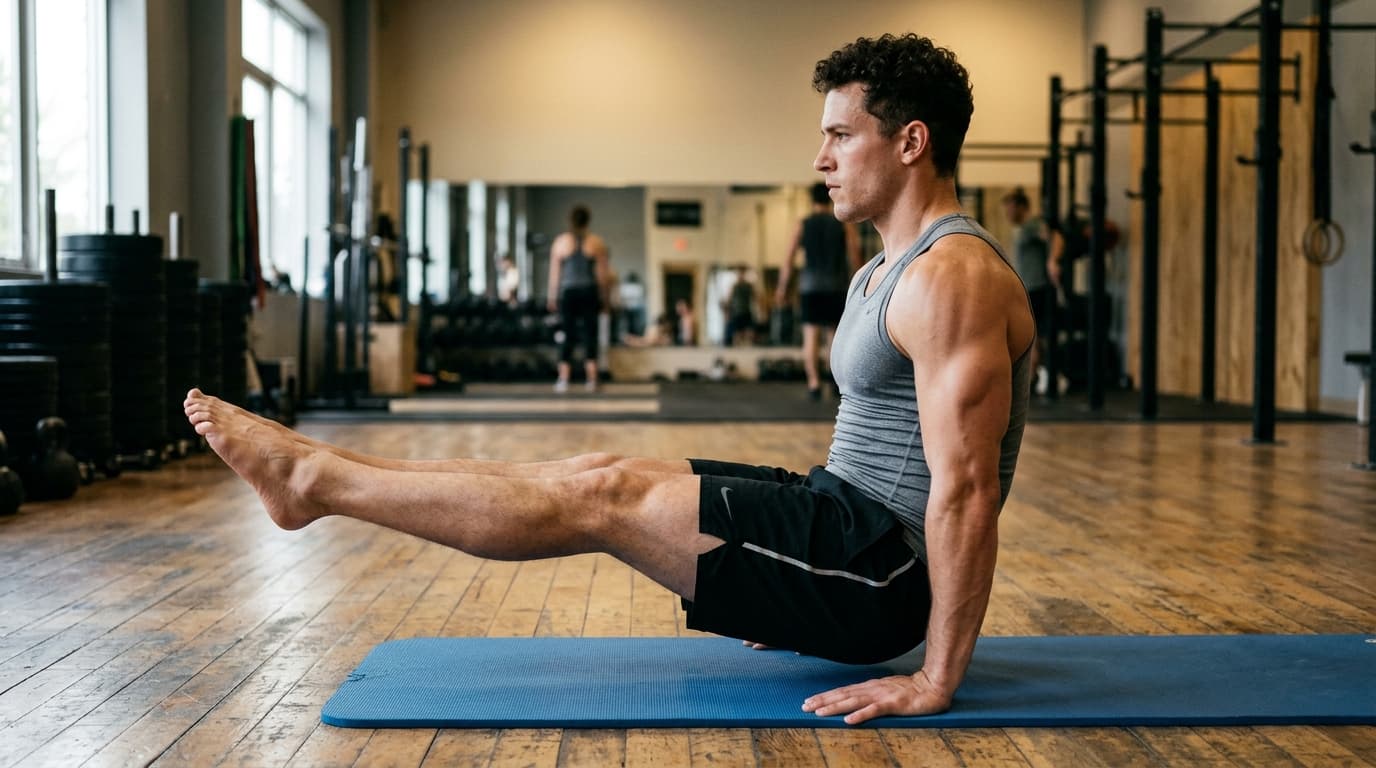
TL;DR: Quick L-Sit Progression Summary
- Timeline: 8-16 weeks from beginner to 30-second L-sit with consistent training (3-4x per week)
- Prerequisites: 30-second plank hold, 10 push-ups, basic scapular depression strength
- Progression path: Foot-supported → One-leg → Tuck → Advanced tuck → Full L-sit
- Key muscles: Hip flexors (primary), core, shoulder stabilizers, triceps
- Training frequency: 3-4 sessions per week with 48-hour rest between sessions
- Most common mistake: Skipping progressions and attempting full L-sit too early
What is an L-Sit and Why Does It Matter?
Definition: An L-sit is an isometric bodyweight hold where you sit on the ground with legs extended parallel to the floor, arms straight, and hands pressing into the ground beside your hips—lifting your entire body off the floor while maintaining a 90-degree angle between torso and legs, forming an "L" shape.
The L-sit is one of the fundamental static holds in calisthenics and gymnastics. It builds exceptional core compression strength, hip flexor endurance, and scapular stability—qualities that transfer to nearly every advanced bodyweight skill including handstands, front levers, and muscle-ups.
As documented on Wikipedia's entry on the L-sit, the hold originates in artistic gymnastics and can be performed on the floor, rings, parallel bars, or parallettes—with a "straddle" variant that widens the legs to reduce hamstring demand. In calisthenics gyms and CrossFit boxes, L-sit holds are a standard benchmark for compression strength before progressing to skills like the V-sit or manna.
Just want the quick version — definition, muscles worked, and realistic hold-time benchmarks by level, without the full program? See L-Sit: The Basics.
Why L-Sits Matter for Your Training
- Functional core strength: Unlike crunches, L-sits build anti-extension strength—your ability to resist spinal extension under load
- Hip flexor development: Crucial for running, kicking, and dynamic movements
- Shoulder stability: Teaches proper scapular depression and protraction under sustained load
- Minimal equipment: Requires only floor space or parallettes—train anywhere
- Skill gateway: Prerequisite for V-sits, manna progressions, and advanced ring work
- Transferable strength: The isometric loading pattern (heavy tension held for a fixed duration) is the same mechanism used to train front levers and planche progressions—time invested in L-sits compounds into other static-hold skills
What Muscles Does the L-Sit Work?
The L-sit is a compound isometric exercise that creates high muscular activation across multiple muscle groups simultaneously. Understanding which muscles are working helps you diagnose weaknesses and optimize training:
Primary Muscles (Highest Activation)
- Hip Flexors (Iliopsoas): Responsible for lifting and holding legs parallel to ground. Because the L-sit is a sustained isometric hold rather than a brief contraction, it falls squarely in the hypertrophy-focused isometric training zone.
- Rectus Abdominis (Six-Pack): Maintains spinal position and prevents lower back arching. Creates isometric tension throughout the hold.
- Triceps Brachii: Keep arms locked straight while supporting bodyweight. Particularly active in the long head.
- Serratus Anterior: Protracts and stabilizes scapulae (shoulder blades), preventing shoulder elevation.
Secondary Muscles (Supporting Role)
- Anterior Deltoids: Assist in shoulder flexion and stabilization during the hold.
- Obliques (Internal and External): Prevent rotation and lateral flexion, maintaining alignment.
- Quadriceps: Keep legs fully extended and knees locked straight throughout the hold.
- Erector Spinae (Lower Back): Work isometrically to maintain neutral spine positioning.
- Scapular Stabilizers: Rhomboids, lower traps, and levator scapulae maintain shoulder blade position.
Research insight: A 2007 EMG study in the Journal of Orthopaedic & Sports Physical Therapy by Ekstrom, Donatelli, and Carp measured muscle activation across nine hip- and trunk-stabilization exercises and found that hip-flexion-dominant movements consistently drove high hip flexor and core recruitment—supporting why sustained hip-flexed holds like the L-sit are an effective (if demanding) way to train this muscle group. See the research section below for a full breakdown of the evidence behind this progression system.
Is the L-Sit Actually Backed by Research?
Short answer: Yes. While no peer-reviewed study has isolated the L-sit specifically, the exercise science behind isometric training and hip-flexion-dominant core exercises directly supports the progression system in this guide.
A 2019 review in the International Journal of Sports Medicine by Lum and Barbosa analyzed the effects of isometric strength training on strength and dynamic performance. The review concluded that isometric holds performed at 70-75% of maximum voluntary contraction for 3-30 seconds per repetition reliably drive hypertrophy, while holds at 80-100% MVC for 1-5 seconds are more effective for maximum strength. This is exactly why the progression path in this guide layers shorter, harder holds (full L-sit at 3-5 seconds) on top of longer, easier ones (foot-supported holds at 10-30 seconds)—it mirrors the dosing that produces measurable adaptation in the research.
Because no controlled trial has measured the L-sit in isolation, the closest available evidence comes from studies on biomechanically similar hip-flexion movements. A 2001 study commissioned by the American Council on Exercise and conducted by Dr. Peter Francis at the San Diego State University Biomechanics Lab put 30 subjects through 13 common abdominal exercises while measuring muscle activity with EMG. The captain's chair—a hanging knee-raise that shares the same hip-flexion mechanics as the L-sit's tuck and full positions—produced 212% of the rectus abdominis activity and 310% of the oblique activity generated by a traditional crunch, ranking second overall out of the 13 exercises tested. That is direct evidence that hip-flexion-driven core holds like the L-sit outwork spinal-flexion exercises (crunches, sit-ups) for the same muscle groups.
"The average exerciser appears unable to differentially recruit the upper and lower abdominal muscles... [the] data suggest that the upper and lower rectus abdominis act as a sheath, or one large muscle group."
The practical takeaway: you cannot selectively target "lower abs" with an L-sit any more than you can with a crunch—but the whole-abdomen, whole-hip-flexor tension it creates is measurably higher than isolated ab exercises. Separately, the 2007 JOSPT study by Ekstrom, Donatelli, and Carp found that exercises requiring sustained hip and trunk stabilization—the same demand an L-sit places on the body—are effective tools for building the kind of strength needed for higher-level movement, reinforcing why compression-style accessory work (see the accessory exercises section below) pairs well with direct L-sit practice.
| Exercise | Rectus Abdominis Activity | Oblique Activity |
|---|---|---|
| Traditional Crunch | 100% (baseline) | 100% (baseline) |
| Reverse Crunch | 109% | 240% |
| Captain's Chair (hip-flexion hold, closest proxy to L-sit) | 212% | 310% |
Source: Francis, P. (2001), ACE-commissioned study, San Diego State University Biomechanics Lab. Values are EMG activity relative to a traditional crunch (100% baseline).
Prerequisites: Are You Ready for L-Sit Training?
Before attempting L-sit progressions, you should have baseline core stability, shoulder strength, and body awareness. Testing these prerequisites prevents frustration and reduces injury risk:
Prerequisite Strength Tests
✓ Test 1: Plank Hold (30 seconds minimum)
How to test: Hold a forearm plank with neutral spine, squeezing glutes and core. If you can maintain perfect form for 30+ seconds without hips sagging or elevating, you pass.
Why it matters: Demonstrates basic anti-extension core strength—required to prevent lower back arching in L-sits.
✓ Test 2: Push-ups (10 reps minimum)
How to test: Perform push-ups with chest touching the ground, full arm extension at top, neutral spine throughout. If you can complete 10 quality reps, you pass.
Why it matters: Indicates sufficient triceps, chest, and shoulder pressing strength to support bodyweight in L-sit position.
✓ Test 3: Scapular Depression (20 seconds)
How to test: Sit on the floor with legs extended, hands beside hips. Press down hard, pushing shoulders away from ears (opposite of shrugging). Hold shoulders maximally depressed for 20 seconds.
Why it matters: Scapular depression is the foundation of L-sit mechanics—without it, you cannot generate enough upward force to lift your body.
✓ Test 4: Seated Pike Flexibility (Optional but Helpful)
How to test: Sit with legs extended, reach forward toward toes. Can you touch your toes without rounding your back excessively?
Why it matters: Hamstring flexibility affects hip flexion range. Tighter hamstrings make L-sits harder but don't prevent progress—you'll build active flexibility through training.
What If You Don't Meet Prerequisites?
If you fail one or more tests, spend 2-4 weeks building foundational strength before starting L-sit progressions:
- For weak planks: Train planks 3x per week, progressing from 20 seconds to 60+ seconds
- For weak push-ups: Use incline push-ups (hands elevated) to build strength, progress to floor push-ups
- For weak scapular depression: Practice scapular push-ups (in plank position, push shoulders away from ears, 3 sets of 15 reps)
- For tight hamstrings: Daily pike stretches (30-60 seconds) and active leg raises
The 6-Stage L-Sit Progression Path
This progression system takes you from complete beginner to 30-second L-sit through six distinct stages. Each stage builds the strength and technique required for the next. Do not skip stages—mastery at each level ensures safe, sustainable progress.
12-Week L-Sit Training Program
This program integrates L-sit progressions with accessory exercises for balanced development. Train 3-4 days per week with at least one rest day between sessions.
| Week | L-Sit Variation | Sets × Time | Accessory Work |
|---|---|---|---|
| 1-2 | Foot-Supported L-Sit | 3-4 × 10-30s | Planks (3×30s), Pike pulses (3×10) |
| 3-4 | One-Leg L-Sit | 3-4 × 10-20s each leg | Scapular push-ups (3×15), Leg raises (3×8) |
| 5-6 | Tuck L-Sit | 4-5 × 8-15s | Compression work (3×10), Dead hangs (3×20s) |
| 7-8 | Advanced Tuck L-Sit | 4-5 × 8-12s | Pike stretches (3×30s), V-ups (3×8) |
| 9-10 | Full L-Sit | 5-6 × 3-8s | Hollow body holds (3×20s), Dips (3×8) |
| 11-12 | Full L-Sit (Duration Build) | 4-5 × 10-20s | L-sit pull-throughs (3×5), Support holds (3×30s) |
Sample Training Session (Week 5-6: Tuck L-Sit Phase)
Warm-up: Wrist circles, shoulder rotations, cat-cow stretches, scapular activation (5 minutes)
Main work - Tuck L-Sit: 5 sets × 8-15 seconds, rest 90-120 seconds
Accessory 1 - Compression Work: 3 sets × 10 reps (seated, pull knees to chest)
Accessory 2 - Dead Hangs: 3 sets × 20-30 seconds (grip and shoulder stability)
Accessory 3 - Pike Stretches: 2 sets × 30 seconds (hamstring flexibility)
Cool-down: Hip flexor stretches, shoulder stretches (5 minutes)
Sample Training Session (Week 9-10: Full L-Sit Phase)
Warm-up: Wrist circles, scapular push-ups (2×10), tuck L-sit holds at 50% effort (2×5 seconds) (5 minutes)
Main work - Full L-Sit: 5-6 sets × 3-8 seconds (building toward your max), rest 2-3 minutes between sets
Accessory 1 - Hollow Body Holds: 3 sets × 20 seconds (reinforces posterior pelvic tilt under fatigue)
Accessory 2 - Dips: 3 sets × 6-8 reps (shoulder and triceps strength transfer)
Accessory 3 - Support Holds: 2 sets × 30 seconds (builds the shoulder endurance needed to hold the final position longer)
Cool-down: Hip flexor stretches, wrist stretches, deep breathing (5 minutes)
Fit L-Sit Practice Around Your Other Training
Tell Odin your level and available days to build a balanced week with focused L-sit practice and enough recovery.
Build My L-Sit ScheduleForm Cues and Technique Coaching
Proper form is non-negotiable for L-sits. Small technical adjustments make the difference between success and frustration. Use these coaching cues to refine your technique:
Critical Form Points
1. Scapular Depression (Shoulder Position)
Cue: "Push the floor away" or "Drive shoulders toward hips." Shoulders should be maximally depressed (pushed down), never shrugged up toward ears. This creates the upward force needed to lift your body.
Test: In the L-sit position, your ears and shoulders should have maximum distance. If shoulders creep toward ears, you lose leverage.
2. Posterior Pelvic Tilt (Hip Position)
Cue: "Tuck your tailbone" or "Round lower back slightly." This engages the abs and prevents excessive lower back arch. Your pelvis should tilt backward, not forward.
Test: Place one hand on your lower back. You should feel abs engaged and lower back slightly rounded, not a deep arch.
3. Straight Arms (Lockout)
Cue: "Lock elbows completely" or "Arms straight as steel rods." Even slight elbow bend dramatically increases difficulty and reduces hold time. Full triceps engagement is required.
Test: Arms should be completely straight—no visible bend at the elbow joint. Film from the side to verify.
4. Leg Position (Parallel to Ground)
Cue: "Legs laser-level with the horizon" or "Toes point at the wall ahead." Legs should be exactly parallel to the floor—not angled up or down. Knees locked straight, toes pointed.
Test: Set up your phone camera at hip height. In the L-sit, your legs should align perfectly with the camera lens.
5. Hand Position
Cue: "Fingers point forward" or "Spread fingers for stability." Hands should be placed beside hips (slightly behind), fingers pointing forward. This maximizes shoulder depression leverage.
Tip: If using parallettes or push-up bars, grip tightly—active hands create more stability than passive hands.
Breathing During L-Sits
Many athletes hold their breath during L-sits, which limits hold time and increases blood pressure. Instead, breathe shallowly and continuously through your nose or mouth. Tension should come from muscle engagement, not breath-holding. Practice maintaining the L-sit position while taking small, controlled breaths. Holding your breath (a Valsalva-style brace) can briefly stiffen your core, but over a 15-30 second hold it spikes blood pressure and starves you of oxygen right when you need consistent output the most—train your breathing pattern in the earlier, easier stages so it's automatic by the time you're chasing a 30-second full L-sit.
Common L-Sit Mistakes and How to Fix Them
Shoulders Shrugging Up (Loss of Depression)
The problem: Shoulders creep toward ears during the hold, losing leverage and making the L-sit collapse prematurely.
The fix: Practice scapular push-ups (in plank position, push shoulders down and away from ears without bending elbows). Do 3 sets of 15 reps before L-sit training. During L-sits, actively think "push floor away" throughout the entire hold.
Lower Back Arching (Anterior Pelvic Tilt)
The problem: Lower back arches excessively (hyperextension), creating discomfort and reducing core engagement.
The fix: Strengthen posterior pelvic tilt awareness through hollow body holds (3 sets × 20-30 seconds). During L-sits, tuck tailbone under and think "pull belly button toward spine." Your lower back should be neutral or slightly rounded, never arched.
Legs Angling Downward (Loss of Hip Flexion)
The problem: Legs start parallel to ground but slowly angle downward as fatigue sets in, breaking the 90-degree L-shape.
The fix: Build hip flexor endurance through compression work. Sit on the floor, grab behind your knees, and pull them toward your chest for 10-15 reps (active compression). Also practice straight-leg lifts from supine position (lying on back). End your L-sit set when legs drop below parallel—quality over quantity.
Progressing Too Fast (Skipping Stages)
The problem: Jumping from foot-supported L-sit directly to full L-sit, skipping intermediate progressions. This leads to poor form, frustration, and potential injury.
The fix: Follow the progression system strictly. Master each stage before advancing (meet the time standards with perfect form). If a stage feels impossible, drop back one level and build strength there. Patience beats ego every time.
Training Too Frequently (Inadequate Recovery)
The problem: Training L-sits daily or 5+ times per week without rest. Hip flexors, core, and shoulders need recovery time.
The fix: Train L-sits 3-4 times per week maximum, with at least one full rest day between sessions. If you experience persistent hip flexor soreness, reduce frequency to 3 sessions per week. Advanced practitioners can handle 4-5 sessions, but beginners need more recovery.
Wrist Pain From Floor Training
The problem: Sharp or aching wrist pain when pressing into the floor with hands flat and fingers forward—common for people who spend a lot of time typing or already have limited wrist extension range.
The fix: Switch to parallettes or push-up bars, which let you grip with a neutral wrist instead of extending it under bodyweight. If parallettes aren't available, try fist-supported L-sits (knuckles down) or place a rolled towel under the base of the palm to reduce the extension angle. Wrist pain that persists despite these changes is a signal to build wrist mobility and pressing tolerance separately before continuing L-sit training.
Bent Knees (Incomplete Extension)
The problem: Legs are elevated but knees remain bent, creating an incomplete L-sit that's significantly easier than the true position.
The fix: This indicates you're at the advanced tuck stage, not full L-sit yet. That's fine—it's a valid progression step. Gradually straighten legs more each week. Also work on hamstring flexibility (pike stretches) and quadricep activation (practice locking knees in leg raises).
Accessory Exercises to Accelerate L-Sit Progress
These supplementary exercises target the specific strength and flexibility qualities required for L-sits. Include 2-3 accessories per training session:
Compression Work (Hip Flexor Strength)
How to do it: Sit on the floor with legs extended. Grab behind your knees and pull them toward your chest using both hands and hip flexors. Hold for 2 seconds, release, repeat.
Sets/Reps: 3 sets × 10-15 reps
Why it helps: Directly strengthens hip flexors in the exact range of motion used in L-sits.
Scapular Push-Ups (Shoulder Stability)
How to do it: In plank position with straight arms, push shoulders down away from ears (scapular depression) without bending elbows. Return to neutral. Repeat.
Sets/Reps: 3 sets × 12-20 reps
Why it helps: Builds scapular depression strength and control, essential for maintaining shoulder position in L-sits.
Hollow Body Holds (Core Strength)
How to do it: Lie on your back, arms overhead, legs straight. Press lower back into floor, lift shoulders and legs 6 inches off ground. Hold.
Sets/Time: 3 sets × 20-40 seconds
Why it helps: Develops anterior core strength and posterior pelvic tilt control.
Pike Stretches (Hamstring Flexibility)
How to do it: Sit with legs extended, reach forward toward toes. Keep back straight (don't round excessively). Hold stretch feeling tension in hamstrings.
Sets/Time: 3 sets × 30-60 seconds
Why it helps: Tight hamstrings limit hip flexion range, making L-sits harder. Improved flexibility allows easier leg positioning.
V-Ups (Dynamic Core + Hip Flexors)
How to do it: Lie flat on back, arms overhead. Simultaneously lift legs and torso, reaching hands toward toes at the top (forming a V). Lower with control.
Sets/Reps: 3 sets × 8-12 reps
Why it helps: Builds dynamic strength through the same muscle groups used in L-sits.
Support Holds (Shoulder Endurance)
How to do it: On parallettes, dip bars, or floor, support your bodyweight with straight arms, shoulders depressed. Hold this position.
Sets/Time: 3 sets × 30-60 seconds
Why it helps: Builds shoulder and triceps endurance for sustained L-sit holds.
How L-Sit Training Fits Into Your Broader Program
L-sit training is an accessory skill, not a full workout—it should sit alongside a broader bodyweight strength program, not replace one. If you're still building your general strength base, work through the first 30 days of a calisthenics roadmap before adding dedicated L-sit sessions—push-up, plank, and pull-up fundamentals give you the pressing and core baseline that makes L-sit progressions click faster.
The dosing principle behind this progression—shorter, harder holds layered on top of longer, easier ones—is a direct application of progressive overload for bodyweight training. If you're also working toward your first pull-up, the scapular depression and shoulder stability built here transfers directly—see the complete guide to your first pull-up for the pulling side of that equation.
A practical way to slot L-sits in: train them at the start of a session (while fresh, since they demand high neuromuscular focus) 2-3 times per week, on days that aren't already leg-flexor-intensive. Pair with pulling work or push-up progressions on the same day rather than stacking L-sits with lower-body-dominant sessions.
Frequently Asked Questions
How long does it take to hold a 30-second L-sit?
What muscles does the L-sit work?
Can beginners do L-sits or do you need to be advanced?
Should I train L-sits every day or give rest days?
Why can't I lift my legs off the ground in an L-sit?
What's the difference between L-sit and V-sit?
Do I need rings or parallettes to train L-sits?
Can L-sit training cause a hip flexor strain?
Fit L-Sit Practice Into Your Training Week
Create a balanced weekly plan that supports core strength and skill work without neglecting the rest of your body.
Build My Free Weekly Plan