
Creatine for Bodyweight Training: Does It Work Without Weights?
Creatine has decades of research behind it — almost all of it done on lifters. Here's what actually happens when you take it without a barbell, the real dosage, and the safety data most supplement pages leave out.
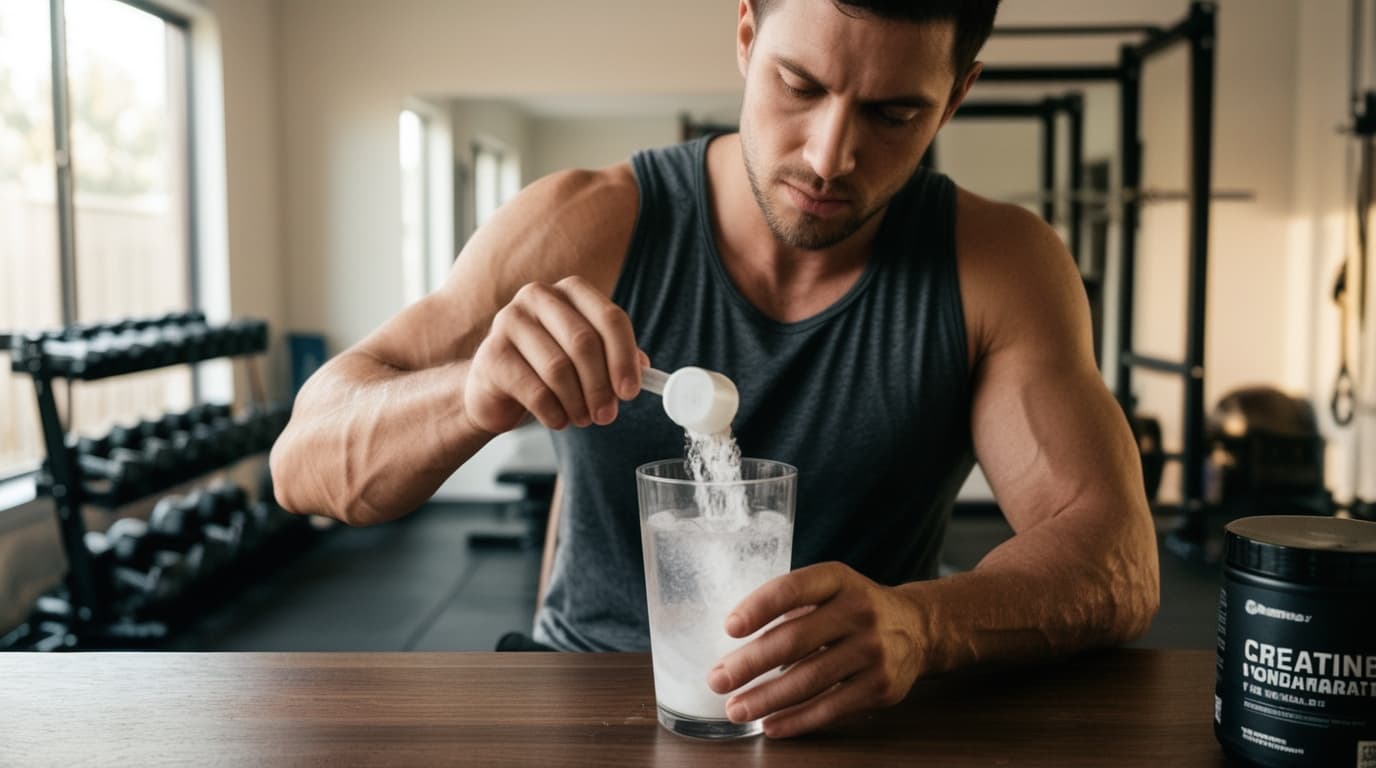
TL;DR — Key Takeaways
- Yes, creatine works without weights. It recharges the ATP-PCr energy system inside muscle cells, which powers any short, hard contraction — a pull-up or pistol squat draws on the exact same system a barbell squat does.
- The dose is simple: 3–5 g of creatine monohydrate daily, every day, indefinitely. A 5–7 day loading phase (0.3 g/kg, split into 4 daily doses) gets you there faster, but it's optional — a flat daily dose reaches full muscle saturation in about 3–4 weeks on its own.
- It's one of the most-studied, safest supplements available. The 2017 ISSN position stand found no evidence of kidney, cramping, or dehydration harm in healthy people at standard doses — the only consistently reported side effect is a small amount of water weight inside the muscle itself.
What Is Creatine and How Does It Work?
The direct answer: Creatine is a naturally occurring compound stored mostly in skeletal muscle that helps regenerate ATP — the molecule your muscle cells burn for energy — during short, intense effort. More creatine in the muscle means faster ATP regeneration, which shows up as an extra rep or two on a hard set, whether that set is a barbell squat or a set of pistol squats.
About 95% of the body's creatine is stored in skeletal muscle, mostly as phosphocreatine (PCr). The liver, kidneys, and pancreas synthesize roughly 1 gram of it per day from amino acids, and an omnivorous diet typically supplies another 1–2 grams daily from red meat and fish — a 7-ounce (200 g) steak contains roughly 1 gram of creatine. Vegetarians and vegans get effectively none of it from food, which is one reason they tend to respond more noticeably to supplementation.
During any explosive or near-maximal contraction — a pull-up, a box jump, the last few reps of a hard set of dips — your muscles first burn through stored ATP in a few seconds, then rely on the phosphocreatine system to rebuild it almost instantly. Supplementing with creatine monohydrate increases muscle creatine and phosphocreatine content by roughly 20–40%, according to the International Society of Sports Nutrition's (ISSN) 2017 position stand, which reviewed the full body of creatine research and called it "the most effective ergogenic nutritional supplement currently available to athletes" for high-intensity exercise capacity and training adaptations.
One more definition worth pinning down: the "energy" creatine provides isn't like caffeine or sugar. It doesn't cross into your bloodstream and give you a buzz, and it does nothing for long, steady-state cardio. Its entire job is confined to short, high-force efforts — typically anything under about 10–15 seconds of near-maximal contraction, repeated across a set. That's exactly the window a hard set of pull-ups, a jump-squat cluster, or an explosive muscle-up attempt lives in.
Does Creatine Work If You Don't Lift Weights?
Yes — the mechanism doesn't care what's creating the resistance. Creatine works at the level of the muscle cell's energy system, not at the level of the tool you're using. A hard set of archer pull-ups taken close to failure demands the same rapid ATP regeneration as a heavy barbell row, and creatine supports both identically.
This is easy to miss because almost every headline creatine study was run on people lifting weights — it's the easiest way to standardize a research protocol. But the ISSN position stand is explicit that the effect generalizes across "resistance and high-intensity training" broadly, not specifically to barbells, and separately reports well-documented benefits in sprinting, jumping, and repeated high-intensity effort — exactly the demands of a bodyweight circuit, an explosive plyometric session, or a hard calisthenics skill-training block.
Where creatine shows up practically for a bodyweight athlete is almost always the same place it shows up for a lifter: the last 1–2 reps of a hard set. If your progressive overload strategy depends on grinding out one more rep before moving to a harder exercise variation — one more archer push-up, one more second in an L-sit hold — creatine is specifically built to help with that exact margin, because that's where the phosphocreatine system is working hardest.
"People ask us if creatine is 'a gym supplement.' It's not — it's an energy-system supplement. Your muscles don't know or care whether the resistance in front of them is a loaded bar or your own bodyweight held at a hard angle. If the set is genuinely difficult, creatine helps you finish it."
What Are the Real Benefits of Creatine for Bodyweight Training?
Beyond the well-known strength effect, creatine has a wider research base than most supplements — including benefits that matter specifically to bodyweight and calisthenics athletes:
More Reps on Hard Sets
The ISSN position stand reports high-intensity exercise performance improvements of roughly 10–20% following a loading protocol. For a bodyweight athlete, that translates into the 1–2 extra reps that push a set from "stuck" to "ready to progress" — the exact margin progressive overload runs on.
Faster Recovery Between Sets
Because creatine speeds ATP resynthesis, it shortens the time your muscles need to recover between hard efforts — useful in circuit-style bodyweight training where rest periods are already short and every recovered watt matters for the next round.
Modestly Greater Lean Mass Over Time
A well-known meta-analysis by Branch (2003) in the International Journal of Sport Nutrition and Exercise Metabolism found creatine supplementation combined with resistance training produced greater gains in lean body mass than training alone — the extra volume creatine enables compounds into more muscle over a training block.
Cognitive Benefits — Especially for Vegetarians
A double-blind, placebo-controlled study by Rae et al. (2003) in Proceedings of the Royal Society B gave 45 vegetarian adults 5 g of creatine daily for six weeks and found a statistically significant improvement (p < 0.0001) in working memory and intelligence testing — likely because vegetarians start with lower baseline creatine stores, having no dietary source to draw on.
A Real Option for Preserving Muscle as You Age
A 2021 review by Candow et al. in Nutrients found that creatine combined with resistance training added roughly 1.2 kg of additional lean tissue mass in older adults compared to training alone, alongside greater upper- and lower-body strength gains — relevant to any bodyweight athlete using calisthenics to manage age-related muscle loss.
None of these benefits require a barbell to unlock. They require hard training and a muscle that has enough phosphocreatine on hand to fuel it — which is precisely what supplementing gives you.
Who Benefits Most?
Everyone training hard can benefit, but the response isn't perfectly even. People starting from lower baseline muscle creatine — vegetarians and vegans who get essentially none from food, and anyone who eats little red meat or fish — tend to see the most noticeable jump after starting supplementation, simply because they have more room to fill. Older adults training with resistance work, per the Candow review above, are another group with an outsized benefit-to-effort ratio: a cheap, well-tolerated supplement that measurably slows age-related strength and muscle loss. If you already eat meat or fish daily, you'll still benefit — your muscle creatine stores just start a little closer to full.
How Much Creatine Should You Take Per Day?
3–5 grams of creatine monohydrate per day, taken consistently, is the dose the research supports. That's it — no cycling, no complicated schedule, no need to time it precisely around training.
The ISSN position stand outlines two paths to the same destination, and both are backed by decades of dosing research:
0.3 g/kg × 4/day
Loading Phase (5–7 Days)
Split into four smaller doses across the day for roughly a week. Reaches full muscle saturation fastest — useful if you have an event or block starting soon.
3–5 g/day
Maintenance (Indefinite)
The dose you stay on after loading, or the only dose you ever need if you skip loading altogether. Keeps elevated muscle creatine stores topped off long-term.
3–4 Weeks
Time to Saturate Without Loading
Starting at a flat 3–5 g/day from day one reaches the same fully saturated muscle creatine level as loading — it just takes about a month instead of a week.
For most bodyweight athletes without a near-term test to prepare for, skipping the loading phase and starting straight at 3–5 g/day is the simpler, equally effective choice — you arrive at the same place, just a few weeks later, with a smaller initial water shift (see the safety section below). Bodyweight is a reasonable way to land in that range: a 70 kg (154 lb) person sits comfortably at 3–4 g/day, while someone at 90 kg (198 lb) can use the top of the range at 5 g/day.
Timing matters far less than daily consistency. Creatine doesn't work as an acute pre-workout stimulant — it works by keeping your muscle's creatine stores saturated over weeks — so taking it with breakfast, mixed into a post-workout shake, or stirred into coffee are all equally effective. Pick whichever time you'll actually remember every single day, including rest days.
If you want to optimize the last few percent, there's a small edge to taking it after training rather than before. A 2013 study in the Journal of the International Society of Sports Nutrition (Antonio & Ciccone) gave recreational lifters 5 g of creatine either immediately before or immediately after training for four weeks and found the post-workout group gained more fat-free mass and strength. The study was small and short, with no placebo group, so treat it as a minor tiebreaker rather than a rule — if pre-workout is what you'll actually stick to every day, consistency will outweigh this small timing edge.
One practical mixing note: creatine powder itself is extremely stable — research has found it shows essentially no breakdown into inactive creatinine even after years of storage at room temperature. Dissolved in water, though, it's a different story: creatine degrades to creatinine faster in solution, especially in acidic liquids or at warmer temperatures, though it stays stable for about three days at neutral pH. Mix your dose fresh rather than pre-mixing a jug for the week, and avoid letting a scoop sit dissolved in acidic juice for days before drinking it.
Do You Need a Creatine Loading Phase?
No — a loading phase is optional, not required. It only changes how fast you get to full muscle saturation, not whether you get there.
Here's a direct comparison of the two approaches so you can pick based on your own timeline:
| Factor | Loading Phase | No Loading (Flat Dose) |
|---|---|---|
| Daily Dose | 0.3 g/kg bodyweight, split into 4 doses/day | 3–5 g, once daily |
| Time to Full Saturation | About 5–7 days | About 3–4 weeks |
| Initial Water Retention | More noticeable — up to ~0.5–1.0 L in week one | Minimal, gradual shift |
| Convenience | 4 doses/day for a week | 1 dose/day from the start |
| Best For | An upcoming event, test, or training block | General, ongoing bodyweight training |
| Long-Term Outcome | Identical | Identical |
Creatine Monohydrate vs. Other Forms: Which Should You Buy?
Supplement shelves carry several creatine variants marketed as "upgrades." The evidence doesn't back most of them up:
| Form | Research Base | Notes |
|---|---|---|
| Creatine Monohydrate | Extensive — decades of trials | The form used in nearly every study cited by the ISSN position stand. Cheapest, most-studied, and the default recommendation. |
| Micronized Creatine Monohydrate | Same as monohydrate | Identical compound, ground finer for easier mixing. No performance difference — purely a convenience upgrade. |
| Creatine HCL | Limited head-to-head data | Marketed as more soluble and gentler on digestion. Plausible for GI sensitivity, but no evidence it outperforms monohydrate for strength or muscle gains. |
| Buffered Creatine (Kre-Alkalyn) | Not shown to be superior | Marketed as more stable/less likely to convert to creatinine. Comparative studies have not shown an advantage over monohydrate at equal doses. |
| Creatine Ethyl Ester | Evidence against | Research has found it converts to creatinine faster than monohydrate and raises blood creatine levels less effectively — a case where the more expensive option underperforms. |
Newer formats — creatine gummies, flavored chews, pre-dosed liquid shots — are mostly a convenience play on the same underlying monohydrate, and convenience is a legitimate reason to pick one if it's what actually gets you to take it daily. The trade-off is dosing precision: a gummy typically delivers 1–2 g of creatine each, so hitting a full 3–5 g dose means eating several, and pre-mixed liquid formats run into the same solution-stability issue covered above. A plain scoop of powder remains the simplest way to hit an exact, consistent daily dose.
Is Creatine Safe? Side Effects, Kidneys, and Common Mistakes
Yes — creatine monohydrate is one of the most thoroughly studied and safest supplements available for healthy people. The main documented side effect is a small, harmless amount of water weight; the myths about kidney damage, dehydration, and cramping don't hold up against the research.
The 2017 ISSN position stand reviewed decades of trials — including use up to 30 g/day for five years in some clinical populations — and concluded that creatine "is safe and well-tolerated in healthy individuals and across a number of patient populations," explicitly stating there is no evidence it increases the incidence of dehydration, muscle cramping, gastrointestinal upset, or musculoskeletal injury. One study cited in that review even found creatine improved thermoregulation during exercise in the heat rather than impairing it.
Kidney safety is the most persistent myth, and the most thoroughly investigated. A 2023 narrative review in Nutrients (Longobardi et al.) concluded that "cumulative evidence from independent, randomized controlled trials" does not support creatine causing kidney damage in healthy people — creatine supplementation can modestly raise serum creatinine, but that reflects normal creatine metabolism, not declining kidney function, and the review states monitoring kidney function is not mandatory for healthy individuals taking standard doses. The one real caveat: evidence in people with pre-existing kidney disease is limited, so that population should check with a doctor first.
The other myth worth addressing directly: does creatine cause hair loss? The concern traces almost entirely back to one small 2009 study in Clinical Journal of Sport Medicine (van der Merwe et al.), which found that three weeks of creatine loading in college rugby players raised dihydrotestosterone (DHT) — the hormone most linked to male pattern baldness — by 56% after the loading week, settling to about 40% above baseline by day 14, without changing total testosterone. No study has directly measured creatine causing actual hair loss or thinning; the DHT increase is a real, replicated finding, but hair loss itself depends heavily on individual genetic sensitivity to DHT at the follicle, which this study didn't test. If you have a strong family history of early hair loss, that DHT finding is worth knowing about — for most people, it's a hormonal footnote, not a documented side effect.
Mistake: Expecting an acute, pre-workout kick
Fix: Creatine builds its effect over weeks of saturated muscle stores, not minutes after you drink it. Judging it after one dose — or one week — is the single most common reason people wrongly conclude 'it doesn't work for me.'
Mistake: Skipping days, then wondering why nothing changed
Fix: Inconsistent dosing keeps muscle creatine stores below full saturation the entire time. A missed day here and there matters far more for creatine than for most supplements — treat the daily dose like brushing your teeth, not an optional extra.
Mistake: Buying an expensive 'advanced' form on marketing alone
Fix: As the comparison table above shows, no alternative form has out-performed plain monohydrate in head-to-head research. Save the money and buy the version every major study actually used.
Mistake: Not increasing water intake slightly during loading
Fix: Because creatine draws water into muscle cells, an extra glass or two of water per day — especially during a loading week — keeps things comfortable. This is a comfort fix, not a safety requirement.
Mistake: Assuming creatine replaces training or protein
Fix: Creatine amplifies a training stimulus that has to already exist. Without progressive overload and adequate protein intake, creatine has very little to amplify — see our guide on how much protein you actually need to pair it with.
Put together, creatine is about as close to a solved question as supplement research gets: the dose is small and cheap, the safety data spans decades and thousands of subjects, and the one honest side effect — a little extra water inside the muscle — is something most people would happily take in exchange for more reps on a hard set. The only real way to get it wrong is inconsistency, an overpriced "upgraded" form, or expecting it to replace the training and nutrition it's meant to amplify.
Frequently Asked Questions
Does creatine work if I only do bodyweight training?
Do I need to cycle off creatine?
Does creatine cause bloating or make you look puffy?
Can women take creatine?
Is creatine safe for teenagers?
Should I take creatine on rest days?
Build a Training Plan That Makes Creatine Worth Taking
Get a personalized bodyweight program with progressive overload built in — the training stimulus creatine is designed to amplify.
Build My Free Weekly Plan