
Jumping Jacks vs Pistol Squats: Muscles, Calories, and Who Each Is Best For
These two exercises don't compete — they play completely different roles. Jumping jacks are a warm-up tool. Pistol squats are a strength skill. Here's exactly what each one does, who it's for, and how to use both.
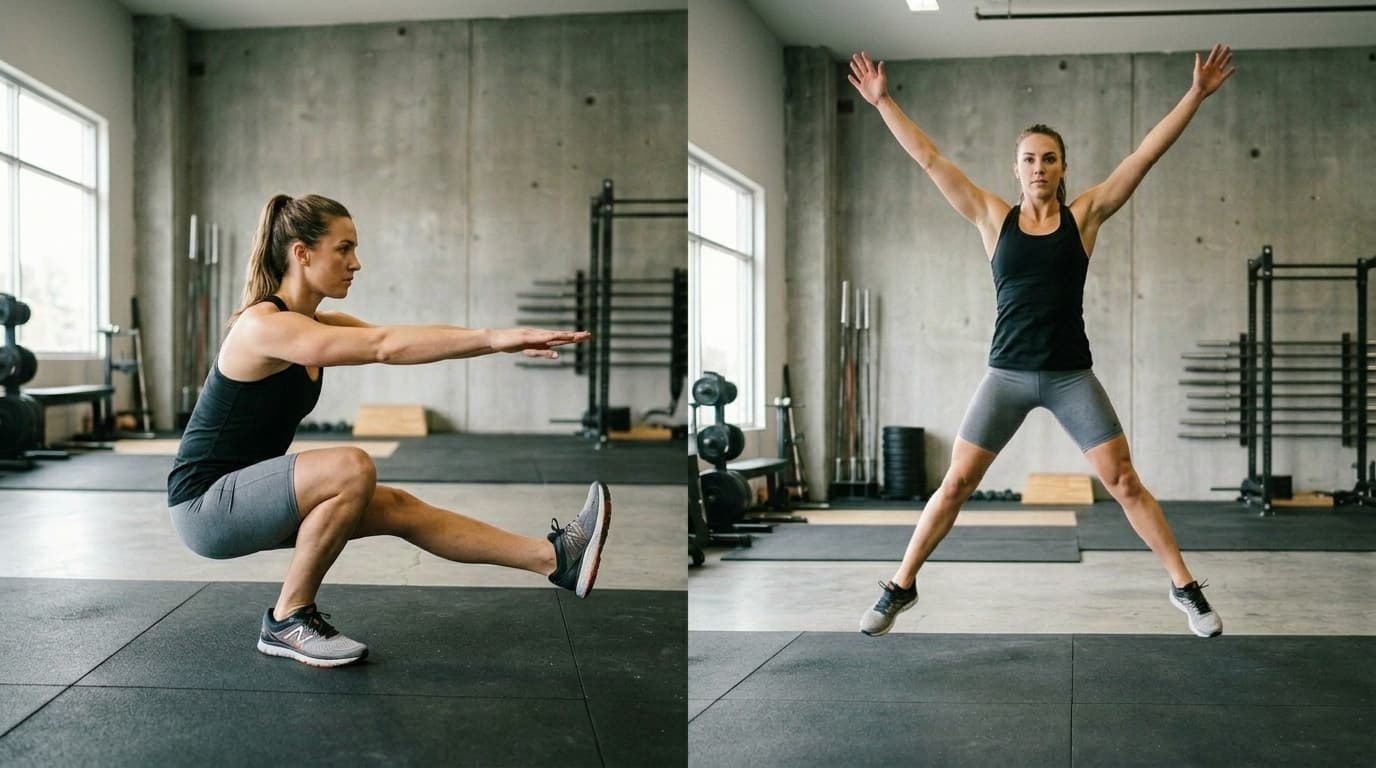
TL;DR — Key Takeaways
- Jumping jacks are a warm-up, not a strength exercise — they raise heart rate, activate hip abductors, and prime joints, but do not build meaningful leg muscle.
- Pistol squats are a full leg strength and mobility skill — they build quads, glutes, and hamstrings while developing ankle dorsiflexion and single-leg balance that transfers directly to sport and daily movement.
- Use them together, not instead of each other — 3–5 minutes of jumping jacks before pistol squat work is the optimal combination for leg training without equipment.
What Are Jumping Jacks and What Do They Actually Do?
Direct answer: Jumping jacks are a low-resistance, high-repetition cardiovascular exercise. They are primarily a warm-up and conditioning tool — not a strength exercise — and perform that role exceptionally well.
A jumping jack involves jumping from a standing position with feet together and arms at sides, out to a position with feet wider than shoulder-width and arms overhead, then returning. The movement is bilateral, rhythmic, and performed at low to moderate intensity for most people.
According to a 2024 systematic review of warm-up strategies, the primary value of a dynamic warm-up like jumping jacks is raising muscle temperature and heart rate before the main session—both linked to better subsequent performance and lower injury risk—while also activating the hip abductors and deltoids through repeated range-of-motion movement.
What jumping jacks are not: a muscle-building stimulus. Because the load is your own bodyweight distributed across both legs with minimal resistance, they do not produce the mechanical tension required for hypertrophy. They are a tool with a specific job — and that job is preparation.
That doesn't make them low-value—it makes them correctly-scoped. A tool that does one job well is more useful than one that tries to do every job poorly. Judging jumping jacks by whether they build leg strength is like judging a stretch by whether it burns fat: it's the wrong metric for what the movement is actually for.
What Is a Pistol Squat and Why Is It a Strength Skill?
Direct answer: A pistol squat is a single-leg squat performed through full range of motion — all the way to the bottom — while keeping the non-working leg extended forward. It requires significant quad strength, ankle dorsiflexion, hip mobility, and balance simultaneously.
Unlike jumping jacks, a pistol squat places the full load of your bodyweight onto a single leg. For most people weighing 140–200 lbs, that means working against 140–200 lbs of effective resistance — well within the range that drives muscle hypertrophy and strength adaptation.
A 2014 EMG study in the International Journal of Exercise Science found single-leg squat variations produce muscle activation comparable to—and for some posterior-chain muscles, higher than—two-legged squats. Combined with the simple fact that a true single-leg movement puts your full bodyweight on one leg instead of splitting it across two, this is why pistol squats can substitute for barbell squats for leg development when progressed correctly.
The "skill" element is real: the pistol squat demands coordination across the hip, knee, and ankle simultaneously under load. Most adults need 8–16 weeks of dedicated practice before achieving a full pistol squat — but that investment builds movement quality that transfers to running, sport, and injury resilience. If you're working toward it, the pistol squat progression guide covers each step of the ladder.
Muscles Worked: Jumping Jacks vs Pistol Squats
Direct answer: Pistol squats work far more muscle mass at far greater intensity. Jumping jacks activate muscles across the whole body at low intensity; pistol squats load the quadriceps, glutes, and hamstrings of one leg near their capacity.
| Muscle Group | Jumping Jacks | Pistol Squats |
|---|---|---|
| Quadriceps | Low — brief knee extension at landing | Very High — primary mover through full ROM |
| Glutes | Low — minimal hip extension demand | High — hip extension at the top of each rep |
| Hamstrings | Minimal | Moderate — stabilize the knee joint |
| Hip Abductors | Moderate — main activation point of jumping jacks | Moderate — stabilize the working hip |
| Calves | Low-Moderate — absorb landing forces | High — control ankle dorsiflexion throughout |
| Core | Low — light postural activation | High — stabilizes torso on single leg |
| Shoulders / Arms | Low — arm swing component | Minimal — arms extended for counterbalance |
The key distinction is intensity of activation. Jumping jacks distribute a light bodyweight load across both legs — nowhere near the effort needed to trigger hypertrophy. A full pistol squat, by contrast, loads one leg with your entire bodyweight taken close to muscular failure by the bottom of the rep, which is exactly the kind of effort a 2017 meta-analysis by Schoenfeld, Grgic, Ogborn, and Krieger found sufficient for muscle growth, regardless of the absolute load involved.
Calorie Burn: Which One Burns More?
Direct answer: Jumping jacks burn more calories per minute during the session. Pistol squats burn fewer calories per minute but build muscle mass, which raises your resting metabolic rate — burning more calories at rest, every day.
| Metric | Jumping Jacks | Pistol Squats |
|---|---|---|
| MET Value | 8.0 (vigorous) / 4.5 (moderate) | 5.0–6.0 (strength sets with rest) |
| Cal/10 min (155 lb person) | 70–100 kcal | 45–65 kcal |
| EPOC (afterburn) | Minimal | Moderate — elevated up to 24–48 hours post-workout |
| Long-term metabolic effect | Minimal | Significant — 1 lb of muscle burns ~6–10 extra kcal/day at rest |
MET values sourced from the Compendium of Physical Activities (Ainsworth et al., 2011). For calorie burn during a single session, jumping jacks win clearly — particularly when performed continuously for 10+ minutes. But the long-term picture favors strength training. Research by Pratley et al. (1994) in the Journal of Applied Physiology found that a 16-week resistance training program increased fat-free mass and raised resting metabolic rate by 7.7% in healthy 50–65 year old men, compounding calorie burn every day without additional effort.
If your goal is fat loss specifically, the most effective approach combines both: jumping jacks for cardiovascular output during the session, pistol squats to build the muscle that elevates your metabolism long-term. This is also why the bodyweight muscle-building framework always pairs strength and conditioning work.
It's worth being honest about the size of each effect. The calorie difference between 10 minutes of jumping jacks and 10 minutes of pistol squat work is real but modest—on the order of 20–40 kcal. The resting-metabolic-rate effect from added muscle compounds daily, but it takes months of consistent training to add enough lean mass for it to matter. Neither exercise is a fat-loss shortcut on its own; the practical takeaway is that total weekly activity and overall calorie balance matter far more than which specific bodyweight exercise you pick.
Mobility Benefits: How Each Exercise Improves Movement
Direct answer: Jumping jacks improve dynamic hip abductor range of motion and shoulder mobility through repetitive movement. Pistol squats actively develop ankle dorsiflexion, hip flexor mobility, and knee stability under load — higher-quality mobility gains that transfer to real-world movement.
Jumping Jacks: Mobility Benefits
- Hip abductor activation: The lateral leg movement trains the gluteus medius and tensor fascia latae through repeated range of motion — useful for reducing knee valgus (inward collapse) during running and squatting.
- Shoulder mobility: The overhead arm sweep lubricates the glenohumeral joint with synovial fluid, particularly useful as a pre-workout warm-up before upper body pushing or pulling movements.
- Limitation: Mobility gains from jumping jacks are transient — they warm up existing range of motion but do not expand it. Long-term mobility improvement requires end-range loading, which jumping jacks do not provide.
Pistol Squats: Mobility Benefits
- Ankle dorsiflexion: The deep squat position demands 35–40 degrees of ankle dorsiflexion — well beyond what most adults have. Regular pistol squat practice progressively improves this range, reducing lower back and knee strain during all squatting movements. Test your own range and follow a dedicated 4-week program in our ankle dorsiflexion guide.
- Hip flexor lengthening: Keeping the non-working leg extended horizontally while squatting actively stretches the hip flexors of that leg under isometric tension — a highly effective mobility stimulus.
- Loaded end-range mobility: Pistol squats train mobility under load rather than passively. A study in the North American Journal of Sports Physical Therapy found a single session of eccentric training through a full range of motion improved flexibility more than static stretching—the same loaded-range-of-motion principle a deep pistol squat applies to the ankle and hip.
Who Is Each Exercise Best For?
Direct answer: Jumping jacks suit virtually everyone as a warm-up or light cardio tool. Pistol squats suit anyone who wants to build serious leg strength and mobility — from beginners starting on progressions, to advanced athletes looking to eliminate bilateral strength imbalances.
Jumping Jacks: Best For
- Complete beginners who need a simple, zero-skill cardio warm-up
- Anyone returning from injury who needs low-impact joint activation
- People with limited time who want a 5-minute full-body warm-up before any workout
- Children and older adults who benefit from low-intensity movement variety
- Circuit training formats where quick transitions and elevated heart rate matter
Pistol Squats: Best For
- Anyone who wants to build real leg strength without a gym or barbell
- Athletes with left/right leg imbalances — bilateral squats can mask asymmetries that pistol squats expose and correct
- People who want to develop functional mobility alongside strength
- Intermediate calisthenics practitioners ready to progress beyond standard bodyweight squats
- Hikers, runners, and climbers who need strong, mobile single-leg support
"We see this mistake constantly: people doing endless jumping jacks hoping their legs will get stronger. Jumping jacks and pistol squats aren't competing for the same job. One warms you up. The other builds the leg you're warming up."
How to Use Both Together in a Workout
Direct answer: Jumping jacks go first — always. Use them to warm up the cardiovascular system, lubricate the joints, and activate the hip abductors. Then move into pistol squat progressions with a primed body and a reduced injury risk.
Here's a complete leg training session structure that uses both:
Warm-Up: Jumping Jacks (5 minutes)
3–5 minutes of continuous jumping jacks at a comfortable pace. Your heart rate should be elevated but you should still be able to hold a conversation. Follow immediately with 10 ankle circles per foot, 10 leg swings per leg, and 5 deep bodyweight squats to complete joint preparation.
Mobility Bridge: Pistol Squat Practice Holds (3 minutes)
Before loading the full movement, spend 3 minutes on assisted pistol squat holds at the bottom position (hold a doorframe or post). This connects your warm body from the jumping jacks to the specific ranges needed for the pistol squat. Hold each side for 20–30 seconds.
Main Strength Work: Pistol Squat Progressions (15–20 minutes)
3–4 sets per leg of your current pistol squat variation (assisted, box, or full). Rest 90–120 seconds between sets — this is strength work, not a circuit. Quality of movement matters more than speed. Target RPE 7–8 out of 10 per set.
Conditioning Finisher: Jumping Jack Circuit (5 minutes)
End with 3 rounds of: 30 jumping jacks, 20-second rest. This maintains cardiovascular conditioning and helps flush metabolic byproducts from the strength work. Keep the intensity easy — you're not trying to fatigue the legs further.
Cool-Down: Static Mobility Work (5 minutes)
Hold a deep calf stretch (30 seconds per side), a standing hip flexor stretch (30 seconds per side), and a pigeon pose or figure-4 stretch (45 seconds per side). This locks in the ankle and hip mobility gains from the pistol squat work.
This structure — warm-up with jumping jacks, strength with pistol squats, condition with jumping jacks, mobilize to finish — covers all four pillars of leg training in under 40 minutes with zero equipment. For the complete roadmap of bodyweight progressions beyond pistol squats, see the 30-day calisthenics roadmap.
Frequently Asked Questions
Are jumping jacks good for leg strength?
How many calories do jumping jacks burn in 10 minutes?
Are pistol squats worth learning?
Can jumping jacks replace squats for leg training?
How long does it take to learn a pistol squat?
Should I do jumping jacks before or after pistol squats?
Put Conditioning and Strength in the Right Places
Build a personalized week that balances conditioning, lower-body strength, recovery, and your available training time.
Build My Free Weekly Plan