
3 Sets of 5–8 Reps Bodyweight Training: Why This Works for Hypertrophy
The 5–8 rep range forces harder exercise variations, higher mechanical tension, and faster strength gains — all without a single weight. Here's the science, the exercise selection, and a complete workout template.
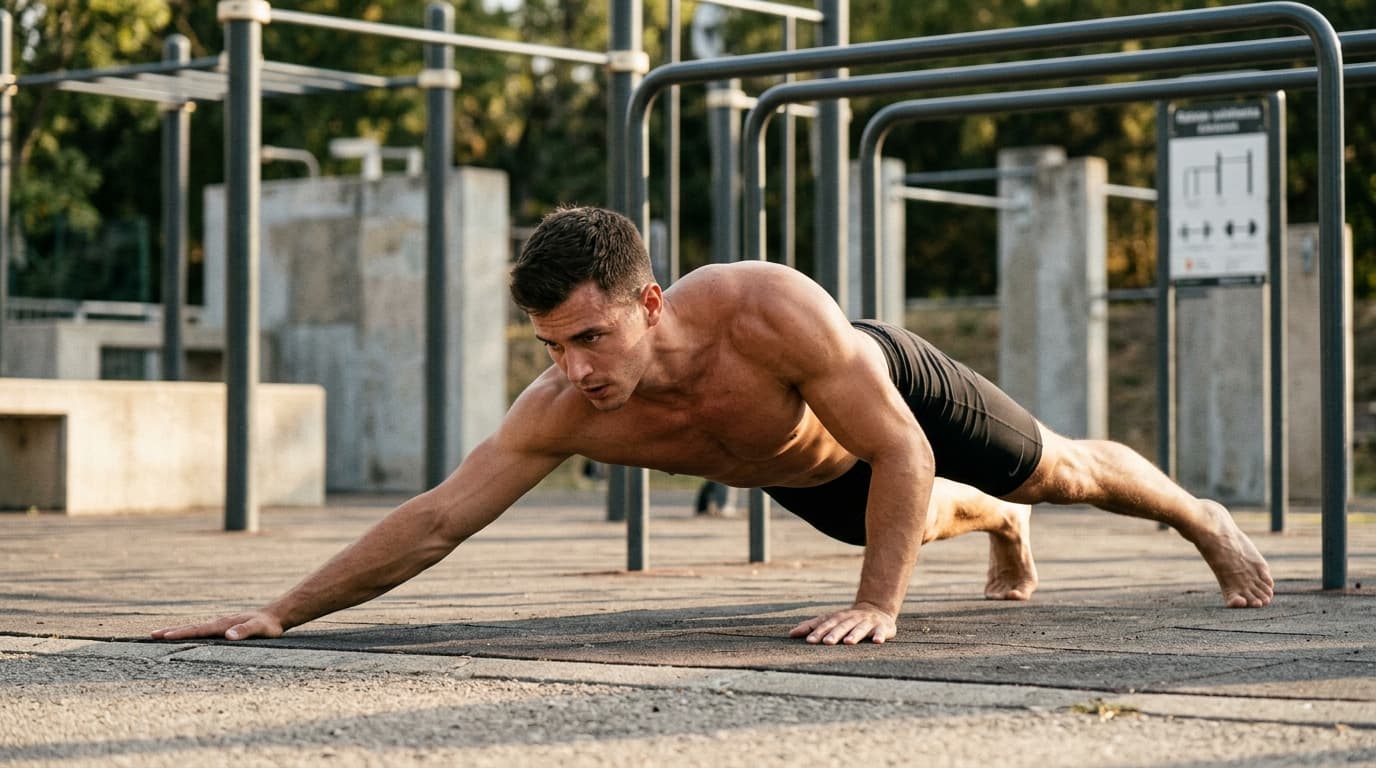
TL;DR — Key Takeaways
- 3 sets of 5–8 reps builds muscle via high mechanical tension — research confirms muscle growth occurs across all rep ranges when sets are taken near failure, and the 5–8 range maximizes the tension stimulus.
- The key is matching difficulty to the rep range — regular push-ups for 20 reps won't work; archer push-ups for 6 reps will. You must use variations hard enough that 5–8 reps represents a genuine challenge.
- Rest 2–3 minutes between sets — the most common mistake is using short rest periods from higher-rep habits. Strength-range sets require near-full recovery to sustain output across all 3 sets.
What Is the 3 Sets of 5–8 Reps Method?
The 3×5–8 method means performing 3 sets of an exercise where you target 5 to 8 reps per set, using enough difficulty that your last rep is genuinely hard. In bodyweight training, this is achieved by selecting advanced exercise variations — not by chasing reps on easy ones.
In weight training, you adjust load: add a plate, build tension. In bodyweight training, you adjust leverage and movement complexity. Training at 5–8 reps means using variations like archer push-ups, weighted pull-ups, or ring dips — exercises where the difficulty is high enough that 8 reps represents a genuine upper limit, not a warm-up.
This rep range sits at the crossover between strength and hypertrophy training. Traditional strength programs like StrongLifts 5×5 and Starting Strength use 5-rep sets for maximum strength development. Research by Schoenfeld, Grgic, Ogborn, and Krieger's (2017) meta-analysis in the Journal of Strength and Conditioning Research pooled 21 studies and found comparable muscle growth between lower-load (≤60% of 1-rep max) and higher-load (>60%) resistance training, provided sets were taken close to failure — which means 5–8 reps is not just for powerlifters. It is a legitimate hypertrophy tool.
The "3 sets" component reflects a minimum effective dose. A 2010 meta-analysis by Krieger in the Journal of Strength and Conditioning Research found that 2–3 sets per exercise produced significantly more muscle growth than 1 set, while the marginal benefit of a fourth set was smaller. For most people doing full-body or push/pull/legs splits, 3 hard sets per movement pattern is the efficient, time-conscious choice.
The 3×5–8 Formula at a Glance
- Sets: 3 per exercise
- Reps: 5–8 per set (stop when you can't maintain form)
- Rest: 2–3 minutes between sets
- Difficulty: variation hard enough that rep 8 is your near-limit
- Tempo: 3-second eccentric (lowering), 1-second pause, controlled concentric
- Frequency: each muscle group 2–3× per week
Why Does Training in the 5–8 Rep Range Build Muscle?
The 5–8 rep range builds muscle primarily through mechanical tension — the pulling force placed on muscle fibers when they resist a heavy load. This is one of three primary hypertrophy mechanisms, and research suggests it may be the most important driver of long-term muscle growth.
Sports scientist Brad Schoenfeld, PhD, identifies three mechanisms of muscle hypertrophy in his foundational 2010 paper in the Journal of Strength and Conditioning Research: mechanical tension, metabolic stress, and muscle damage. Higher-rep training (15–30 reps) leans heavily on metabolic stress — the "pump" and burn. The 5–8 rep range maximizes mechanical tension, which triggers satellite cell activation and downstream anabolic signaling through the mTOR pathway.
Why Mechanical Tension Matters for Bodyweight Training
In weight training, mechanical tension scales with load. In bodyweight training, it scales with leverage difficulty. An archer push-up places far greater tension on the pectorals than a standard push-up — not because you weigh more, but because your leveraged body position forces more of your bodyweight to load the working muscle. This is why exercise selection is critical when training in the 5–8 range: without the right variation, you never generate the tension necessary to stimulate growth.
The Role of Proximity to Failure
A 2022 review by Refalo, Helms, Trexler, Hamilton, and Fyfe in Sports Medicine pooled 15 studies and found only a trivial hypertrophy advantage to training all the way to muscular failure versus stopping just short of it. In other words, how close a set gets to failure matters far more than the specific rep count. A set of 5 taken close to failure and a set of 15 taken close to failure land in the same ballpark for muscle growth. This is the foundational logic of 3×5–8: it works not because 5–8 is a magic number, but because the correct exercise variation ensures those reps are genuinely demanding.
| Rep Range | Primary Mechanism | Rest Needed | Bodyweight Application |
|---|---|---|---|
| 1–4 reps | Neural strength | 3–5 min | Weighted variations, one-arm work |
| 5–8 reps | Mechanical tension | 2–3 min | Advanced variations (archer push-up, weighted pull-up) |
| 8–15 reps | Tension + metabolic | 60–90 sec | Intermediate variations (push-ups, pull-ups) |
| 15–30 reps | Metabolic stress | 30–60 sec | Easier variations, conditioning work |
How Do You Pick the Right Exercise Difficulty for 5–8 Reps?
The right difficulty for 5–8 rep bodyweight training is the variation where rep 7 or 8 feels like a genuine struggle with good form. If you can complete 9 reps without significant effort, the exercise is too easy. If you can't complete 5 with clean technique, it's too hard.
Use the RPE (Rate of Perceived Exertion) scale from 1–10 as your guide. In the 5–8 rep range, you should finish each set at RPE 8–9, meaning you have approximately 1–2 reps left in the tank. Training to absolute failure (RPE 10) on every set is unnecessary and increases injury risk — research by Refalo et al. (2022) shows stopping 1–2 reps short of failure produces comparable hypertrophy with significantly less fatigue.
Push Exercise Difficulty Ladder
Too Easy (15+ reps)
Regular push-ups
Progress to a harder variation
Slightly Easy (10–14 reps)
Diamond push-ups, wide push-ups
Add slow tempo (3-second eccentric) to increase difficulty
Correct Range (5–8 reps)
Archer push-ups, pseudo-planche push-ups, pike push-ups
This is your working variation
Too Hard (under 5 reps)
One-arm push-up negatives, planche progressions
Regress to the variation below
Pull Exercise Difficulty Ladder
Too Easy (15+ reps)
Jumping pull-ups, ring rows at low angle
Progress to harder variation
Slightly Easy (10–14 reps)
Standard pull-ups, chin-ups
Add slow tempo or add weight via weighted vest
Correct Range (5–8 reps)
Chest-to-bar pull-ups, L-sit pull-ups, weighted pull-ups (+5–15 kg)
This is your working variation
Too Hard (under 5 reps)
Archer pull-ups, one-arm negatives
Use the variation below and add load gradually
"The number one thing we fix in people's programs isn't their rep range — it's that they picked an exercise that was never hard enough to need one. Match the variation to the goal first. Everything else is bookkeeping."
For a complete exercise progression roadmap, see our progressive overload for bodyweight training guide, which covers 8 methods for increasing difficulty without weights.
How to Progress When You Can Do 8 Reps Easily
When 3 sets of 8 reps feels comfortable for two consecutive workouts, it is time to advance to the next harder variation and drop back to 5 reps. This is the double progression method — progress reps first (5→8), then advance difficulty and reset.
Progression in the 5–8 range follows a predictable cycle. Beginners may move through variations every 2–3 weeks; intermediates every 4–6 weeks; advanced athletes every 8–12 weeks. The timeline is less important than the signal: two consecutive sessions at 3×8 with excellent form and RPE 7 or below means the variation has been mastered.
The Rep Accumulation Phase (Weeks 1–4)
Start a new variation at 3×5. Each workout, add 1 rep to any set where you felt you had room. The goal is to reach 3×8 with consistent form and RPE 8–9 on the final set.
The Variation Advancement Phase
Once you hit 3×8 on 2 consecutive workouts, move to the next variation in the progression ladder. Drop back to 3×5 with the new variation. Expect the first session at a new variation to feel significantly harder — this is the correct stimulus.
Using Tempo as an Intermediate Step
If the jump between variations is too large (e.g., you can do 10 standard pull-ups but only 2 chest-to-bar pull-ups), use tempo as a bridge: add a 4-second eccentric to standard pull-ups. This increases difficulty without requiring the next skill level.
Adding External Load When Skill Ceiling Is Reached
For pull-ups and dips, a weighted vest is the cleanest solution once bodyweight variations become insufficient. A 5 kg vest can extend a lifetime of 5–8 rep training on standard pull-ups before transitioning to archer pull-ups or one-arm work.
Sample 8-Week Progression: Push-Ups
| Week | Variation | Target Sets × Reps | Notes |
|---|---|---|---|
| Wk 1 | Archer push-up | 3×5 | New variation, RPE 9 |
| Wk 2 | Archer push-up | 3×6 | Add 1 rep per set |
| Wk 3 | Archer push-up | 3×7 | RPE settling to 8 |
| Wk 4 | Archer push-up | 3×8 | Near-max — close to advancing |
| Wk 5 | Archer push-up | 3×8 | Confirm 2 sessions at 3×8, then advance |
| Wk 6 | Pseudo-planche push-up | 3×5 | New harder variation |
| Wk 7 | Pseudo-planche push-up | 3×6–7 | Building reps |
| Wk 8 | Pseudo-planche push-up | 3×7–8 | Approaching next progression |
The Best Bodyweight Exercises for 3×5–8 Training
The best bodyweight exercises for 3×5–8 training are advanced compound variations that create high mechanical tension at low rep counts. These are not beginner exercises — they are the variations you graduate to once standard push-ups and pull-ups are no longer challenging enough.
Push Exercises (Chest, Shoulders, Triceps)
Archer Push-Up
Chest, anterior deltoidWide hand position; lower toward one arm while keeping the other nearly straight. Each side counts as a rep.
Tip: Keep hips square. Don't let the straight-arm elbow bend.
Pseudo-Planche Push-Up
Chest, anterior deltoid, serratusHands rotated backward pointing toward feet; lean forward so shoulders are ahead of wrists before descending.
Tip: Start with partial forward lean. Full pseudo-planche lean takes weeks to build.
Pike Push-Up
Deltoids (overhead strength)Hips high, body in inverted V shape; lower head toward floor between hands. Builds toward handstand push-ups.
Tip: Elevate feet on a chair to increase difficulty without changing the movement pattern.
Ring Dip
Chest, tricepsOn gymnastic rings set at hip height; dip with controlled descent, elbows back, lean slightly forward.
Tip: Rings introduce instability that recruits significantly more stabilizer muscle than bar dips.
Pull Exercises (Back, Biceps)
Chest-to-Bar Pull-Up
Lats, rhomboids, bicepsStandard pull-up grip; pull until chest touches the bar at the top. Far greater range of motion than chin-over-bar.
Tip: Use a pronated (overhand) grip for greater lat activation; supinated (underhand) emphasizes biceps more.
L-Sit Pull-Up
Lats, core, hip flexorsHold legs parallel to the ground throughout the entire pull-up. Core engagement increases dramatically.
Tip: Work up to 5-second L-sit holds before attempting L-sit pull-ups.
Weighted Pull-Up
Lats, biceps, upper backAdd 5–15 kg via weighted vest or dip belt. One of the cleanest ways to scale pull-up difficulty in the 5–8 range.
Tip: More accessible than skill variations — you don't need to master new technique, just add load.
Archer Pull-Up
Lats (unilateral emphasis)Wide grip; pull toward one hand while keeping the other arm nearly straight. Bridges toward one-arm pull-up.
Tip: Use a towel or rope for the assisting hand to adjust how much help you give yourself.
Leg Exercises (Quads, Hamstrings, Glutes)
Pistol Squat
Quadriceps, glutes, single-leg balanceSingle-leg squat to full depth with the non-working leg extended forward. Extremely demanding — most people need months of progressions.
Tip: Use a box or TRX for assistance if you can't complete 5 full pistol squats yet.
Nordic Curl (Negative)
Hamstrings (eccentric)Kneel with feet anchored; lower your body toward the ground as slowly as possible by resisting with hamstrings. Push up with hands.
Tip: Even 3 slow negatives build enormous hamstring strength. One of the most effective injury-prevention exercises in sports science.
Bulgarian Split Squat
Quads, glutesRear foot elevated on a bench; front foot forward. Lower back knee toward floor. Add weight via backpack if needed.
Tip: Front foot placement determines emphasis: closer = quads, farther = glutes.
Shrimp Squat
Quads, glutes, balanceSingle-leg squat with rear leg bent, holding your foot behind you. Descend until rear knee nearly touches the floor.
Tip: Harder than a pistol squat for most people. Use a low surface to touch with your knee when learning.
For a deep dive on lower body progressions, see our pistol squat progression guide. For upper body calisthenics skill work, the complete pull-up guide covers the full progression ladder from zero to advanced variations.
5–8 Reps vs. Higher Reps: Which Builds More Muscle?
When taken to similar proximity to failure, 5–8 reps and 8–20 reps produce equivalent muscle growth in most studies. The practical difference is that higher reps create more metabolic fatigue and require less advanced exercise variations, while lower reps build strength faster and demand harder progressions.
The definitive study on this question is Schoenfeld, Grgic, Ogborn, and Krieger (2017), a meta-analysis of 21 studies comparing lower-load (≤60% of 1-rep max) against higher-load (>60%) training. Muscle growth was similar between conditions, but the higher-load group gained significantly more maximal strength — a meaningful advantage for bodyweight training, where strength gains directly unlock access to harder (more hypertrophy-generating) exercise variations.
The Compounding Advantage of the 5–8 Rep Range
Here is the key insight for bodyweight athletes: strength gains earned in the 5–8 range unlock harder exercise variations, which create greater mechanical tension, which drives more hypertrophy. The athlete who trains at 3×5–8 and progresses to archer push-ups builds more chest muscle in 12 months than the one who stays at 3×15 standard push-ups — not because low reps are magic, but because harder variations create more stimulus.
This is the compounding logic behind the strength rep range in calisthenics. As explained in the bodyweight muscle building guide, the limiting factor for long-term bodyweight hypertrophy is not rep range — it is access to progressively harder exercises. Training in the 5–8 range accelerates that access.
| Factor | 5–8 Reps | 8–15 Reps | 15–30 Reps |
|---|---|---|---|
| Muscle growth (equal volume) | ★★★★ | ★★★★ | ★★★ |
| Strength gains | ★★★★★ | ★★★ | ★★ |
| Workout fatigue | ★★ | ★★★ | ★★★★ |
| Skill progression speed | ★★★★★ | ★★★ | ★★ |
| Time per workout | ★★★ (longer rests) | ★★★★ | ★★★★★ |
| Beginner-friendly | ★★ | ★★★★★ | ★★★★ |
For most intermediate bodyweight athletes, the optimal approach combines rep ranges: 3×5–8 on the main compound exercise, 2–3×10–15 on one or two accessory exercises. This gives you the strength adaptation and skill progression benefits of the lower range alongside the metabolic volume of higher reps.
Common Mistakes When Training in the 5–8 Rep Range
The most common mistake is using too-easy exercise variations. If you are doing 3 sets of 5–8 regular push-ups, you are not training in the 5–8 rep range — you are just stopping early. The rep count only matters when the variation is hard enough that those reps represent genuine near-maximum effort.
Using Variations That Are Too Easy
If you can do 5–8 reps of an exercise but could easily do 15, you are not training in the hypertrophy strength range — you are doing endurance work with early termination. The correct solution is not to stop at 8 reps on regular push-ups, but to use archer push-ups or pseudo-planche push-ups where 8 reps is genuinely close to your maximum.
Resting Too Little Between Sets
Athletes accustomed to higher-rep training often rest 45–60 seconds and apply that habit to 5–8 rep sets. This causes significant performance drops from set 1 to set 3. Rest 2–3 full minutes between sets in the strength rep range. The total workout may take 10–15 minutes longer, but the quality of each set — and the growth stimulus — will be dramatically higher.
Neglecting Eccentric Control
Rushing through the lowering phase wastes the highest-tension portion of each rep. A 2009 meta-analysis by Roig et al. in the British Journal of Sports Medicine found eccentric-focused training produced greater gains in eccentric strength than concentric-only training, particularly at higher intensities. In the 5–8 range, a 3-second eccentric effectively doubles your time under tension per rep, amplifying the stimulus of each set.
Progressing Variation Before Mastering Current One
Advancing too quickly — moving to pseudo-planche push-ups before your archer push-ups are technically clean — leads to compensation patterns, joint stress, and plateaus. Two consecutive sessions at 3×8 with excellent form is the benchmark. If you are not meeting that standard, the variation is still teaching you something.
Training to Absolute Failure on Every Set
Going to complete muscular failure on every set creates excessive fatigue, impairs performance on subsequent sets, and increases injury risk. Stop 1–2 reps short of failure (RPE 8–9). This is sufficient for a maximal hypertrophy stimulus according to the research literature, and it allows you to sustain performance across all 3 sets and across multiple training sessions per week.
For more on structuring a complete beginner program, see the 30-day calisthenics roadmap, which walks through the first month of training with progressive difficulty built in from day one.
Frequently Asked Questions
Does 3 sets of 5–8 reps build muscle?
Is 3 sets enough to build muscle with bodyweight exercises?
What bodyweight exercises work best for 5–8 reps?
How do I know if I'm using the right difficulty for 5–8 reps?
Can beginners use the 3 sets of 5–8 reps approach?
How long should I rest between sets at 5–8 reps?
Put the 5–8 Rep Method Into Your Week
Choose your goal, training days, and session length, and Odin will organize effective bodyweight strength sessions across your week.
Build My Free Weekly Plan