
Workout Plan for Traveling Professionals: The 20-Minute Calisthenics System (2026)
Build and maintain real strength anywhere — hotel rooms, airports, home offices. A structured calisthenics system designed for engineers, consultants, and business travelers who can't afford a gym but can't afford to stop training.
TL;DR — Key Takeaways
- 20 structured minutes beats 60 random minutes — a 2016 PLoS ONE study found that 10 minutes of properly structured, high-intensity training produced fitness adaptations equivalent to 50 minutes of moderate continuous exercise, at a fifth of the time cost.
- Use the 3-2-1 rule for irregular schedules: aim for 3 sessions per week (progress), accept 2 (maintenance), treat 1 as the absolute floor — and always track where you left off, not what day it is.
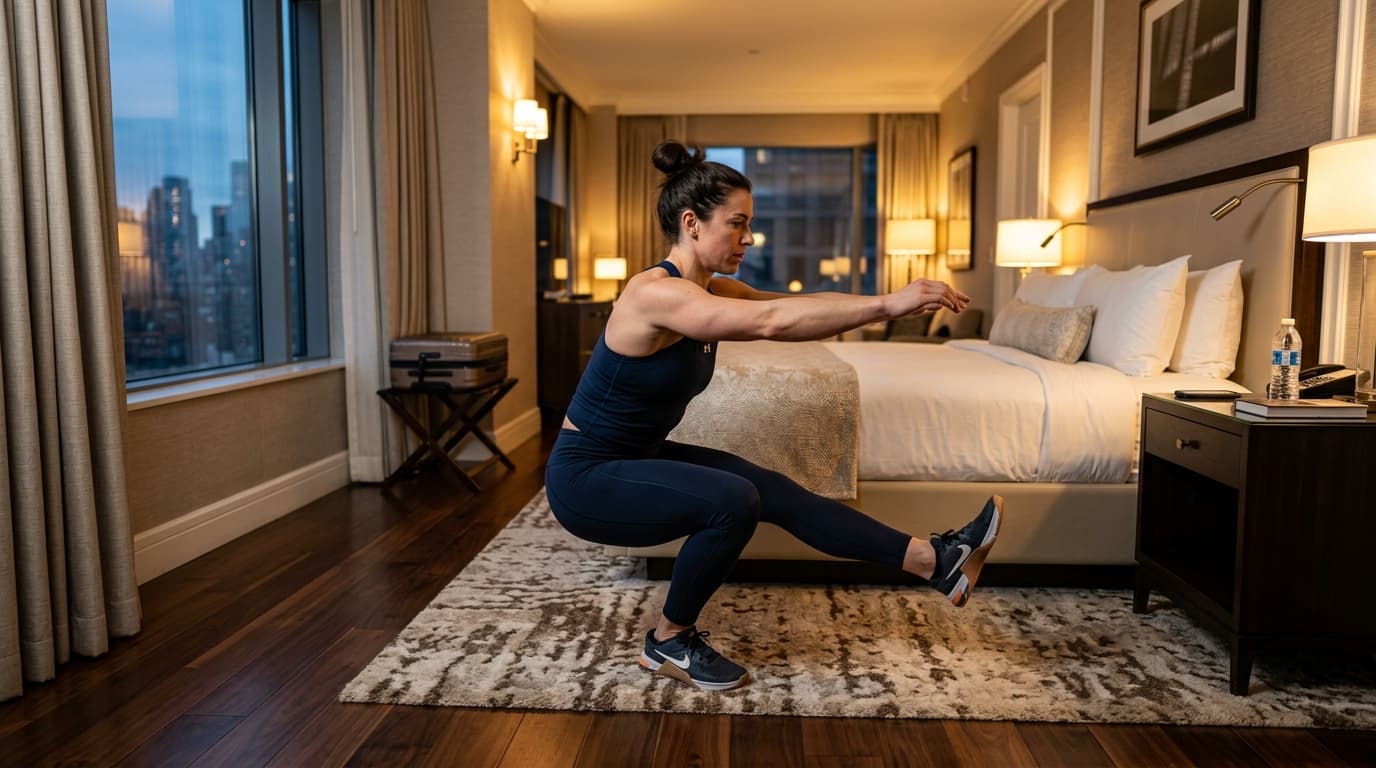
- Pistol squats are the traveler's secret weapon — no equipment, 3 square feet of space, months of progression, and they directly fix the hip and leg weakness caused by sitting on planes and at desks.
What Is a Workout Plan for Traveling Professionals?
Definition: A workout plan for traveling professionals is a structured, equipment-free training system designed around three hard constraints — limited time (under 20 minutes), limited space (a hotel room or office), and an irregular schedule that may shift by days or time zones week to week.
Standard gym programs fail road warriors for an obvious reason: they were designed for people with consistent access to equipment, a fixed weekly schedule, and a home base. When you're an engineer flying to a client site, a consultant working across cities, or a developer at a week-long offsite, a program built around “Monday: chest day, Wednesday: back day” becomes useless by Tuesday evening.
The professionals who stay in shape while traveling aren't doing anything heroic. They have a system that works regardless of location. That system has three properties:
Location-Independent
Every session runs on zero equipment. No gym, no hotel gym, no resistance bands required. Just floor space and your bodyweight.
Time-Capped
Sessions run 20 minutes from first rep to last. Not “about 20 minutes” — exactly 20, with a structure that makes every minute count.
Schedule-Agnostic
Progression is tracked by session number, not calendar day. Miss three days? Pick up where you left off. No restarting, no guilt.
This guide builds that system specifically for the busy professional demographic — engineers, developers, consultants, and managers — whose search data shows they care about pistol squats, irregular schedules, and evidence-based training, not generic “hotel workout” advice that amounts to 30 jumping jacks and a prayer.
Can You Really Build Strength in 20 Minutes?
Yes — with structure. A 2016 study in PLoS ONE (Gillen et al.) found that a 10-minute sprint interval session — containing just 1 minute of actual high-intensity work — produced cardiometabolic and aerobic fitness improvements equivalent to 50 minutes of continuous moderate-intensity exercise, a five-fold reduction in time commitment for the same result. The variable that matters is not duration — it is density.
The problem with most “20-minute workouts” online is that they're designed to feel like a workout, not to produce adaptation. They cycle through 12 different movements, keep rest so short that intensity collapses, and provide no progressive overload — so the same workout feels the same after three months because it is the same.
Random 20-Minute Workout
- 10 different exercises, 45 seconds each
- No tracking, no progression
- Same difficulty week 1 and week 12
- High heart rate, low mechanical tension
- Result: cardio adaptation, minimal strength
Structured 20-Minute Session
- 3–4 compound exercises, 3 sets each
- Logged reps and variation difficulty
- Progression target every 1–2 weeks
- Controlled tempo, adequate rest
- Result: real strength and muscle gains
The key variables in a 20-minute window are exercise selection (compound movements only — push-ups, rows, squats, core) and rest management (45–60 seconds between sets keeps sessions tight without sacrificing output). A 2017 meta-analysis in the Journal of Sports Sciences (Schoenfeld, Ogborn & Krieger) found a graded dose-response relationship between weekly training volume and muscle growth — each additional weekly set per muscle group was associated with roughly 0.37% more hypertrophy, with higher-volume groups showing a 3.9% larger gain than lower-volume groups. Total weekly volume — not session duration — is what drives results. Three 20-minute structured sessions produce the same weekly volume as one 60-minute session, distributed across more training days.
The Density Training Principle
Density training — completing a fixed amount of work in less time, or more work in the same time — is the time-compressed professional's version of progressive overload. When you can't add weight and can't add time, you add density: harder variations, shorter rest, slower tempo. This is exactly what makes calisthenics ideal for travelers — the progression system is built into the exercises themselves.
The 20-Minute Hotel Room Workout System
The system uses two alternating sessions — Day A (push + core) and Day B (legs + pull) — each structured as 3 minutes warm-up, 15 minutes work, 2 minutes cool-down. Alternate A-B-A one week, B-A-B the next.
You do not need a hotel gym. You do not need a pull-up bar. You need approximately 6 square feet of floor space and the willingness to start. Here is the complete system:
Day A — Push + Core (20 Minutes)
Warm-Up (3 min)
- 30 seconds arm circles (forward + backward)
- 30 seconds chest openers (hands clasped behind back)
- 10 slow bodyweight squats
- 10 half-intensity push-ups
- 30 seconds wrist circles
| Exercise | Sets × Reps | Rest | Progression |
|---|---|---|---|
| Push-up variation | 3 × 8–12 | 45 sec | Incline → Regular → Diamond → Archer |
| Pike push-up | 3 × 6–10 | 45 sec | Pike → Elevated pike → Wall HSPU |
| Tricep dip (bed/chair) | 3 × 8–12 | 45 sec | Bent knee → Straight leg → Elevated feet |
| Plank variation | 3 × 20–45 sec | 30 sec | Forearm → Extended arm → Single-arm |
Cool-Down (2 min)
- 60-second chest stretch (doorframe or arms wide)
- 60-second shoulder cross-body stretch each side
Day B — Legs + Pull (20 Minutes)
Warm-Up (3 min)
- 30 seconds leg swings (forward/back, then side-to-side each leg)
- 10 bodyweight squats, controlled
- 10 hip circles each direction
- 30 seconds ankle circles
| Exercise | Sets × Reps | Rest | Progression |
|---|---|---|---|
| Pistol squat progression | 3 × 5 each leg | 60 sec | Assisted → Box → Full (see Section 6) |
| Inverted row (desk/table) | 3 × 8–12 | 45 sec | High angle → Horizontal → Feet elevated |
| Bulgarian split squat (bed) | 3 × 8–12 each | 45 sec | Bodyweight → Slow tempo → Jump variation |
| Hollow body hold | 3 × 15–30 sec | 30 sec | Tuck → Extended legs → Arms overhead |
Cool-Down (2 min)
- 60-second standing hip flexor lunge stretch each side — essential after flights
- 30 seconds calf stretch each side
No Desk Available for Rows?
Most hotel rooms have a sturdy desk — lie underneath it and grip the edge. If not, substitute towel rows (anchor a towel around a door handle, lean back, and row your chest to the door). It's less than ideal but covers the horizontal pull pattern until you find a pull-up bar. See our complete pull-up guide for more pulling progressions that work without a bar.
How to Train With an Irregular Schedule
The fix is to decouple training from the calendar. Most training programs fail busy professionals because they assume a fixed weekly structure. The moment one week breaks the pattern, motivation collapses. The solution: track sessions, not days. Pick up from session 7 whether it's been 3 days or 10.
The 3-2-1 Rule
The most useful framework for irregular training is the 3-2-1 rule — a simple hierarchy that removes the all-or-nothing thinking that kills most professional fitness attempts:
3
Sessions/Week (Progress)
Your target. Three 20-minute sessions produce consistent progressive overload. Use Day A, Day B, Day A one week; Day B, Day A, Day B the next.
2
Sessions/Week (Maintenance)
Acceptable during heavy travel weeks. Research shows 2 sessions maintain strength for months — you're not losing ground, just holding position until you can push forward again.
1
Session/Week (Floor)
The absolute minimum. Even one 20-minute session per week preserves the neural patterns that took months to build. Never do zero if you can avoid it.
Time Zone Shifts and Recovery
International travel adds a layer most travel fitness guides ignore: circadian disruption. A 2026 systematic review in Sports (Benito et al.) found that long-haul travel and jet lag measurably reduce strength, reaction time, and other performance markers in athletes, with eastward travel producing stronger disruption than westward travel and some performance drops persisting for several days post-arrival. For practical purposes: do not push to max intensity on the first full day after a long-haul flight. Use that session to move, activate, and reset — not to PR.
| Travel Scenario | Recommended Session | Intensity |
|---|---|---|
| Same timezone, busy day | Full Day A or B session | 100% — no excuse |
| 1–4 hour time shift | Full session, normal intensity | 90–100% |
| 5+ hour shift, day of arrival | Movement session (10 min walk, stretching) | 50% — active recovery |
| 5+ hour shift, 24h after arrival | Full session, reduce sets by 1 | 80% |
| 5+ hour shift, 48h+ after arrival | Full session, normal progression | 100% |
Progressive Overload When You Miss Days
Rule #1: Never restart. When you miss sessions, pick up exactly where you left off — same exercise variation, same rep target. Strength is retained for 2–3 weeks with minimal training. A week off doesn't undo months of work.
The research on detraining is more reassuring than most people realize. The classic Mujika & Padilla review in Sports Medicine on short-term detraining (under 4 weeks of insufficient training stimulus) found that trained individuals retain the large majority of their strength gains across that window, and even minimal training (one session per week) is enough to prevent meaningful decline. For a traveling professional doing one session during a conference week, you are not losing fitness — you are maintaining it.
The Session-Based Progression Log
Instead of thinking “I'm on Week 4 of my program,” think “I'm on Session 11.” This small reframe removes the anxiety of missed weeks and keeps the focus on what matters: what was your last session, and how do you beat one metric in this one.
What to Log Each Session (takes 90 seconds)
Required Fields
- Session number and type (A or B)
- Each exercise variation used
- Sets and reps completed
- Difficulty rating 1–10
Progression Decision
- Hit top of rep range? → Advance variation
- Difficulty 7 or below? → Add a rep per set
- Difficulty 9–10? → Maintain current level
- Missed 7+ days? → Same session, same weight
The Odin app automates this entirely — it stores your last session and tells you exactly what to do next, whether that session was yesterday or three weeks ago. For more on building the progressive overload habit, see our guide on the science of progressive overload for bodyweight training.
What to Do After a Long Break (2+ Weeks Off)
After 2+ weeks of complete detraining, reduce volume slightly for the first session back — not because you've lost strength, but because accumulated fatigue has dissipated and you're likely to overshoot. Take one set off each exercise and return to full volume the following session.
Before break:
Diamond push-ups: 3 × 11 reps (RPE 8)
First session back:
Diamond push-ups: 2 × 11 reps, then assess
Pistol Squats for Engineers and Developers: Why This Skill Fits Your Lifestyle
Pistol squats are uniquely suited for engineers and developers — they require zero equipment, fit in 3 square feet, provide months of progressive challenge, and directly address the hip, glute, and single-leg weakness caused by sedentary desk work and long flights. See our dedicated pistol squat progression guide for the full breakdown.
Search data confirms this. Queries like “pistol squats for travelers” and “pistol squats for engineers” represent a real audience of technically-minded professionals who want a skill-based, measurable strength goal that fits their lifestyle. Unlike a gym PR, a pistol squat is a milestone you can hit in a hotel room in Tokyo or a home office in Austin — it travels with you.
Why Desk Workers Need Single-Leg Strength
Prolonged sitting creates a specific weakness pattern: tight hip flexors, inhibited glutes, reduced ankle dorsiflexion, and single-leg stability deficits. A 2017 systematic review in the Journal of Sports Sciences (Bishop, Turner & Read) found that inter-limb strength asymmetries are detrimental to jumping, kicking, and cycling performance — exactly the kind of imbalance desk workers accumulate over years of chair time. Training each leg independently, as pistol squats force you to, is a direct way to identify and close that gap.
The 8-Week Pistol Squat Progression
This timeline assumes you can currently do 10 bodyweight squats with good form. If you have limited ankle mobility, read our guide on ankle dorsiflexion requirements for pistol squats before starting.
Weeks 1–2: Assisted Pistol Squat — 3 × 5 each leg
Hold a doorframe, desk edge, or TRX-style strap with both hands. Lower on one leg until your hips drop below your knee, then stand. The arm support allows you to practice the full range of motion safely.
Key cue: Focus on keeping the heel of your working foot flat — don't let it rise.
Weeks 3–4: Box Pistol Squat — 3 × 8 each leg
Squat onto the hotel bed or a chair with one leg extended. The target height determines difficulty — a higher surface is easier (requires less depth). Lower until you touch, pause 1 second, then stand.
Key cue: Keep your extended leg truly extended — a bent knee cheats the movement and reduces the balance demand.
Weeks 5–6: Counterweight Pistol Squat — 3 × 5 each leg
Hold a water bottle, laptop, or small bag extended in front of you. The counterweight shifts your center of mass forward, making it easier to balance without arm assistance. This bridges box pistols to the full movement.
Key cue: Let the counterweight pull you slightly forward — this is correct. A vertical torso in a pistol squat actually makes balance harder.
Weeks 7–8: Full Pistol Squat — 3 × 3–5 each leg
Unassisted full pistol squat to the floor. Arms extended forward for balance, working heel flat, non-working leg extended and parallel to the floor. Build from 3 reps to 5 reps each leg over 2 weeks.
Key cue: If you fail at the bottom, your ankle mobility needs work — add 10 minutes of calf and ankle stretching to your Day B warm-up.
| Exercise | Equipment | Space Needed | Targets |
|---|---|---|---|
| Pistol squat | None | 3 sq ft | Quads, glutes, balance, ankle mobility |
| Bulgarian split squat | Bed or chair | 4 sq ft | Quads, glutes, hip flexors |
| Shrimp squat | None | 3 sq ft | Quads, hip flexors, knee stability |
| Nordic curl (door) | Heavy door | 4 sq ft | Hamstrings, glutes |
Common Mistakes Busy Professionals Make With Fitness
The biggest fitness mistake busy professionals make is not skipping workouts — it's having no system. Skipping a session is recoverable. Having no progressive plan means every returned session feels like starting over, which eventually makes you actually start over.
“Every traveling client who quits didn't quit because they missed a week — they quit because they had no way to pick back up without feeling like they were starting from zero. The system has to survive the missed week, not just the perfect one.”
The All-or-Nothing Trap
The mistake: “I only have 15 minutes, so I'll skip it.” Missing a session because it can't be a full one.
The fix: Define a 10-minute minimum session in advance: push-ups (3 sets), squats (3 sets), done. Ten minutes of compound work maintains more than zero minutes of guilt. Set this as your fallback before the week starts.
Relying on the Hotel Gym
The mistake: Building a program around hotel gym access — which may be closed, occupied, or not exist. When the gym isn't available, the session disappears.
The fix: Treat hotel gym access as a bonus, never a dependency. Your primary program runs on zero equipment. If the gym is available, use it — but your progress shouldn't depend on it.
Random YouTube Workouts Instead of a Progressive System
The mistake: Searching “hotel workout” and following a different video each session. These are designed for engagement, not for progressive overload. After 3 months of this, you will be exactly as strong as after 3 weeks.
The fix: Follow a single program for 12 weeks minimum. The exercises matter less than the progression. A boring plan you follow beats an interesting plan you abandon. See our 30-day calisthenics roadmap for a structured starting point.
Ignoring Legs While Traveling
The mistake: Doing push-ups and planks in a hotel room while completely skipping leg training because “squats aren't that hard without weights.” Bodyweight squats are easy — pistol squat progressions are not, and your legs take up half your muscle mass.
The fix: Make Day B (legs + pull) your priority during travel weeks. If you can only do one session during a conference, do Day B — your upper body will forgive a week off; your glutes and hamstrings are already weakened by the flights.
No Protein Target on Travel Days
The mistake: Training diligently but eating airport food (mostly carbohydrate, minimal protein) during travel weeks. Muscle retention during irregular training requires adequate protein — the International Society of Sports Nutrition's position stand recommends 1.6–2.2 grams per kilogram of bodyweight daily for people doing regular resistance training.
The fix: Pack protein. Greek yogurt and jerky survive airport security. Identify high-protein options at chain restaurants you'll encounter (grilled chicken salads, eggs at breakfast, steak options). See our protein intake guide for exact targets.
Skipping the Warm-Up to Save Time
The mistake: Going straight into push-ups and pistol squats from cold — especially after sitting on a plane for 8 hours. Cold muscle tissue is less extensible and more injury-prone. Injuries end programs.
The fix: The 3-minute warm-up is not optional. It's built into the 20-minute session structure. If you only have 15 minutes, do 2 minutes of warm-up and 13 minutes of work — not zero warm-up and 15 minutes of work.
Frequently Asked Questions
Can you stay fit with only 20 minutes of exercise a day?
What is the best workout for traveling professionals?
How do you work out in a hotel room without equipment?
How do you keep progressing when your schedule is inconsistent?
Are pistol squats good for travelers?
How often should busy professionals work out?
Build a Plan Around Your Busy Week
Tell Odin which days and how many minutes you have, and get a personalized bodyweight schedule that fits around work.
Build My Free Weekly Plan