
How to Stretch Your Hip Flexors: 7 Stretches for Tight Hips
Hours of sitting keep your hip flexors short, and it shows up everywhere — a stiff first step out of your chair, shallow lunges, and a lower back that does more work than it should. Here are 7 stretches that actually reach the hip flexors, the hold time the research supports, and the one form fix most people miss.
TL;DR — Key Takeaways
- Stretch your hip flexors for about 60 seconds per side, at least 2-3 days a week. That matches the American College of Sports Medicine's flexibility guideline, and studies show measurable gains in hip extension within 3-6 weeks.
- The half-kneeling stretch is the best place to start — add the couch stretch for the front of the thigh and leg swings as a warm-up. Active and passive stretching worked equally well in a 2004 randomized trial.
- Tuck your pelvis before you lean forward. Arching your lower back is the most common mistake — it lets you lunge deeper while the hip flexor barely stretches at all.
What Are Your Hip Flexors and Why Do They Get Tight?
The direct answer: Your hip flexors are the muscles at the front of your hip that lift your thigh toward your chest. They usually get tight because sitting holds them in a shortened position for hours at a time, and muscles adapt to the positions they spend the most time in.
"Hip flexors" is a group name, not a single muscle. The biggest is the iliopsoas — two muscles, the psoas major and the iliacus, that share a tendon. The psoas is unusual because it starts on the lower spine and runs through the pelvis to the top of the thigh bone, which is why tight hip flexors are so often linked to lower-back discomfort. The rectus femoris, one of your four quad muscles, also crosses the hip and helps flex it. Smaller helpers include the sartorius and the tensor fasciae latae on the outside of the hip.
Every time you sit, your hips are bent about 90 degrees and these muscles rest in a shortened position. Do that for most of the day and they gradually lose comfortable range at the other end — hip extension, the movement of your thigh going behind you. That's not a niche problem: a 2018 study by Ussery et al. in JAMA found that 25.7% of US adults sit for more than 8 hours a day.
Sitting isn't the only cause. Runners, cyclists, and anyone doing lots of high-knee or leg-raise work use their hip flexors heavily without balancing that with hip extension. Weak glutes — the muscles that extend your hip — can leave the front of the hip doing more than its share. And sometimes what feels like "tightness" is really your nervous system limiting how much stretch it will tolerate, which also improves with regular practice.
The good news: hip flexors respond well to consistent stretching. In the research covered below, people gained measurable range in as little as three weeks. You don't need special equipment — a floor, a wall, and a couch cover every stretch in this guide.
Are Your Hip Flexors Actually Tight? (Self-Test)
Use a simplified Thomas test: lie at the edge of a bed, hug one knee to your chest, and see where the other thigh settles. If that thigh stays above the bed instead of resting flat or dropping slightly below, your hip flexors are likely tight on that side.
The Thomas test is the standard clinical check for hip flexor length. A 1998 study by Harvey in the British Journal of Sports Medicine used a modified version to measure the flexibility of the iliopsoas, quadriceps, and tensor fasciae latae in 117 elite tennis players, basketball players, rowers, and runners — and recommended that athletes address differences between their left and right sides. You can do a home version in about 60 seconds:
Get into position
Sit on the very edge of a firm bed or sturdy table, then roll back onto your back while hugging both knees to your chest.
Lower one leg
Keep hugging your left knee tight to your chest so your lower back stays flat. Slowly lower your right leg and let it hang off the edge, completely relaxed.
Read the result
Have someone look from the side, or take a phone photo. Note where your right thigh rests and how bent the knee is. Then switch legs.
| What You See | What It Suggests | Stretches to Prioritize |
|---|---|---|
| Thigh rests flat or slightly below the bed, knee bends easily | Normal hip flexor length | Maintenance: 1-2 stretches, 2-3 days a week |
| Thigh stays raised above the bed | Tight iliopsoas (the deep hip flexor) | Half-kneeling, standing split-stance, edge-of-bed |
| Thigh is level but the knee straightens out | Tight rectus femoris (the quad that crosses the hip) | Couch stretch, standing quad stretch |
| Thigh drifts out to the side | Tight tensor fasciae latae on the outside of the hip | Low lunge with side reach |
How Do You Stretch Your Hip Flexors? (7 Stretches)
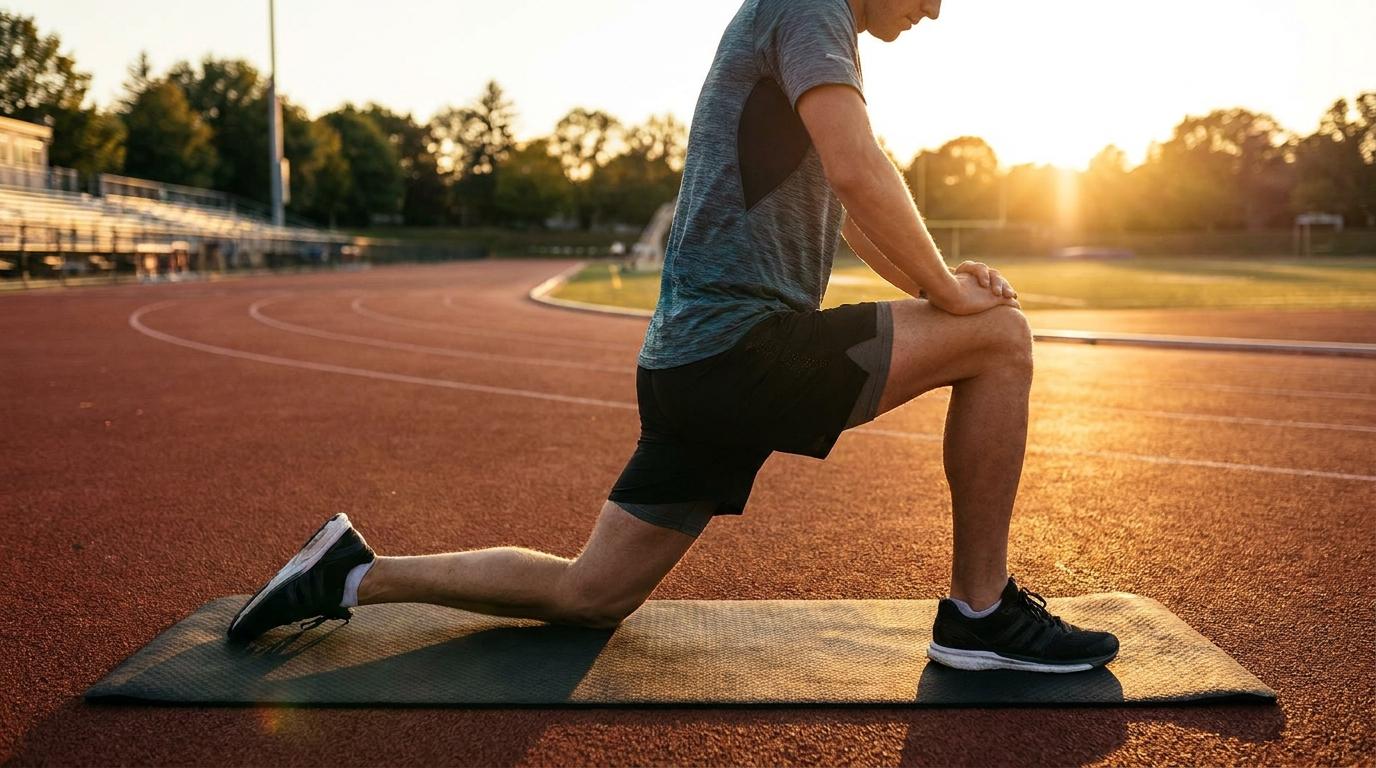
Start with the half-kneeling hip flexor stretch: kneel on one knee, tuck your pelvis, squeeze your glute, and shift your hips forward a few inches. Hold 30 seconds per side, twice. The other 6 stretches below cover the same muscles from different angles.
Ease into each stretch until you feel mild-to-moderate tension at the front of the hip — never sharp pain. You don't need all seven: pick 2-3 based on your self-test result and do them consistently.
Half-Kneeling Hip Flexor Stretch
Kneel on one knee with the other foot flat in front of you. Before you lean forward, squeeze the glute on the kneeling side and tuck your tailbone under — this posterior pelvic tilt is what actually puts the hip flexor on stretch. Then shift your hips forward only a few inches. Hold 30 seconds per side. Put a folded towel under the kneeling knee if the floor is hard.
Standing Split-Stance Hip Flexor Stretch
Step into a long split stance with your back heel off the floor. Tuck your pelvis, squeeze the back-leg glute, and bend the front knee slightly until you feel the front of the back hip open up. Hold 30 seconds per side. This is the easiest version to do in work clothes — a good one to break up long stretches of sitting.
Couch Stretch
Kneel facing away from a couch, slide your right shin up the front of the cushion so your foot points at the ceiling, and step your left foot forward. Tuck your pelvis and slowly bring your torso upright. Because the knee is deeply bent, this targets the rectus femoris — the one quad muscle that crosses the hip — much harder than the basic kneeling stretch. Start with your hands on the floor and only come upright once that feels manageable.
Standing Quad Stretch
Hold a wall for balance, bend one knee, and grab that ankle behind you. Keep your knees side by side and press the hip of the bent leg slightly forward — that small push is what turns a quad stretch into a hip flexor stretch. Hold 30 seconds per side. If you can't reach your ankle, loop a towel around it.
Edge-of-Bed Hip Flexor Stretch
Lie on your back with your hips at the very edge of a firm bed. Hug one knee to your chest — this flattens your lower back and locks your pelvis in place — and let the other leg hang off the edge. Gravity does the work, so it's an easy stretch to hold for 30-60 seconds and a good end-of-day option. It's the same position used for the self-test above.
Low Lunge With Side Reach
From the half-kneeling position with your right knee down, reach your right arm overhead and lean gently to the left. The psoas attaches to the lower spine, so the side bend lengthens it from the top as well as the bottom. Hold 30 seconds, then switch sides. Keep the tuck from stretch 1 — the side bend shouldn't turn into a lower-back arch.
Dynamic Front-to-Back Leg Swings
Hold a wall with one hand and swing the outside leg forward and back like a pendulum, starting small and building range over 10-15 swings per side. This is dynamic stretching — moving through a range instead of holding it — and it's the best option right before squats, lunges, sprints, or any lower-body workout.
How Long and How Often Should You Stretch Your Hip Flexors?
Aim for about 60 seconds per side per stretch — two 30-second holds — at least 2-3 days a week. Daily is better if you sit most of the day, and you should expect noticeable change within 3-6 weeks.
60 sec
Per Stretch
The American College of Sports Medicine's 2011 position stand recommends about 60 seconds of total stretching per flexibility exercise.
2+ days
Per Week
The same position stand recommends flexibility exercises on at least 2 days a week to maintain joint range of motion.
3-6 weeks
To See Change
Winters et al. (2004) measured improved hip extension range of motion at 3 and 6 weeks of home stretching.
The American College of Sports Medicine's 2011 position stand recommends flexibility exercises for each major muscle-tendon group on at least 2 days a week, for a total of about 60 seconds per exercise. For hip flexors, that's two 30-second holds per side — under 5 minutes for two stretches on both legs. The same position stand also recommends breaking up long periods of sitting with frequent, short bouts of standing and activity, which matters just as much for desk workers as the stretching itself.
Hip flexor research supports a range of doses. In the 2004 randomized trial by Winters et al. in Physical Therapy, 33 people with limited hip extension (average age 23.6) did home hip flexor stretches, and their range of motion improved by both the 3-week and 6-week checkpoints. At the high-volume end, a 2011 randomized trial by Watt et al. in PM&R had 43 healthy older adults stretch their hip flexors twice daily for 10 weeks, and they significantly improved passive hip extension compared with a control group that stretched their shoulders instead.
Practical takeaway: two 30-second holds per side, once a day, is a solid default. If your schedule only allows 2-3 sessions a week, that still meets the guideline — consistency across weeks matters far more than squeezing extra minutes into a single session.
Active vs. Passive Hip Flexor Stretching: Which Works Better?
Both work equally well for flexibility. A randomized trial found no difference in hip extension gains between active stretching (using your own muscles to hold the position) and passive stretching (using gravity, your hands, or a surface).
Active stretching means your muscles create the stretch — for example, squeezing your glute hard to push your hip into extension. Passive stretching means something else holds you there, like gravity in the edge-of-bed stretch or a couch in the couch stretch. The theory behind active stretching is that it lengthens the tight muscle while strengthening the opposite one.
Winters et al. tested exactly this. Their 33 participants — people with low back pain or lower-body injuries and limited hip extension — were randomly assigned to active or passive home stretching programs. Both groups improved over 6 weeks, and the authors found no difference between them, concluding the two methods were "equally effective" for increasing range of motion.
| Factor | Passive Stretching | Active Stretching |
|---|---|---|
| Example | Edge-of-bed stretch, couch stretch | Half-kneeling stretch with a hard glute squeeze |
| Flexibility Gains | Improved over 6 weeks | Improved over 6 weeks — no difference |
| Effort Required | Low — easy to hold longer | Moderate — glutes work throughout |
| Best For | Relaxed end-of-day sessions | Before workouts and building glute control |
Should You Stretch Hip Flexors Before or After a Workout?
Do dynamic stretches like leg swings before a workout, and save longer static holds for afterward or a separate session. Short static holds under 45 seconds before training are fine if you need them.
A 2013 meta-analysis by Simic et al. in the Scandinavian Journal of Medicine & Science in Sports pooled 104 studies on stretching before exercise. Static stretching reduced strength by about 5.4% on average, with smaller drops in power and explosive performance. Importantly, the effect depended on duration: the smallest losses came from stretches lasting 45 seconds or less. The authors advised against using static stretching as the only part of a warm-up.
In practice, that means:
- Before training: 10-15 leg swings per side, plus a few walking lunges. If your hips feel very stiff, one 20-30 second half-kneeling stretch per side is fine.
- After training: your main static work — 2 stretches, two 30-second holds per side.
- On rest days or at your desk: standing split-stance stretches every hour or two to break up sitting.
If you're following a home workout routine, add the half-kneeling stretch to your cool-down — it takes under two minutes and you're already warm.
Why Hip Flexor Flexibility Matters
Flexible hip flexors let your hip extend fully when you walk, run, lunge, and stand up straight. Research shows stretching them can lengthen your stride and reduce forward pelvic tilt while walking.
The clearest evidence comes from walking. In Watt et al.'s 2011 trial with 82 healthy older adults, participants who started with limited hip extension and completed the 10-week stretching program increased their stride length and peak hip extension during walking and reduced their anterior pelvic tilt. A companion trial in 74 frail older adults found the same program significantly increased walking speed and stride length.
| Movement | Effect of Tight Hip Flexors | Why |
|---|---|---|
| Lunges & split squats | Shallow back leg, torso tips forward | The back hip can't extend, so the body leans to find the range somewhere else. |
| Standing & walking | Pelvis tips forward, lower back arches | Short hip flexors pull the front of the pelvis down — the anterior tilt Watt et al. measured. |
| Running & sprinting | Shorter stride | Stride length depends on how far the trailing leg extends behind you. |
| Glute bridges | Hips won't fully lock out | Tight hip flexors resist the full hip extension at the top of the bridge. |
For bodyweight training, this matters most in single-leg work. Deep split squats and single-leg squats need the back hip to open up. One nuance worth knowing: the L-sit needs strong hip flexors to hold your legs up, and tight hamstrings are usually what limits it — so pair this guide with how to stretch your hamstrings and keep strengthening the front of the hip too.
And the lower back? Because the psoas attaches to the lumbar spine, tight hip flexors are a plausible contributor to lower-back strain, but the evidence is mixed and they're rarely the only cause. Our guide on how to stretch your lower back covers the other stretches worth trying and when to see a doctor instead.
Common Mistakes That Stall Your Progress
The biggest mistakes are arching your lower back instead of tucking your pelvis, lunging too far forward, stretching only occasionally, and ignoring how many hours you spend sitting.
Arching instead of tucking
If your lower back arches as you lean forward, the stretch moves into your spine and the hip flexor goes slack. Tuck your tailbone and squeeze your glute first, every time.
Lunging too far
A deeper lunge isn't a deeper stretch. With a proper pelvic tuck, a forward shift of just a few inches is usually plenty.
Bouncing
Bouncing in and out of a static stretch triggers muscle tension and raises strain risk. Hold steady, or use controlled leg swings if you want movement.
Stretching once in a while
The studies that showed results used regular home programs over 6-10 weeks. Two minutes most days beats twenty minutes once a week.
Ignoring sitting time
Five minutes of stretching can't fully offset ten hours of sitting. Stand up every hour or two and do a quick split-stance stretch while you're up.
Never strengthening the glutes
Your glutes extend your hip — the opposite of your hip flexors. Glute bridges and split squats help you use the new range you gain from stretching.
"Almost everyone we coach does the kneeling hip flexor stretch wrong the first time — big lunge, arched back, nothing happening at the hip. Tuck the pelvis, squeeze the glute, and move two inches. The look on people's faces when they finally feel it is always the same."
Frequently Asked Questions
How long does it take to loosen tight hip flexors?
What is the best stretch for tight hip flexors?
How often should you stretch your hip flexors?
Can tight hip flexors cause lower back pain?
Should I stretch my hip flexors before or after a workout?
Does sitting all day tighten your hip flexors?
Are tight hip flexors the same as weak hip flexors?
Turn Your New Hip Mobility Into Real Strength
Get a personalized bodyweight program that pairs mobility work with the lunges, split squats, and glute work that make it last.
Build My Free Weekly Plan