
Home Workout Without Equipment: 10, 20 & 30-Minute Routines
No gym, no dumbbells, no excuses needed. Here are three bodyweight home workout routines built around the time you actually have, a 4-week plan to string them together, and the research that shows why your living room floor is enough.
TL;DR — Key Takeaways
- A home workout without equipment builds real strength and fitness. Research shows push-ups can build chest muscle as well as a matched-load bench press, and an 11-minute bodyweight routine improved aerobic fitness in inactive adults in just six weeks.
- Every good routine covers 5 movement patterns — squat, lunge or hinge, push, pull, and core. Pick the 10, 20, or 30-minute routine below based on your day, and aim for at least 3 sessions a week.
- The biggest mistake is never making it harder. Add a rep, a round, a slower tempo, or a harder variation every week — or your body stops adapting by week four.
Can You Get a Good Workout at Home Without Equipment?
Yes. Your bodyweight is enough resistance to build strength, muscle, and aerobic fitness — as long as you train hard enough and keep making the exercises more difficult over time.
A home workout without equipment is a bodyweight training session — often called calisthenics — that uses your own body as the resistance. Push-ups load your chest, shoulders, and triceps. Squats and lunges load your legs. Planks train your core to resist movement. None of it needs a gym, and all of it can be scaled from complete beginner to advanced.
The research backs this up. A 2017 study by Kikuchi and Nakazato in the Journal of Exercise Science & Fitness split 18 young men into two groups training twice a week for 8 weeks: one did bench press at 40% of their one-rep max, the other did push-ups adjusted to the same load. Both groups gained bench press strength and grew their triceps and chest — chest thickness rose from 17.0 mm to 20.8 mm in each group. The authors concluded push-ups were "comparably effective" for muscle growth and strength.
The reason bodyweight works comes down to effort, not the weight on the bar. A 2017 meta-analysis by Schoenfeld et al. in the Journal of Strength and Conditioning Research pooled 21 studies and found muscle growth was similar whether people trained with light loads (60% of their max or less) or heavy loads — as long as sets were taken to muscular failure. Heavy loads still won for maximal strength, which is why the progression methods below matter: harder variations keep your sets in the effective range.
2+ days
Strength Training
The Physical Activity Guidelines for Americans recommend muscle-strengthening activity, like push-ups, at least 2 days each week.
150-300 min
Moderate Aerobic Activity
The same guidelines recommend 150-300 minutes of moderate-intensity aerobic activity per week, and any amount counts.
31%
Adults Inactive Worldwide
The World Health Organization reports nearly one third of the world's adults — 1.8 billion people — are physically inactive.
That last number is the real problem a home workout solves. The World Health Organization estimates 31% of adults don't get enough activity, and the usual reasons — no time, no gym, no equipment — all disappear when your workout fits in a 6-by-6-foot patch of floor. The Physical Activity Guidelines for Americans even name push-ups as an example of muscle-strengthening activity. If you want the deeper science on muscle growth specifically, read Can You Build Muscle With Bodyweight Training?
How Do You Build a Home Workout Routine? (6 Steps)
Warm up, pick one exercise for each of the 5 movement patterns (squat, lunge or hinge, push, pull, core), fit them into the time you have, train close to failure, progress weekly, and cool down. Every routine in this guide follows these 6 steps.
Random exercise lists are why most home workouts stall. A structured routine makes sure every major muscle gets worked each week, so you don't end up with 100 crunches and zero leg training. Here's the framework:
Warm up for 3-5 minutes
Raise your heart rate and move every major joint before working hard.
- March or jog in place for 60 seconds
- Do 10 arm circles each direction and 10 bodyweight good-mornings
- Finish with 10 slow squats and 5 easy push-ups
Pick one exercise for each movement pattern
Cover squat, lunge or hinge, push, pull, and core so the whole body gets trained.
- Squat: bodyweight squat, split squat, or Bulgarian split squat
- Lunge or hinge: reverse lunge, glute bridge, or single-leg Romanian deadlift
- Push: incline push-up, push-up, or pike push-up
- Pull and core: table row or prone Y-T raise, then plank or hollow hold
Choose your time block
Match the routine to the time you actually have: 10, 20, or 30 minutes.
- 10 minutes: a timed circuit for fitness and consistency
- 20 minutes: paired sets for full-body strength
- 30 minutes: a strength block plus a short conditioning finisher
Work at a challenging effort
Finish most sets with only 1-3 good reps left in the tank.
- If you could do 10 more reps, the exercise is too easy
- Pick a harder variation instead of adding endless reps
- Keep form strict — slow lowering, full range of motion
Progress every week
Add a rep, a round, a slower tempo, or a harder variation each week.
- Write down your reps after every workout
- Add 1-2 reps per set or one extra round when all sets feel solid
- Move to a harder variation once you hit the top of the rep range
Cool down for 2-3 minutes
Bring your heart rate down and stretch the muscles you trained.
- Walk around for 60 seconds while breathing slowly
- Hold a hamstring stretch and a hip flexor stretch for 30 seconds per side
- Note your session in a log so next week has a target
The pull pattern is the hardest one to cover with no equipment, because pulling normally needs something to hold. Your best options are inverted rows under a sturdy dining table (lie underneath, grip the edge, and pull your chest up), prone Y-T raises lying face down on the floor, and reverse snow angels. Always test a table by leaning your full weight on the edge before you hang from it. When you're ready to add one piece of kit, a doorway bar opens up the full pull-up progression.
Setup matters less than you think, but a few details make home workouts safer and easier to repeat. Clear a space about the size of a yoga mat plus an arm's length on each side. Train on a non-slip surface — a rug, mat, or bare floor in sneakers — rather than socks on hardwood, which turns lunges and mountain climbers into a slipping hazard. Keep a sturdy chair or couch nearby for incline push-ups, split squats, and balance support. And pick the same time slot most days: attaching your workout to an existing routine, like right after your morning coffee, removes the daily decision of when to train.
What Is the Best Quick Workout at Home? (10 Minutes)
The best quick workout at home is a 10-minute full-body circuit: 5 exercises for 40 seconds each with 20 seconds of rest, repeated twice. It's short enough to do before work and hard enough to improve your fitness.
Short workouts aren't a compromise when the effort is high. In a 2021 study by Archila et al. in the International Journal of Exercise Science, inactive young adults did an 11-minute bodyweight routine — burpees, high knees, split squat jumps, and squat jumps for 60 seconds each with walking recovery — for 18 sessions over six weeks. They worked at an average of 82% of their maximum heart rate, compliance was 100%, and they finished with a significantly higher VO2peak (the standard measure of aerobic fitness) than a control group: 34.2 vs. 30.3 ml/kg/min.
That fits a bigger pattern. A 2016 study by Gillen et al. in PLOS ONE compared a 10-minute cycling session containing just 1 minute of all-out effort with 50 minutes of steady cycling. After 12 weeks, aerobic fitness rose 19% in both groups, and insulin sensitivity improved similarly — despite a five-fold lower time commitment for the short-session group. The study used bikes, not bodyweight, but the lesson carries over: intensity can stand in for duration.
The 10-Minute Home Workout
Set a timer for 40 seconds of work and 20 seconds of rest. Do each exercise once, in order, then repeat the whole circuit a second time. Total: 10 minutes.
1. Bodyweight Squat
40 sec · legs and glutesFeet shoulder-width apart, sit your hips back and down until your thighs are at least parallel to the floor, then stand tall.
Tip: Too easy? Add a 2-second pause at the bottom of every rep.
2. Push-Up
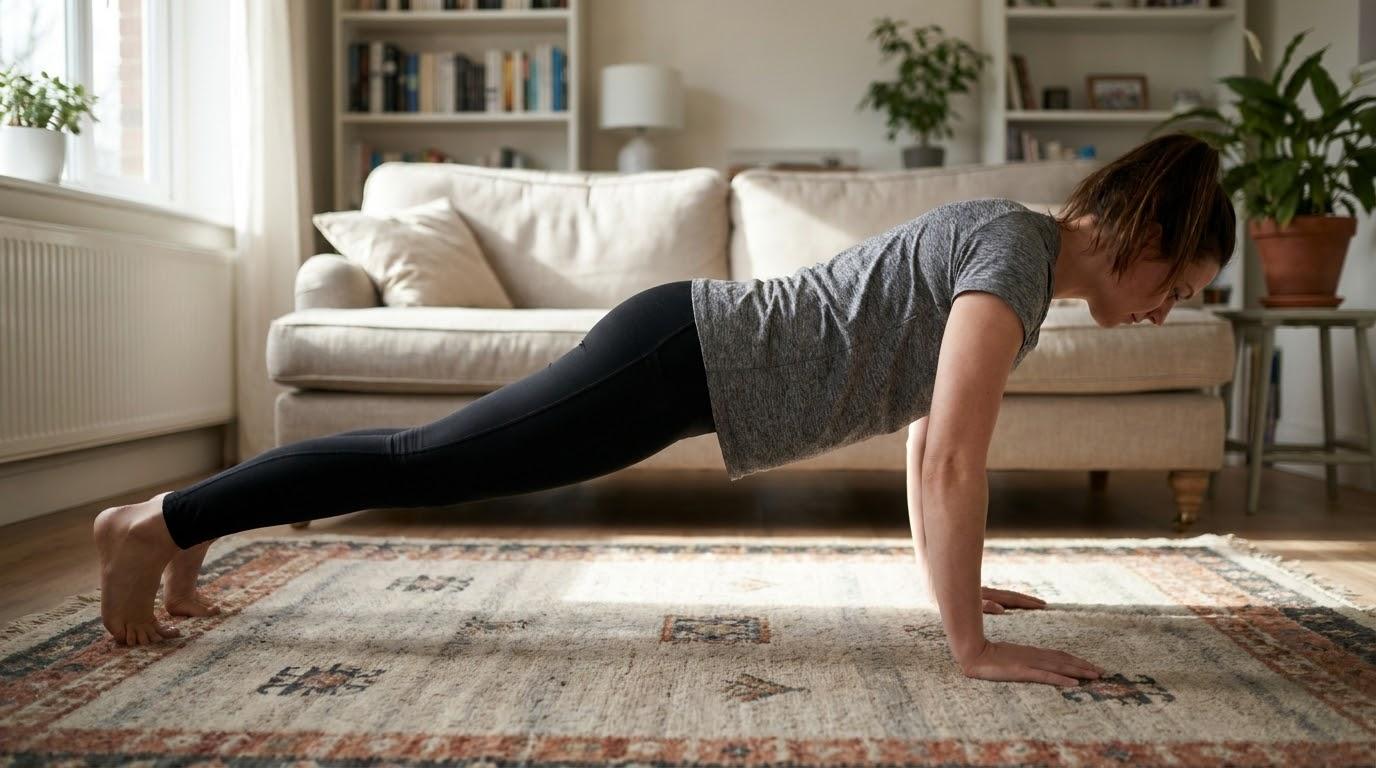
40 sec · chest, shoulders, tricepsHands slightly wider than shoulders, body in a straight line from head to heels. Lower your chest to just above the floor and press back up.
Tip: Hands on a couch or counter makes it easier without losing the full range of motion.
3. Alternating Reverse Lunge
40 sec · legs, glutes, balanceStep one foot back and lower until both knees are bent about 90 degrees, then drive through the front heel to stand. Alternate legs.
Tip: Reverse lunges are easier on the knees than forward lunges for most beginners.
4. Prone Y-T Raise
40 sec · upper back and rear shouldersLie face down with arms overhead in a Y. Squeeze your shoulder blades and lift your arms off the floor, lower, then repeat with arms out in a T.
Tip: Thumbs pointing up toward the ceiling keeps the work in your upper back.
5. Mountain Climbers
40 sec · core and conditioningFrom the top of a push-up, drive one knee toward your chest, then switch legs quickly while keeping your hips level.
Tip: Slow it down to a controlled march if your hips start bouncing.
Even Quicker: 1-2 Minute "Exercise Snacks"
Don't have 10 minutes? Break it up. A 2022 study by Stamatakis et al. in Nature Medicine tracked 25,241 adults who did no formal exercise using wrist-worn activity trackers for an average of 6.9 years. Those who did about 3 short bursts of vigorous activity per day — each lasting 1 to 2 minutes, like hurrying up stairs — had a 38-40% lower risk of death from any cause than those who did none. It's an observational study, so it shows an association rather than proof of cause and effect, but it's a strong argument that short bouts count. Try 60 seconds of squats while the kettle boils, or a flight of stairs taken fast, three times a day.
20-Minute Home Workout: Full-Body Strength
This 20-minute home workout uses 3 paired sets (supersets) — two exercises done back to back — for 3 rounds each. It builds strength in every major muscle group and is the best default routine for 3 workouts a week.
Where the 10-minute circuit is about conditioning and consistency, this routine is about strength. You'll do fewer exercises with more focus, resting 60 seconds after each pair. Pick a variation that lets you hit the rep target with 1-3 reps to spare. Start with a 3-minute warm-up (step 1 above).
| Pair | Exercise | Sets × Reps | Easier / Harder |
|---|---|---|---|
| A1 | Split squat | 3 × 8-12 per leg | Hold a doorframe / slow 3-second lowering |
| A2 | Push-up | 3 × 6-15 | Incline on a couch / feet elevated |
| B1 | Single-leg glute bridge | 3 × 10-15 per leg | Two-leg bridge / pause 3 seconds at top |
| B2 | Table row or prone Y-T raise | 3 × 8-12 | Bend knees more / straighten legs |
| C1 | Hollow body hold | 3 × 20-30 sec | Knees tucked / arms overhead |
| C2 | Side plank | 3 × 20-30 sec per side | From knees / top leg raised |
Each pair pairs muscles that don't compete with each other — legs with chest, hips with back, front core with side core — so one side recovers while the other works. That's how you fit 18 hard sets into 20 minutes without the quality dropping off.
Your target for the next session: add 1 rep to any set where you hit the top of the range. When you hit the top of the range on all 3 sets, move to the harder variation. That simple rule is the whole engine of progress. The push-up progression and single-leg squat progression lay out every variation step by step.
30-Minute Home Workout: Strength + Conditioning
The 30-minute home workout combines an 18-minute strength block with a 5-minute conditioning finisher modeled on the 11-minute routine from the Archila et al. study. It's the most complete option when you have half an hour.
Use this on days you want to train both strength and fitness in one go. It uses harder exercise variations than the 20-minute routine, so it works well once that routine starts to feel manageable.
Warm-up (4 minutes)
60 seconds marching in place, 10 arm circles each way, 10 bodyweight good-mornings, 10 slow squats, 10 glute bridges, and 5 easy push-ups.
Strength block (18 minutes)
Do 3 rounds of this circuit, resting 90 seconds at the end of each round:
- Bulgarian split squat (back foot on a couch): 8-10 per leg
- Pike push-up (hips high, head toward floor): 6-10
- Single-leg Romanian deadlift (hinge on one leg): 8-10 per leg
- Table row or reverse snow angel: 8-12
- Plank shoulder taps: 10 per side
Conditioning finisher (5 minutes)
30 seconds hard, 30 seconds walking recovery, five times through: burpees, high knees, squat jumps, high knees, burpees. Work at a pace that feels challenging but repeatable.
Cool-down (3 minutes)
Walk for 60 seconds, then hold a hamstring stretch and a kneeling hip flexor stretch for 30 seconds per side. See how to stretch your hamstrings for more options.
Which Home Workout Routine Should You Do? (4-Week Plan)
Use the 20-minute routine as your base, the 10-minute circuit on busy days, and the 30-minute workout once a week when you have time. Three sessions a week is the sweet spot to start.
| Routine | Format | Best For | Use It When |
|---|---|---|---|
| 10-minute | Timed circuit, 40s on / 20s off | Conditioning and consistency | Busy days, mornings, travel |
| 20-minute | 3 supersets × 3 rounds | Full-body strength | Your default 3x-a-week session |
| 30-minute | Strength circuit + finisher | Strength and fitness together | Weekends or one longer session a week |
Your 4-Week Home Workout Plan
This plan starts at 3 days a week and builds to 4, giving you at least 2 strength days every week — the minimum in the Physical Activity Guidelines for Americans — from week one.
| Week | Mon | Wed | Fri | Sat | Focus |
|---|---|---|---|---|---|
| 1 | 20 min | 10 min | 20 min | Rest | Learn the movements, easier variations |
| 2 | 20 min | 10 min | 20 min | 10 min | Add 1-2 reps per set |
| 3 | 20 min | 10 min | 30 min | 10 min | Try the 30-minute routine |
| 4 | 30 min | 10 min | 20 min | 10 min | Move up one variation where you can |
Walk on your rest days if you can — it adds to your aerobic minutes without cutting into recovery. After week 4, keep the same structure and keep progressing the exercises, or move into the 30-day calisthenics plan for a more skill-focused program. Short on ideas on a given day? The free workout generator builds a no-equipment session in seconds.
Complete beginner, or coming back after a long break? Run week 1 twice before moving on, and use the easiest variation of every exercise: incline push-ups against a counter, squats to a chair, and two-leg glute bridges. Muscle soreness for a day or two after your first sessions is normal and fades within the first couple of weeks as your body adapts. Sharp or joint pain is not normal — stop that exercise and swap in an easier variation, and check with a doctor if it doesn't settle. The goal of the first month isn't exhaustion; it's showing up 12 times and leaving each session feeling like you could have done a little more.
How Do You Make Bodyweight Workouts Harder?
Make bodyweight exercises harder by changing leverage, training one limb at a time, slowing the tempo, adding pauses, cutting rest, or adding reps and rounds. Change one variable at a time, every week.
This is progressive overload — gradually increasing the demand on your muscles so they keep adapting. With weights you add plates. At home you change the exercise. These six methods cover everything you need:
Change the leverage
Move from incline push-ups to floor push-ups to feet-elevated push-ups. The more of your bodyweight the muscle has to move, the harder the exercise.
Go single-limb
Swap squats for split squats, then Bulgarian split squats. Swap two-leg glute bridges for single-leg bridges. One leg doing the work of two roughly doubles the load.
Slow the lowering phase
Take 3-4 seconds to lower into each rep. It increases time under tension — how long the muscle stays loaded — without any extra equipment.
Add pauses
Hold 2-3 seconds at the hardest point: the bottom of a squat, an inch above the floor in a push-up. Pauses remove the bounce that makes reps easier.
Cut the rest
Drop rest from 60 to 45 to 30 seconds between pairs. This leans the workout toward conditioning, so use it on top of harder variations, not instead of them.
Add reps and rounds
The simplest lever: one more rep per set, or one more round. Once a variation takes more than about 20 reps to challenge you, switch to a harder one instead.
Want the full menu? The progressive overload without weights guide covers 8 methods in detail, and the 5-8 rep method shows how to program harder variations for muscle growth.
Common Home Workout Mistakes
The most common home workout mistakes are doing the same easy routine for months, skipping pulling exercises, training without a plan, and quitting after missing a few days.
Doing the same workout forever
A routine that challenged you in week one is maintenance by week six. Log your reps and progress something every week.
Skipping the pull pattern
Push-ups without pulling work leave your upper back behind, which many desk workers can't afford. Keep table rows or Y-T raises in every session.
Going too easy (or too hard)
Sets that end with 10+ reps left don't drive change. Sets that wreck your form don't either. Aim for 1-3 reps in reserve.
Following random videos
Different workouts every day feel fresh but make progress impossible to measure. Repeat the same routine long enough to beat your numbers.
All-or-nothing thinking
Missed your 30-minute session? Do the 10-minute one. A shorter workout keeps the habit alive — see how to build a workout habit that sticks.
"The people who get results from home workouts aren't the ones with the perfect routine. They're the ones who wrote down last week's numbers and tried to beat them. A notebook does more for your progress than any new exercise."
Frequently Asked Questions
Can you build muscle with home workouts without equipment?
Is a 10-minute workout at home enough?
How long should a home workout be?
How many days a week should I do home workouts?
What is the best home workout for beginners with no equipment?
How do you train your back at home without a pull-up bar?
Do home workouts without equipment burn fat?
Get a Home Workout Plan That Progresses With You
Tell Odin how much time you have and your current level, and get a no-equipment weekly plan that gets harder as you get stronger.
Build My Free Weekly Plan