
L-Sit: The Basics
What an L-sit actually is, which muscles it trains, and how long you should realistically be able to hold one — the quick-answer version, before the full training guide.
TL;DR — Key Takeaways
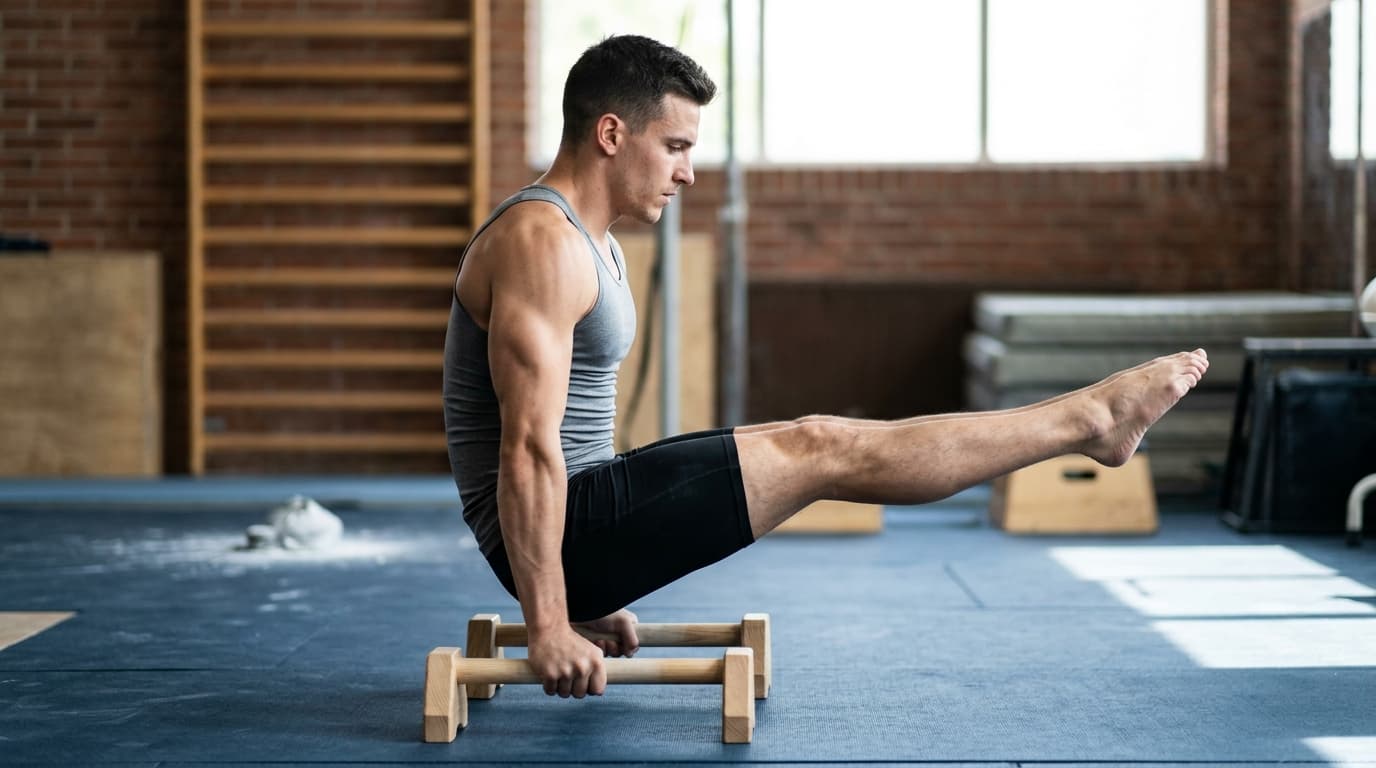
- An L-sit is an isometric hold where you support your bodyweight on straight arms with your legs extended parallel to the floor, forming an "L" shape — a core, hip flexor, and shoulder compression exercise, not a stretch or a plank variation.
- 0 seconds is a normal starting point. Most people can't hold a full L-sit at all untrained; a 20–30 second full L-sit is a genuinely solid, respectable benchmark most people have to train toward.
- The most important thing to know: this page is the quick reference. For the actual 12–16 week program that gets you from zero to a 30-second hold, see our complete L-sit progression guide.
What Is an L-Sit?
Definition: An L-sit is an isometric bodyweight hold performed by pressing your hands into the ground (or parallettes) beside your hips, straightening your arms to lift your body off the floor, and extending your legs out parallel to the ground — forming a 90-degree "L" shape between your torso and legs. As Wikipedia's entry on the L-sit describes it, it's an acrobatic position requiring significant abdominal strength, with common variants including the straddled L-sit (legs spread wide) and the more advanced V-sit (legs raised above hip height).
It's a static hold, not a rep-based exercise — you're not moving, you're resisting gravity for time. That's what makes it a genuinely useful strength benchmark: there's no way to fake a longer hold with momentum the way you can sometimes fake extra reps on a dynamic exercise.
This page is intentionally the short version. For the full breakdown — why L-sits matter, the complete research backing, and the exact 6-stage, 12–16 week progression to a 30-second hold — see our complete L-sit progression guide.
How Long Can the Average Person Hold an L-Sit?
Most people can't hold a full L-sit at all on a first attempt. That's not a sign of weakness — it's the normal starting point, because an L-sit demands a combination of hip flexor and core strength that almost nobody trains directly outside of gymnastics and calisthenics.
No single controlled study has measured L-sit hold times across a general population — it's too specialized a skill for that kind of research. The tiers below are coaching benchmarks used across calisthenics gyms, not a formal norm, but they're a reliable, practical way to see roughly where you stand:
| Level | Typical Hold Time | What That Looks Like |
|---|---|---|
| Untrained | 0 seconds | Can’t lift hips off the ground yet — completely normal |
| Beginner | 10–20 seconds | Tuck L-sit or single-leg L-sit, not yet full extension |
| Developing | 3–10 seconds | Full L-sit attempted, but not yet solid |
| Solid | 20–30 seconds | The standard goal benchmark in most calisthenics programs |
| Advanced | 30–60+ seconds | Gymnastics and high-level calisthenics territory |
Even without L-sit-specific research, the case for training it as a timed isometric hold is solid. A 2025 systematic review and meta-analysis in the Journal of Science and Medicine in Sport (Ghayomzadeh et al.) found that isometric resistance training produced greater isometric strength gains than dynamic resistance training or no training at all — direct support for why a held position like the L-sit is a legitimate strength-building tool, not just a party trick.
Want to find your own number? Use the self-test below, then compare it to the table above.
1. Test a tuck L-sit
Hands beside your hips, knees pulled to your chest, hips lifted off the ground. Time your best strict-form hold.
2. Test a single-leg or straddle L-sit
If the tuck felt solid, extend one leg (or straddle both) and time it again. Expect a shorter time — that's expected.
3. Test a full L-sit
Extend both legs parallel to the floor and hold as long as you can. A few seconds on your first attempt is completely normal.
4. Compare to the table above
Use whichever variation you can hold with strict form as your real current level — not the one you wish you were at.
What Muscles Does an L-Sit Work? (Quick Answer)
Three groups do most of the work: your hip flexors and abs lift and hold your legs in position, your triceps keep your arms locked straight to support your bodyweight, and your shoulder stabilizers (particularly the serratus anterior) keep your shoulder blades depressed and stable under load. It's a genuine full-body compression hold, not an isolated ab exercise.
That's the short version. For the complete muscle-by-muscle breakdown — primary movers, secondary stabilizers, and the research behind why hip-flexion holds outwork traditional ab exercises — see the "What Muscles Does the L-Sit Work?" section in our complete progression guide.
Frequently Asked Questions
What is an L-sit?
How long can the average person hold an L-sit?
What's considered a good L-sit time?
Is an L-sit basically a plank with your legs up?
Is an L-sit a core exercise or a shoulder exercise?
Do you need to be flexible to do an L-sit?
Get the Full L-Sit Progression, Personalized to You
Skip the guesswork — get a free weekly plan that builds toward your first (or next) 30-second L-sit at your actual level.
Build My Free Weekly Plan