Odin LogoOdin
Anatomy Breakdown

Push-Up Muscles Anatomy

Every muscle a push-up actually trains — the primary movers, the stabilizers nobody talks about, and how hand position shifts which one works hardest.

12 min readBy Odin Fitness Team
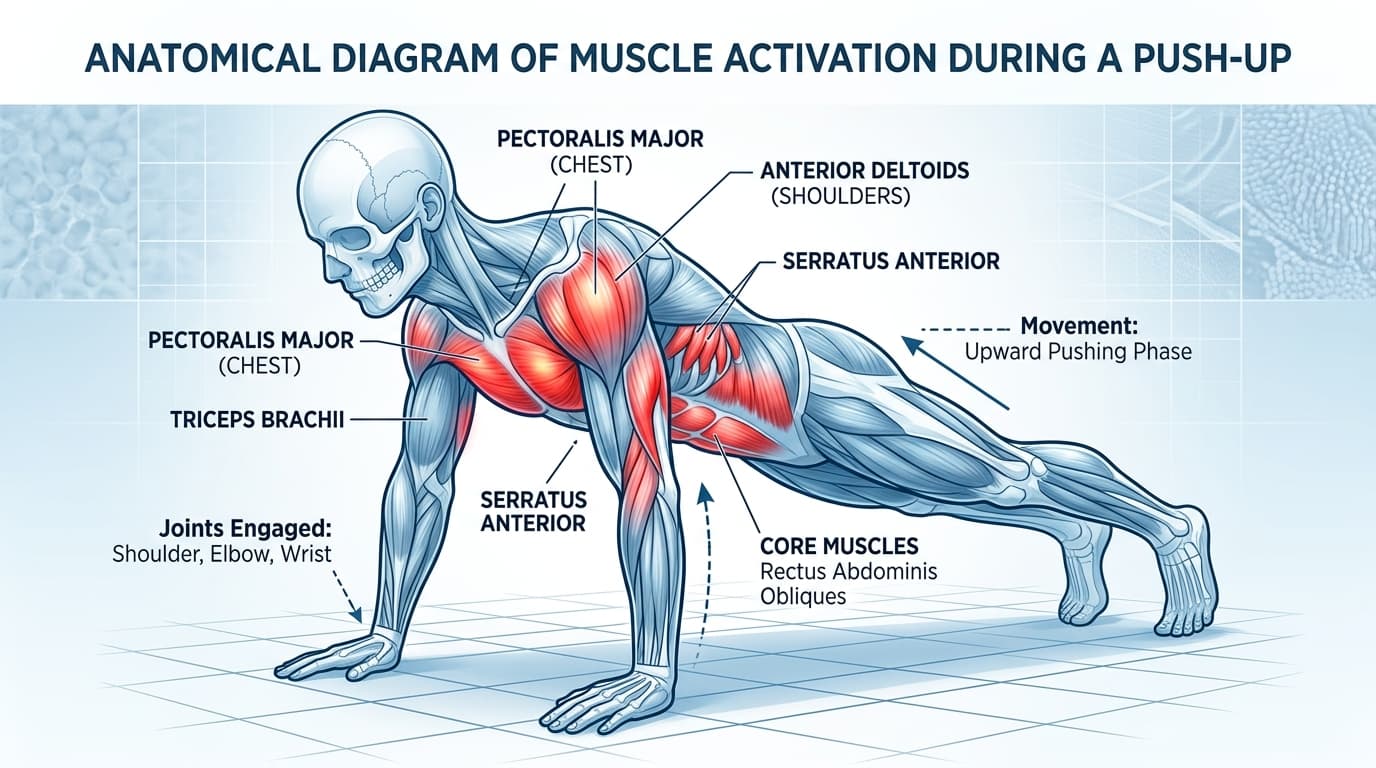
Anatomical diagram showing the muscles worked during a push-up: pectoralis major, anterior deltoids, triceps, serratus anterior, and core

TL;DR — Key Takeaways

  • Three muscles do most of the pushing: the pectoralis major (chest), anterior deltoids (front shoulders), and triceps brachii (back of the upper arm). Everything else in a push-up is stabilizing, not pushing.
  • The stabilizers matter more than most people think: the serratus anterior keeps your shoulder blades flush against your ribcage, and your core contracts isometrically the entire rep to stop your hips sagging.
  • The most important thing to know: hand position changes the emphasis — narrow (diamond) shifts load to the triceps, wide shifts it toward the chest — but it doesn't change which muscles are involved, just how much each one works.

What Muscles Do Push-Ups Work?

The direct answer: Push-ups primarily train the pectoralis major (chest), anterior deltoids (front shoulders), and triceps brachii (back of the upper arm) as the muscles actually producing the pushing force. A second group — the serratus anterior, core, upper back, and hip stabilizers — doesn't move you up and down but works just as hard to keep your body rigid and your shoulder blades stable through the entire rep.

That distinction — movers versus stabilizers — is the key to understanding why push-ups feel different depending on hand position, why your shoulders sometimes hurt more than your chest, and why a strong plank doesn't automatically mean strong push-ups. This guide breaks down exactly which muscle does what, so you know precisely what you're training and can identify your own weak link.

If you're here to actually build push-up strength rather than just understand the anatomy, our complete push-up progression guide has the full 12-week program. This page is the anatomy deep dive — the "why" behind that program, not a replacement for it.

The Primary Movers: Chest, Shoulders & Triceps

Three muscles generate essentially all of the force that pushes your body away from the floor. Everything else in the movement supports or stabilizes — it doesn't contribute meaningfully to the actual pressing motion.

Pectoralis Major (Chest)

A large, fan-shaped muscle spanning your upper chest to your breastbone and inserting on your upper arm bone. Its fibers run in two main directions — the clavicular (upper) head and the sternocostal (lower/main) head — which is why incline and decline hand positions shift emphasis between them. In a push-up, the pec major contracts to adduct and internally rotate the arm, driving the pressing motion. It's also the single most common limiting muscle for beginners: if you can hold a rigid plank but can't press yourself up, your chest — not your core — is almost always the reason.

Anterior Deltoids (Front Shoulders)

The front head of your shoulder muscle, sitting just above the chest and assisting with shoulder flexion — lifting your arm forward and up. During a standard push-up it works as a synergist to the chest, but its share of the load grows substantially in variations that increase the shoulder angle, like decline push-ups (feet elevated) or pike push-ups, where the movement starts to resemble a shoulder press more than a chest press.

Triceps Brachii (Back of the Upper Arm)

A three-headed muscle (long, lateral, and medial heads) running along the back of your upper arm, responsible for extending the elbow — straightening your arm at the top of the rep. The triceps work throughout the entire range of a push-up, but their contribution increases sharply as hand position narrows: a diamond or close-grip push-up increases elbow flexion range and shifts noticeably more of the workload onto the triceps relative to a standard-width push-up.

What Stabilizer Muscles Do Push-Ups Actually Use?

Push-ups recruit at least four stabilizer groups that never move you up or down but determine whether your form holds together. Ignore these and you'll plateau, or get shoulder pain, long before your chest and triceps run out of strength.

Serratus Anterior — the "Boxer's Muscle"

A thin, fan-shaped muscle along your ribs that protracts your shoulder blade — pulling it forward and around your ribcage. It's the muscle that keeps your shoulder blade flush against your back instead of "winging" outward at the top of a rep. A 2019 systematic review and meta-analysis in the Journal of Athletic Training (Kang et al.) identified the "push-up plus" — a standard push-up with an extra shoulder-blade protraction added at the top — as one of the most effective closed kinetic chain exercises available for isolating the serratus anterior, which is exactly why it's a standard rehab exercise for shoulder issues, not just a push-up variation.

Core (Abs, Obliques, Lower Back)

Contracts isometrically — resisting movement rather than creating it — to stop your hips from sagging or piking. This is anti-extension core work, the same category of training as a plank, not a crunch.

Upper Back & Rhomboids

Work opposite the serratus anterior to control how far your shoulder blades travel, preventing excessive protraction and keeping the shoulder joint tracking safely through the full range of motion.

Glutes & Hip Flexors

Hold your hips in a neutral, extended position. This is the most commonly skipped stabilizer — most people focus entirely on ab bracing and forget the glutes are doing real work to keep the plank line straight.

How Hand Position Changes Which Muscles Work Hardest

A 2022 scoping review in Shoulder & Elbow (Kowalski et al.) synthesized 30 EMG studies across six common push-up variations and confirmed a consistent pattern: the muscles involved in a push-up don't change based on hand position or body angle — only how much load each one carries does.

VariationPrimary EmphasisWhy
Standard (shoulder-width)Balanced chest, shoulder & tricepsNo single joint angle is exaggerated
Wide hand positionChest (pectoralis major)Greater horizontal adduction range at the shoulder
Diamond / close-gripTriceps brachiiIncreased elbow flexion range shifts load to the triceps
Decline (feet elevated)Upper chest & anterior deltoidsIncreases the shoulder-flexion angle, shifting load upward
Incline (hands elevated)Lower chest, easier overallReduces the percentage of bodyweight being pressed
Pike / feet-elevated pikeAnterior & medial deltoidsVertical torso angle turns the press into a shoulder press

Practical takeaway: if a specific muscle is your weak link, pick the variation that emphasizes it, rather than assuming more push-up volume in general will fix a specific weakness.

Do Push-Ups Work Your Back? (And Other Muscle Myths)

Myth: Push-ups work your back

Fact: Not the large pulling muscles. Push-ups are a horizontal press — they train pushing muscles (chest, shoulders, triceps), not pulling muscles (lats, rhomboids as primary movers). The upper back does work as a stabilizer, but you need a pulling exercise like rows or pull-ups to train it directly.

Myth: A strong core means strong push-ups

Fact: A strong plank helps, but it isn't sufficient on its own. Push-ups additionally require enough chest and triceps strength to move your bodyweight against gravity — plenty of people can hold a 60-second plank and still fail their first push-up, because pressing strength and isometric core stability are different qualities.

Myth: Wide hands are always better for chest growth

Fact: Wide hands do shift more emphasis toward the chest, but excessively wide positions increase stress on the shoulder joint without a proportional increase in chest activation. Shoulder-width to moderately wide is the practical sweet spot most guidance converges on.

Myth: Push-ups don't work your abs because they're not a core exercise

Fact: Push-ups are functionally a moving plank — your core has to resist extension (hip sag) for the full set, which is genuine, valuable ab training, just not the crunch-style spinal flexion people associate with "ab exercises."

Push-Ups vs. Bench Press: Which Builds More Muscle?

Neither — they train the same muscles through the same mechanism, and produce comparable results when the difficulty is matched. A 2018 study published in the Journal of Strength and Conditioning Research (Kotarsky et al.) put 23 moderately trained men through 4 weeks of either progressive push-up training or traditional barbell bench press, 3 days a week, and found comparable increases in muscle strength and muscle thickness between the two groups.

The real difference isn't which muscles get activated — it's how you add difficulty over time. Bench press lets you add small, precise increments of external weight. Push-ups require changing leverage instead: elevating your feet, narrowing your hands, slowing the tempo, or moving to a single-arm variation. Both are valid progressive-overload strategies — see our guide to progressive overload without weights for exactly how that works with bodyweight training.

“People treat 'push-ups vs. bench' like a rivalry. It isn't one. Same muscles, same mechanism, different dial for adding difficulty. Pick whichever one you'll actually do consistently — that variable matters more than which lever you pull.”

— Odin Fitness Team

How to Actually Train These Muscles

Knowing which muscle does what is only useful if it changes what you train. Use the self-test below to find your specific weak link, then follow a real progression — not more unstructured push-up volume. Prefer an instant assessment instead of running the test yourself? Our push-up level test tool does the same evaluation interactively.

This page is deliberately the anatomy reference, not the training plan. For the actual step-by-step program — a 12-week path from wall push-ups to one-arm push-ups, with the exact variations that target each muscle above — see our full push-up progression guide. If your test below points to a core limitation specifically, our L-sit progression guide covers building that foundation directly.

1. Test chest strength

Do as many strict incline push-ups as you can (hands on a knee-height surface). Fewer than 8 clean reps points to the chest as your limiting muscle.

2. Test triceps strength

Do as many diamond push-ups as you can. If your elbows stall while your chest still feels fresh, the triceps are the bottleneck.

3. Test scapular control

At the top of a push-up, protract your shoulder blades (push-up plus) without bending your elbows. Visible winging means a weak serratus anterior.

4. Test core stability

Hold a strict plank and time it. Breakdown before 45–60 seconds means the core needs direct work before adding more push-up volume.

5. Train the weakest one first

Whichever test was hardest relative to the others is where your program should start — not the exercise you already find easiest.

Frequently Asked Questions

What muscles do push-ups work the most?
The pectoralis major (chest) does the majority of the pushing work, assisted by the anterior deltoids (front shoulders) and triceps brachii (back of the upper arm). Weakness in the chest specifically is the single most common reason beginners stall on push-ups — if you can hold a plank but can't press yourself up, the chest and triceps are almost always the limiting muscles, not the core.
Do push-ups work your back?
Only indirectly, and only certain muscles. Push-ups don't train the large pulling muscles of the back (lats, rhomboids as primary movers) at all — pushing and pulling are opposite movement patterns. What push-ups do train is the upper back's stabilizers, which contract isometrically to hold your shoulder blades in place while the chest and triceps do the pressing. If you want to train your back directly, you need a pulling exercise like rows or pull-ups.
Do push-ups work your abs?
Yes, but not the way sit-ups do. Push-ups train the core isometrically — your rectus abdominis, obliques, and deep core muscles contract to resist your hips sagging or piking, keeping your body in a rigid plank line for the entire rep. A 2014 study in The Physician and Sportsmedicine found greater ab activation during a standard push-up than during a bench press at matched intensity, since the bench removes the need to stabilize your own bodyweight.
Do push-ups build a bigger chest than bench press?
Push-ups and bench press build the chest through the same mechanism — mechanical tension on the pectoralis major — and a 2018 study found comparable strength and muscle-thickness gains between the two after 4 weeks of progressive training. Push-ups don't have a ceiling advantage or disadvantage; the real difference is that bench press lets you add small, precise increments of external load, while push-ups require changing leverage (decline, single-arm, weighted vest) to keep progressing once bodyweight alone stops being challenging.
Why do my shoulders hurt more than my chest during push-ups?
Usually one of two things: your hands are too far forward relative to your shoulders (increasing anterior deltoid and joint stress), or your shoulder blades aren't stabilizing properly — a weak serratus anterior lets the shoulder blade wing instead of staying flush against your ribcage. Try keeping your hands roughly under your shoulders (not flared forward), and add push-up-plus reps (protracting your shoulder blades at the top of the rep) to build the stabilizer strength that's usually missing.
What muscles does a diamond push-up target?
Diamond (close-grip) push-ups shift emphasis toward the triceps brachii by narrowing the hand position, which increases elbow flexion range and triceps recruitment relative to a standard-width push-up. The chest and shoulders are still involved as synergists, but the triceps carry a noticeably larger share of the work — which is exactly why diamond push-ups feel harder in the back of the arm even at the same rep count as a standard push-up.

Continue Your Training Education

Train Every Muscle in This Guide, In the Right Order

Get a free weekly plan that sequences push-up, pull, and core work around your actual weak points — not a generic routine.

Build My Free Weekly Plan
Personalized weekly schedule15–45 minute sessionsWorks with or without a pull-up bar