
What Is a Lunge? Muscles Worked, Proper Form & 8 Variations
The lunge is one of the simplest lower-body exercises you can do — and one of the easiest to do slightly wrong. Here's exactly what a lunge is, which muscles it trains, how to do one with clean form, and 8 variations to take you from your first wobbly rep to jumping lunges.
TL;DR — Key Takeaways
- A lunge is a single-leg-dominant leg exercise: you step into a split stance, lower until both knees bend to about 90 degrees, then push back up. It mainly trains the quads and glutes, with the hamstrings, calves, and core stabilizing.
- Start with the split squat, then progress through reverse, forward, walking, lateral, and Bulgarian split squats to jumping lunges. Do 2-4 sets of 8-15 reps per leg, 2-3 times a week.
- Lunges aren't bad for healthy knees. A knee drifting slightly past your toes is normal — the bigger mistakes are a too-short step, a caving front knee, and lurching forward to stand up.
What Is a Lunge Exercise?
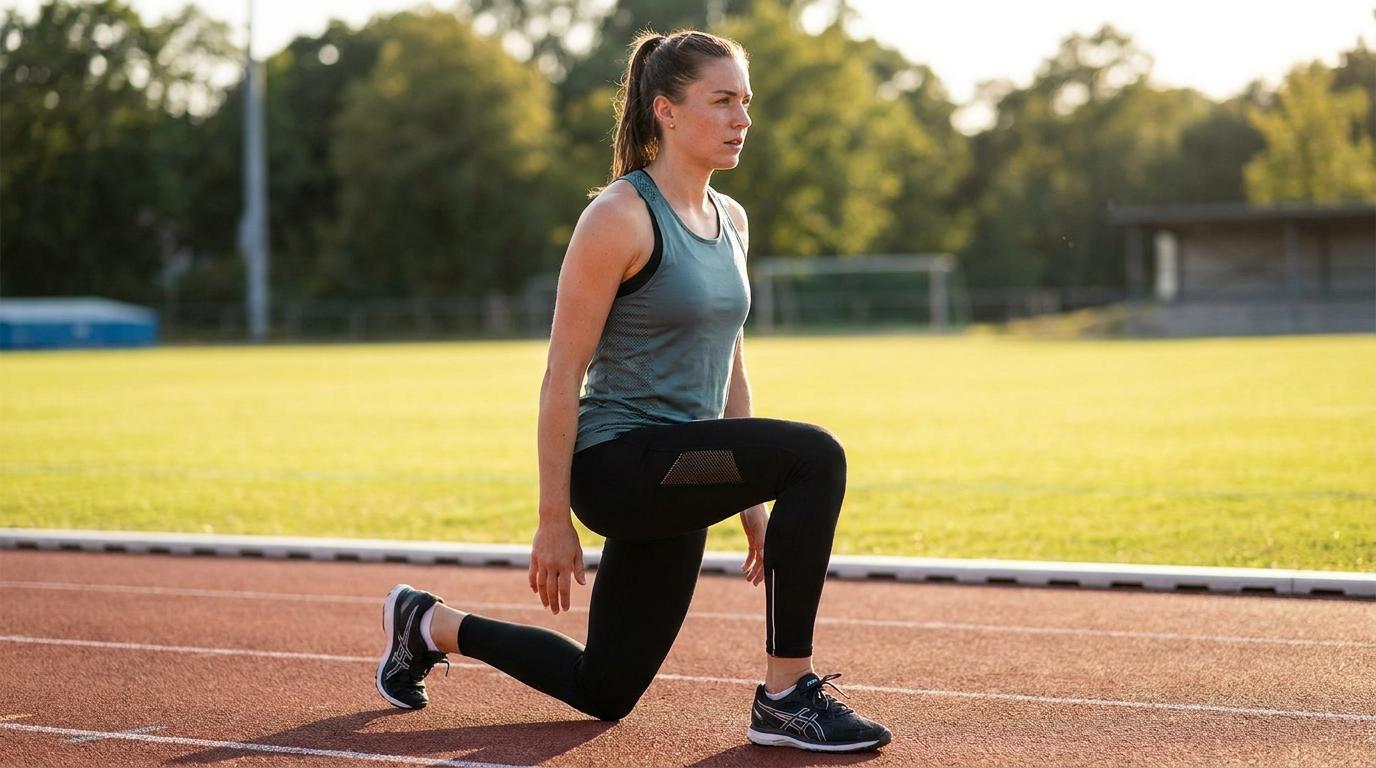
Definition: A lunge is a lower-body strength exercise where you step one leg forward or backward into a split stance, bend both knees to lower your hips toward the floor, then push back up to standing. It trains one leg at a time, mainly working the quadriceps and glutes.
In everyday terms, a lunge is a big step with a dip at the end. The Wikipedia entry for the lunge describes it as any position where one leg is positioned forward with the knee bent while the other leg sits behind. That split stance is what makes the lunge different from a squat: instead of sharing the load evenly between two legs, your front leg does most of the work while the back leg helps balance and push.
That makes the lunge a unilateral exercise — one that trains each side of the body separately. Unilateral work exposes strength differences between your left and right legs, trains the balance you need for walking, running, and stairs, and gets a lot out of your bodyweight alone. It's why lunges show up in physical therapy clinics, athletic warm-ups, and calisthenics programs alike.
The lunge is also a family of exercises, not a single move. You can step forward, backward, or to the side, stay in place, walk, raise your back foot, or jump. Each version shifts the challenge a little, which is what makes the lunge so useful for progressing without equipment — covered in the 8 variations below.
What Muscles Do Lunges Work?
Lunges mainly work your quadriceps (front of the thigh) and glutes (buttocks). Your hamstrings, adductors (inner thigh), calves, and core work as helpers and stabilizers to keep you balanced.
Research backs up the quads-first, glutes-second pattern. A 2020 study by Muyor et al. in PLOS ONE measured muscle activity with surface electromyography (EMG — sensors on the skin that record how hard a muscle is working) in 20 active men and women. During the forward lunge, the vastus lateralis and vastus medialis — two of the four quad muscles — showed the highest activity, followed by the gluteus medius and gluteus maximus. Every muscle tested worked harder on the way up than on the way down.
| Muscle | Role in the Lunge | Where You Feel It |
|---|---|---|
| Quadriceps | Primary mover — straightens the front knee | Front of the front thigh |
| Gluteus maximus | Primary mover — extends the front hip | Buttock of the front leg |
| Gluteus medius | Stabilizer — stops the front knee caving in | Side of the hip |
| Hamstrings | Helper — assists hip extension | Back of the front thigh |
| Adductors | Helper and stabilizer | Inner thigh |
| Calves & core | Balance and posture | Lower legs, midsection |
You can also shift the emphasis. According to Wikipedia's summary, a long lunge emphasizes the glutes while a short lunge emphasizes the quadriceps. Torso angle matters too: a 2008 study by Farrokhi et al. in the Journal of Orthopaedic & Sports Physical Therapy compared upright, forward-leaning, and backward-leaning lunges in 10 healthy adults and found leaning the trunk forward significantly increased gluteus maximus and biceps femoris (hamstring) activity compared with an upright torso.
How Do You Do a Lunge? (6 Steps)
Stand tall, take a long step, lower straight down until both knees bend to about 90 degrees, keep your front knee in line with your toes, then push through your front foot to stand back up. Repeat on the other leg.
These six steps work for the basic forward or reverse lunge. Go slowly for your first few sets — balance improves quickly once your body learns the pattern.
Stand tall
Start with your feet hip-width apart, chest up, and core lightly braced.
- Feet hip-width apart, toes pointing forward
- Shoulders stacked over hips
- Hands on hips or relaxed at your sides
Take a long step
Step one foot forward (or back, for a reverse lunge) about 2-3 feet.
- Keep your feet hip-width apart side to side, like standing on train tracks, not a tightrope
- Land with the front foot flat
- Rise onto the ball of the back foot
Lower straight down
Bend both knees and drop your hips toward the floor.
- Think 'down,' not 'forward'
- Lower until the back knee hovers an inch or two above the floor
- Both knees should bend to roughly 90 degrees
Keep the front knee tracking
Let your front knee travel in line with your middle toes.
- Don't let the knee cave inward
- It's fine for the knee to move slightly past the toes
- Keep most of your weight through the front heel and mid-foot
Drive back up
Push through the front foot to return to standing.
- Press the whole front foot into the floor
- Squeeze the front glute as you rise
- Stay tall — avoid lurching your chest forward to get up
Switch legs
Repeat on the other side, keeping reps equal on both legs.
- Alternate legs each rep, or finish all reps on one side first
- Start each set with your weaker leg
- Match the reps on both sides
8 Lunge Variations From Beginner to Advanced
Start with the split squat, then progress to reverse, forward, walking, lateral, and curtsy lunges, then Bulgarian split squats and jumping lunges. Move on once you can do 3 sets of 12 controlled reps per leg.
The variations are listed roughly in order of difficulty. All of them work with bodyweight only — no equipment needed beyond a chair or couch for the Bulgarian split squat.
1. Split Squat (Static Lunge)
Beginner · quads and glutesSet up in a split stance and stay there, lowering and rising without moving your feet. Hold a wall for balance if needed.
Tip: The easiest lunge to learn — master this before stepping lunges.
2. Reverse Lunge
Beginner · glutes and quadsStep backward into the lunge, lower, then push through the front foot to return to standing.
Tip: Stepping back keeps your weight over the front foot, which many people find easier on the knees.
3. Forward Lunge
Beginner-intermediate · quadsStep forward, lower until both knees bend to about 90 degrees, then push back to the start.
Tip: Harder than the reverse lunge because you have to brake your forward momentum.
4. Walking Lunge
Intermediate · legs and conditioningLunge forward, then bring the back foot through into the next lunge, traveling across the room.
Tip: Great for conditioning — try 20 total steps per set.
5. Lateral (Side) Lunge
Intermediate · adductors, glutes, quadsStep wide to one side, sit your hips back over that foot while the other leg stays straight, then push back to center.
Tip: Trains side-to-side movement that forward lunges miss.
6. Curtsy Lunge
Intermediate · glutes, especially the side of the hipStep one leg diagonally behind the other, as if curtsying, and lower straight down.
Tip: Keep the front knee tracking over the toes rather than twisting.
7. Bulgarian Split Squat
Advanced · quads and glutesRest the top of your back foot on a couch or chair behind you and lower into a split squat.
Tip: Elevating the back foot puts much more load on the front leg — one of the hardest no-equipment leg exercises.
8. Jumping Lunge
Advanced · power and conditioningFrom the bottom of a lunge, jump up and switch legs in the air, landing softly in a lunge on the other side.
Tip: Only add these once regular lunges feel easy; land quietly with bent knees.
Beyond jumping lunges, the next step in single-leg training is the shrimp squat and pistol squat. Our single-leg squat progression picks up exactly where this list ends, and the pistol squat progression takes it all the way to a full one-leg squat.
Lunges vs. Squats: Which Is Better?
Neither is better — they complement each other. Squats let you load both legs at once, while lunges train each leg on its own and challenge your balance. Research shows single-leg and two-leg training can build strength equally well.
The best direct evidence comes from a 2016 study by Speirs et al. in the Journal of Strength and Conditioning Research. Eighteen academy rugby players trained twice a week for 5 weeks, either with only rear-foot-elevated split squats (a Bulgarian split squat) or only back squats. Both groups significantly improved their back squat strength, split squat strength, 40-meter sprint time, and agility — with no meaningful difference between the groups. In other words, a lunge-style exercise built two-leg squat strength as well as squats themselves did.
| Factor | Lunges | Squats |
|---|---|---|
| Legs Trained | One leg at a time | Both legs together |
| Balance Challenge | High — trains stability | Lower |
| Fixes Left-Right Imbalances | Yes — each leg works alone | Stronger leg can compensate |
| Bodyweight Difficulty | Gets hard fast without weights | Bodyweight squats get easy quickly |
| Easiest to Learn | Takes a few sessions for balance | Very beginner-friendly |
For bodyweight training specifically, lunges have a big advantage: putting your full bodyweight on one leg makes them much harder than bodyweight squats, so they keep challenging you long after air squats feel easy. That's why they're a staple of home workouts without equipment.
Are Lunges Bad for Your Knees?
No — lunges are not bad for healthy knees when done with good form. Letting the front knee move slightly past the toes is normal; what matters more is keeping the knee in line with the toes and controlling the descent.
The old rule that your knee must never pass your toes comes from good intentions but doesn't hold up well. A 2003 study by Fry et al. in the Journal of Strength and Conditioning Research tested this in the squat. When a barrier stopped the knees moving forward, knee torque dropped from about 150 to 117 newton-meters — but hip torque jumped from about 28 to 303 newton-meters, and the lifters leaned their trunks further forward. The authors concluded that restricting the knees likely shifts force inappropriately to the hips and lower back, and that knees moving slightly past the toes may be appropriate.
~150 → 117
Knee Torque (N·m)
Knee torque fell when the knees were blocked from passing the toes.
~28 → 303
Hip Torque (N·m)
Hip torque rose roughly tenfold, with more forward trunk lean.
7
Lifters Tested
A small study in a squat, not a lunge — but the same mechanics apply.
That study looked at squats in seven weight-trained men, so treat it as directional rather than definitive for lunges. The practical takeaway is the same, though: don't force your shin vertical. Focus on the things that do matter for your knees:
- Keep the front knee tracking over the middle toes — not caving inward
- Lower under control rather than dropping into the bottom
- Take a long enough step that your front heel stays down
- Choose reverse lunges or split squats if forward lunges bother you
How Many Lunges Should You Do?
Most people should do 2-4 sets of 8-15 lunges per leg, 2-3 times a week. End each set with 1-3 good reps left, and move to a harder variation once 15 reps feels easy.
The Physical Activity Guidelines for Americans recommend muscle-strengthening activity at least 2 days a week, so two or three leg sessions with lunges covers your lower body. You don't need to lunge daily — muscles need time to recover between hard sessions.
| Goal | Sets × Reps (per leg) | Variation | Frequency |
|---|---|---|---|
| Learn the movement | 2 × 8 | Split squat or reverse lunge | 2-3x/week |
| Build strength & muscle | 3-4 × 6-12 | Bulgarian split squat | 2x/week |
| General fitness | 3 × 10-15 | Reverse or walking lunge | 2-3x/week |
| Conditioning | 3 × 30-45 sec | Walking or jumping lunges | 1-2x/week |
Bodyweight lunges stop building strength once they get too easy, so keep progressing: slow the lowering phase to 3 seconds, add a pause at the bottom, or move to the next variation. The progressive overload without weights guide covers eight ways to do it.
Common Lunge Mistakes
The most common lunge mistakes are taking too short a step, letting the front knee cave inward, lining the feet up on a tightrope, lurching forward to stand up, and rushing the reps.
Stepping too short
A short step lifts your front heel and piles pressure onto the front of the knee. Lengthen the step until both knees can bend to about 90 degrees with the front heel down.
Front knee caving in
Push the front knee gently out so it tracks over your middle toes. If it keeps caving, slow down and lower your depth.
Tightrope feet
Feet lined up heel-to-toe make you wobble. Keep them hip-width apart side to side.
Lurching forward to stand
Throwing your chest forward to get up means the leg isn't doing the work. Drive through the whole front foot and stay tall.
Rushing
Fast, bouncy reps skip the hardest part of the movement. Take about 2 seconds down and 1 second up.
Ignoring the weaker leg
Start each set with your weaker side and match the reps on the stronger side — not the other way around.
"When someone tells us lunges hurt their knees, nine times out of ten their step is too short. Lengthen the stride, keep the front heel down, and the knee pain usually goes with it. Lunges look simple — the details are what make them work."
Tight hip flexors can also limit how deep your back leg can go. If the front of your back hip feels stuck at the bottom of a lunge, add a few stretches from how to stretch your hip flexors to your cool-down.
Frequently Asked Questions
What is a lunge exercise?
What muscles do lunges work?
Are lunges better than squats?
Are lunges bad for your knees?
How many lunges should I do a day?
Do lunges work your glutes?
What is the easiest lunge for beginners?
Turn Lunges Into Real Leg Strength
Get a no-equipment plan that progresses you from split squats to Bulgarian split squats and beyond, tracking every rep as you get stronger.
Build My Free Weekly Plan